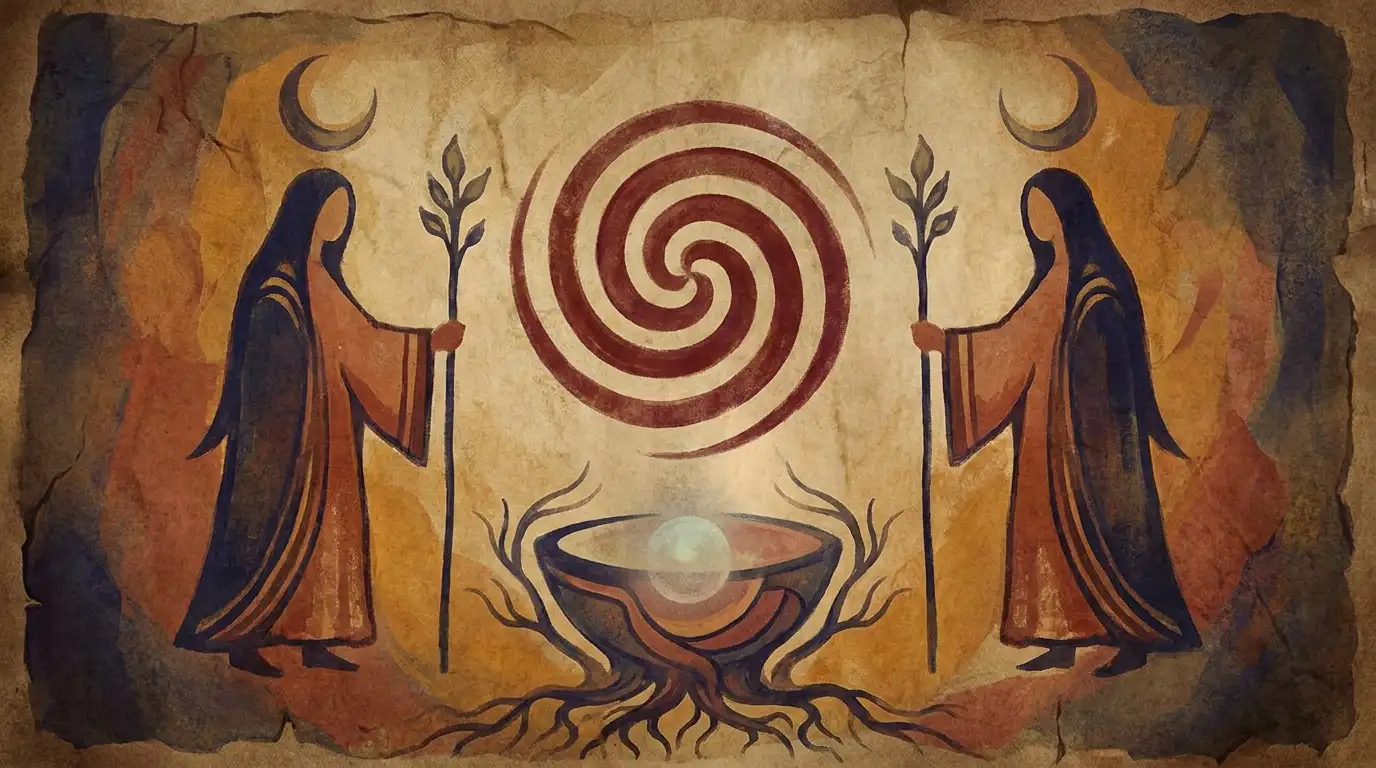
Shamanic divination and reading the Web of Wyrd involve the ritualized practice of accessing hidden knowledge, interpreting natural signs, and actively engaging with the interconnected threads of fate. Practitioners utilize altered states of consciousness, intuitive observation, and animistic communication to gather information from the spirit world and the surrounding environment. This ancient tradition encompasses various techniques, including spirit journeying, casting lots, gazing into reflective surfaces, and interpreting the behavior of wildlife. Ultimately, the objective extends beyond mere fortune-telling; it serves to diagnose spiritual illnesses, locate lost objects, predict future probabilities, and manipulate the cosmic fabric to restore balance or manifest specific outcomes within the community.
Magical Epistemology and the Tapestry of Fate
Understanding shamanic divination requires a fundamental shift in how one acquires and validates knowledge, a framework known as magical epistemology. This perspective views the universe not as a collection of isolated objects, but as an intricately woven tapestry where past, present, and future coexist in a state of dynamic tension. Interpreting this fabric demands an acknowledgment of the profound connection between the macrocosm of the universe and the microcosm of the individual.
Magical epistemology establishes that truth is revealed through direct spiritual revelation rather than strictly empirical observation. Shamans gather insight through ecstatic trance, spirit communication, and animistic engagement. They operate on the premise that everything possesses a spirit and a voice. Animals, plants, stones, and weather patterns act as messengers transmitting data across the cosmic network. Knowledge obtained through these non-ordinary realities is treated as factual and actionable, providing the foundation for diagnosing ailments or predicting seasonal shifts.
The Web of Wyrd, connected to the Old Norse concept of Urðr, serves as the central metaphorical and literal matrix of destiny in Northern European animism. Originating from Norse cosmology, the Norns—three ancient entities—spin, measure, and cut the threads of fate at the roots of Yggdrasil, the world tree. Every being, action, and event constitutes a thread woven into this immense fabric. An action taken in one corner of the web reverberates throughout the entire structure. Diviners attempt to pluck these threads, sensing the vibrations to understand current circumstances and anticipate probable outcomes.
Microcosmic and Macrocosmic Reflection
Microcosmic and macrocosmic reflection forms the philosophical backbone of reading fate. The Hermetic axiom as above, so below perfectly encapsulates this principle. A practitioner observes a small, localized event and scales its meaning to understand vast, universal currents.
- The sudden appearance of a dying raven on a doorstep mirrors the impending death of a chieftain
- A drop of blood falling onto a specific rune during a casting session maps the exact energetic blockage preventing a hunter from securing game
- The way water swirls in a tiny clay bowl corresponds to the chaotic weather fronts forming across the ocean
Methods of Shamanic Seeing and Interpreting Signs
Shamans deploy an extensive array of diagnostic tools and perceptive techniques to decode the messages embedded within the physical and spiritual environments. Shamanic seeing transcends ordinary sight, relying on deep intuition and a cultivated sensitivity to anomalies within the natural order. These techniques often require years of rigorous training to master, blending spontaneous revelation with structured interpretative frameworks.
Augury involves observing and interpreting the behavior of birds and other animals to determine the will of spirits or gods. A seer watches flight patterns, listens to calls, and notes the specific species that appear during significant moments. If an owl silently glides from the left to the right during a healing ritual, the practitioner might interpret this as a portent of swift, smooth recovery. Conversely, a flock of crows aggressively mobbing a hawk could signal approaching conflict or the presence of hostile entities.
Reading nature extends beyond animal behavior to include weather phenomena, botanical anomalies, and geological shifts. Interpreting signs in this manner requires an intimate understanding of the local ecosystem. Synchronicity plays a dominant role here. When a sudden, violent gust of wind extinguishes the ritual fire precisely as the diviner asks a question, this is not dismissed as a coincidence. It is registered as a direct, emphatic response from the environment. Omens and portents manifest continuously; the practitioner simply maintains the receptive awareness necessary to document and decode them.
Sortilege and Scrying Practices
Sortilege relies on the random casting of objects to reveal patterns hidden within chaos. This technique falls under the broader category of cleromancy. Diviners cast bones, stones, shells, or carved wooden staves onto a marked cloth or the bare earth. The spatial relationship between the fallen objects, their orientation, and their proximity to the caster provide a detailed narrative. For example, a bone representing the seeker landing crossed over a bone representing illness indicates an imminent health crisis.
Scrying demands a meditative, receptive state to trigger visual or auditory hallucinations within a specific medium. Practitioners gaze softly into water, fire, smoke, or dark mirrors. The scryer allows their peripheral vision to blur, lowering their brainwave frequency until the logical mind steps aside. A seer gazing into a bowl of blackened water might initially see nothing, but as the trance deepens, shapes form. A swirling vortex could signify confusion, while the image of a ship might indicate travel or the arrival of news.
| Divination Method | Primary Medium | Interpretative Focus | Common Tools |
|---|---|---|---|
| Sortilege | Solid objects | Spatial orientation and proximity | Bones, runes, dice, marked sticks |
| Scrying | Translucent or shifting matter | Internal visions and emergent symbols | Crystal spheres, water bowls, flames, obsidian mirrors |
| Augury | Wildlife | Movement patterns and behavioral anomalies | Birds, insects, predatory mammals |
| Nature Reading | Environment | Weather shifts and elemental responses | Clouds, wind, water currents, falling leaves |
Journeying for Answers Through Spirit Flight
Journeying represents the most direct and immersive form of shamanic divination, requiring the practitioner to project their consciousness into non-ordinary reality. This spirit flight allows the seer to bypass symbolic interpretation entirely and speak face-to-face with ancestors, deities, and helping spirits. The technique relies heavily on rhythmic stimulation, typically provided by a drum or rattle, to induce a profound ecstatic trance.
Practitioners experience several distinct stages during this process:
- The initial separation of the soul from the physical vessel
- The navigation of spiritual boundaries and threshold crossings
- The direct negotiation with non-physical entities for hidden knowledge
- The safe return and reintegration of the soul back into the body
Seiðr, a specialized form of Norse magic, heavily features this type of journeying. A Völva ascends a high seat, elevating herself physically and spiritually above the mundane world. A choir of assistants sings Varðlokkur, hypnotic chants that anchor the seer’s physical body and provide the energetic fuel for her soul to travel. Her spirit navigates the perilous pathways of the Nine Realms, perhaps descending into the underworld to consult the dead regarding a looming famine, or ascending to higher planes to negotiate with nature spirits.
During these journeys, the shaman actively interrogates the entities they encounter. They might demand to know why a particular illness has struck a family member, requesting a specific cure or ritual action. The answers received are often visceral and immediate. A spirit might hand the shaman a glowing root, indicating the exact medicinal plant required. Upon returning to the physical body, the practitioner translates these experiences into actionable advice for their community.
Probability Manipulation and Altering Destiny
Divination in the shamanic context rarely functions as passive observation; it is an inherently active and dynamic process designed to enable probability manipulation. The Web of Wyrd is not a static, predetermined script, but rather an ongoing weaving process. Once a shaman perceives a specific trajectory, they possess the agency to intervene, reweaving the threads to alter the final outcome.
Practitioners utilize the information gleaned from their prophetic visions to implement counter-measures. If a bone casting reveals an impending attack from a rival clan, the shaman does not simply accept this as an unavoidable doom. They immediately perform protective magic, perhaps creating amulets, erecting energetic wards, or conducting rituals to confuse the enemy. This proactive stance highlights the dual nature of the seer as both an observer and an architect of reality.
Probability manipulation requires immense focus and energetic expenditure. The shaman identifies the weakest point in an undesirable thread of fate and applies spiritual force to snap it. Alternatively, they might reinforce a fragile thread representing a positive outcome, feeding it power through chants, sacrifices, or focused intention. The practitioner essentially negotiates with the cosmos, leveraging their relationships with helping spirits to bend the arc of destiny toward harmony, survival, and prosperity.
Shamans actively intervene in the web of fate through multiple avenues:
- Plucking specific threads to unravel approaching disasters
- Tying energetic knots to bind harmful spirits or malevolent intentions
- Weaving entirely new lifelines to secure prosperity for the harvest
- Reinforcing fraying connections between the community and their ancestral guardians