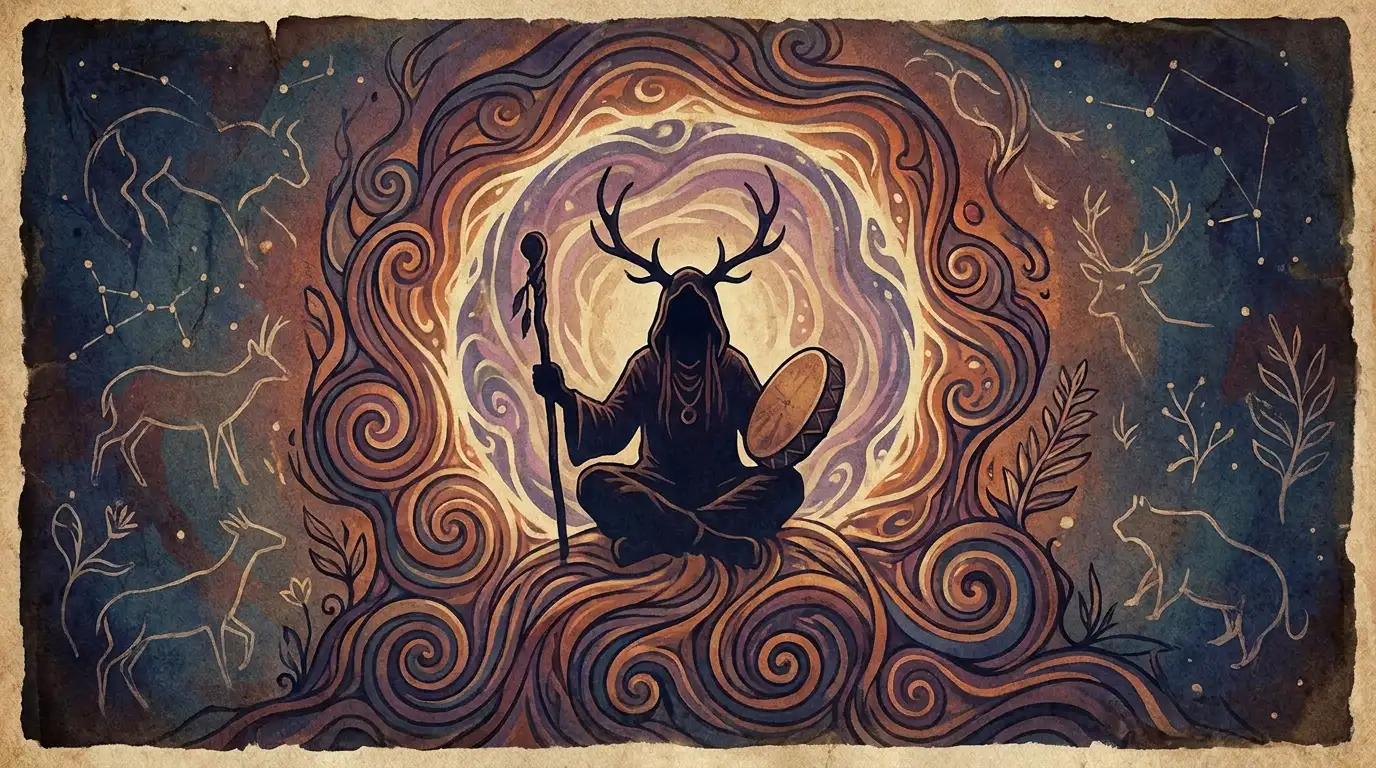
Shamanic journeying is a deliberate shift in consciousness designed to bypass the physical senses and interact with non-ordinary reality for healing, divination, and spiritual growth. Practitioners alter their brainwave states to detach from everyday awareness. This altered state of consciousness allows the traveler to cross thresholds into hidden realms populated by animal spirits, ancestral guides, and elemental forces. Successfully navigating these domains requires mastering specific trance mechanics, establishing clear objectives, and developing the subtle faculties needed to perceive spiritual landscapes.
Foundations of Visionary Magic and Shamanic Journeying
Entering a trance state initiates the practice of visionary magic, a discipline where the practitioner intentionally alters perception to interact with esoteric realms. The waking mind acts as the primary vehicle for this exploration, translating subtle energies into recognizable symbols, landscapes, and entities. Initiates rely on specific psychological and spiritual frameworks to maintain focus and prevent the experience from degrading into random daydreaming.
Intention Setting as the Compass
Every successful foray into the spirit world relies on intention setting to dictate the destination and purpose of the operation. A clear directive acts as a tether, keeping the mind focused when encountering abstract or overwhelming stimuli.
Formulating a precise objective prevents the practitioner from getting lost in the vastness of the internal landscape. A traveler seeking advice on a physical illness might mentally frame the phrase, “I am traveling to the lower realm to find a healing guide for my chronic pain.”
Specific guidelines dictate how to construct an effective journeying prompt:
- Phrase the goal in the present tense to lock the mind into immediate action
- Avoid compound questions that split the focus of the trance state
- Center the request around personal empowerment rather than controlling others
- State the target destination clearly to establish the energetic trajectory
Focusing on this single anchor filters out irrelevant psychic noise and signals the helping spirits to orchestrate a relevant experience.
Active Imagination and Pathworking
Psychological techniques heavily influence how modern practitioners access spiritual states. Carl Jung developed the concept of active imagination, a method where the waking mind consciously interacts with unconscious imagery without asserting total control over the narrative.
Occult traditions expanded on this cognitive mechanism through pathworking, a structured visualization exercise used to traverse specific symbolic environments. Both methods train the brain to accept self-generated imagery as valid experiences, forming the bridge required to step fully into a shamanic trance.
The primary differences between unguided journeying and structured psychological frameworks include:
- Spontaneous exploration relies on organic symbol generation during the trance
- Scripted meditations utilize predetermined landscapes to evoke specific archetypes
- Deep psychological immersion requires the suspension of conscious disbelief
- Ritual ascents map the cosmos according to rigid esoteric traditions
Modalities of Spiritual Travel
Human consciousness utilizes different mechanisms to project awareness beyond the physical body. Practitioners categorize these modalities based on the locus of perception, the density of the spiritual body, and the degree of separation from the physical vessel. Understanding these distinctions allows practitioners to choose the correct technique for their specific mystical objectives.
Astral Projection vs Mental Journey Differences
Discerning the mechanics of spiritual travel requires examining the functional divide between projecting the astral body and directing the mind’s eye. An out-of-body experience physically displaces the center of consciousness, creating a sensation of literal separation where the practitioner can look back at their resting physical form.
Projecting awareness into the astral plane involves the traveler essentially wearing their subtle anatomy to interact directly with esoteric environments.
Conversely, mental wandering keeps the locus of awareness seated within the physical brain while the imagination acts as a remote viewing screen. The practitioner remains fully aware of their physical surroundings but directs a mental avatar through the inner planes, deep into the subconscious mind.
| Modality | Separation | Locus of Awareness | Sensory Experience | Primary Use |
|---|---|---|---|---|
| Astral Projection | Complete displacement | Exterior to physical body | Highly tactile and immersive | Exploring the astral plane directly |
| Mental Journey | No physical separation | Seated in the brain | Visual and symbolic | Safe exploration of non-ordinary reality |
| Out-of-Body Experience | Spontaneous or induced | Floating near the body | Literal observation of reality | Verifiable remote viewing |
| Pathworking | Guided framework | Internal imagination | Narrative and structured | Integrating archetypal energies |
The Cosmology of Non-Ordinary Reality
Animistic traditions map the spiritual universe into a tripartite cosmology interconnected by a central axis, often visualized as the axis mundi or the World Tree. These three distinct realms—the lower world, middle world, and upper world—vibrate at different frequencies and host specific types of non-physical intelligence. Navigating this map requires the traveler to utilize transitional portals to shift their awareness from ordinary reality into the target dimension.
Entering the Lower World
The descent into the subconscious and earth-based energies characterizes the process of entering the lower world. Practitioners visualize a downward-facing portal in nature, such as a hollow tree stump, a deep cave, an animal burrow, or a swirling whirlpool.
Traveling down this internal tunnel shifts the brainwave state deeper into theta waves, eventually opening into an idyllic, natural landscape untouched by human industry. This realm vibrates with dense, grounding energy and serves as the primary domain of power animals, earth elementals, and ancient ancestral spirits.
Travelers seek out this subterranean realm for specific restorative purposes:
- Retrieving soul fragments lost through psychological trauma
- Connecting with totemic animal guides for physical vitality
- Grounding erratic mental energy into the stability of the earth
- Uncovering hidden wisdom buried within the collective unconscious
Navigating the Middle World
The hidden spiritual overlay of our present physical dimension is accessed by navigating the middle world. This realm runs parallel to waking life, containing the spiritual essence of living people, geographical locations, buildings, and nature spirits.
Journeyers enter this transitional space by visualizing themselves stepping out of their physical bodies and walking directly into their immediate surroundings. Because it mirrors the physical plane, this world is utilized for real-time information gathering, finding lost objects, distance healing, and space clearing.
The localized entities residing here possess dualistic natures, requiring the practitioner to exercise caution and strong spiritual boundaries.
Ascending to the Upper World
Seeking elevated wisdom and cosmic perspective involves ascending to the upper world. The journeyer visualizes an upward trajectory, climbing a mountain peak, riding the smoke of a fire, scaling a giant beanstalk, or ascending the branches of the World Tree.
Pushing through a mental membrane or cloud layer typically marks the threshold into this ethereal, abstract realm. The landscape often features crystalline structures, vast skies, or celestial cities.
Ascended masters, pantheonic deities, and enlightened teachers residing here dispense philosophical guidance, spiritual initiation, and insight into destiny and future pathways.
Sensory Perception and Information Gathering
Extracting accurate knowledge from non-ordinary reality depends on the practitioner’s ability to translate spiritual stimuli into human understanding. The spirit world rarely communicates through literal spoken language, relying instead on metaphorical constructs, direct energetic transmission, and symbolic imagery.
Engaging the Astral Senses
Perceiving the spirit realms requires the deliberate activation of the astral senses. While novice journeyers expect cinematic visuals, spiritual perception often manifests through claircognizance or clairsentience.
Subtle energetic pressure often replaces overt visual confirmation, manifesting as sudden knowing or physical sensation. Hearing a rhythmic chanting or smelling damp earth during a lower world descent relies heavily on clairaudience and clairalience.
Training these subtle faculties involves acknowledging and trusting faint sensory impressions rather than dismissing them as mere imagination.
Techniques for Information Gathering
Retrieving actionable data demands active engagement with the spiritual environment and the entities encountered. Information gathering in a trance state involves asking precise, unambiguous questions.
Examining symbolic objects and asking probing questions extracts literal meaning from abstract encounters. When an entity speaks in riddles, the practitioner has the agency to ask for clarification or request that the message be shown as a physical memory.
Practitioners utilize several active techniques to decode spiritual messages:
- Requesting the entity to translate abstract symbols into literal words
- Observing the behavioral patterns of animal guides for hidden meaning
- Touching the spiritual landscape to receive tactile emotional data
- Asking the helping spirit to implant the knowledge directly into the mind
Returning and Grounding
Concluding a spiritual operation safely prevents the practitioner from developing psychological disassociation. Linger too long in the subtle realms, and the traveler risks spiritual fatigue, brain fog, or psychic fragmentation. A structured return sequence signals the brain to close the energetic portals and reintegrate fully with the physical nervous system.
Returning to Ordinary Reality
The transition back to waking consciousness requires reversing the exact route taken during the journey. The practitioner listens for a prearranged recall signal—typically a rapid shift in the drumbeat’s tempo—which acts as an auditory tether pulling the mind back to the physical room.
Retracing the mental steps from the upper or lower realms anchors the consciousness back into the immediate environment. If the traveler climbed a rope to the upper world, they must visualize themselves climbing back down that same rope; if they crawled through a cave, they must re-emerge through the exact same entrance.
This deliberate retraction of awareness gathers all dispersed mental energy, ensuring no part of the psyche remains stranded in the trance state.
Grounding the Physical Body
Re-establishing equilibrium in the physical body requires immediate and intentional grounding. The sudden shift from theta waves back to beta waves causes physiological disorientation.
Combatting physiological disorientation involves physically interacting with dense matter. Eating heavy foods, drinking cold water, pressing the palms flat against the floor, or washing the face shocks the nervous system back into ordinary reality.
Documenting the experience in a journal finalizes the grounding process, pulling the abstract, esoteric experiences of the mind down into the tangible, physical world.