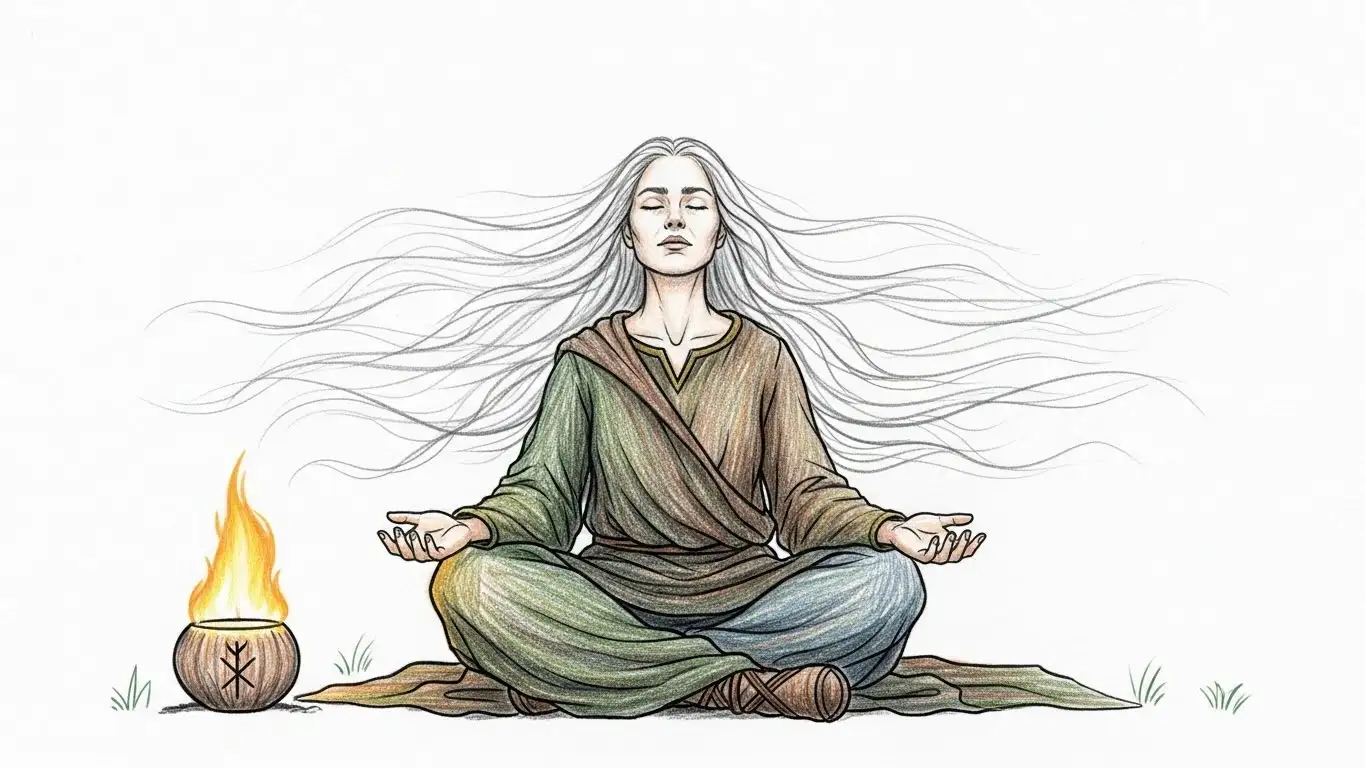
Seiðr is a form of Old Norse trance magick practiced during the Late Scandinavian Iron Age, utilized for prophecy, healing, weather manipulation, and shaping the future. Modern eclectic witches integrate this intuitive, fate-weaving practice with Runic Magick to create a comprehensive system of spiritual transformation. The practice relies on altered states of consciousness, spirit communication, and the symbolic spinning of destiny. Historical evidence from sagas and archaeological excavations indicates that practitioners, primarily female seeresses known as Vǫlur (singular: Vǫlva), utilized specific tools like the ritual distaff to enter trance states and interact with the Web of Wyrd. Today, solitary practitioners reconstruct these ancient techniques by combining core shamanic journeying methods with the active, symbolic casting of the Elder Futhark runes.
Seiðr and Modern Eclectic Witchcraft
Modern eclectic witchcraft synthesizes the historical fragments of Old Norse trance rituals with contemporary magickal frameworks. The original practices of Seiðr declined after the Christianization of Scandinavia, leaving gaps in the historical record regarding exact ritual mechanics. Contemporary practitioners extract core concepts from texts like the Saga of Erik the Red and the Ynglinga saga, adapting them for solitary use.
This adaptation process involves substituting lost community-based rituals with individualized trance induction techniques. Witches combine the passive, receptive states required for Seiðr with the structured, directive forces of runic inscription. The resulting hybrid system allows practitioners to divine future events through trance and subsequently alter those outcomes using specific runic formulas.
Mythological Origins of Norse Trance Magick
The origins of Norse trance magick stem from the pre-Christian mythology of the Vanir and the Æsir, the two principal pantheons of Norse deities. The practice is fundamentally rooted in the manipulation of fate, a concept governed by the Nornir who spin, measure, and cut the threads of time at the base of Yggdrasil.
Freyja and the Magick of the Vanir
Freyja, a prominent goddess of the Vanir, serves as the archetypal Vǫlva who originally introduced Seiðr to the Æsir pantheon. The Ynglinga saga documents that Freyja taught this specific form of magick to the Æsir after the Æsir-Vanir war.
Her association with Seiðr encompasses divination, trance journeying, and the manipulation of desires. Mythological accounts frequently depict her utilizing a falcon cloak (Valshamr) to travel between the Nine Realms, a direct metaphor for the shamanic journeying undertaken by human practitioners.
Óðinn and the Pursuit of Hidden Wisdom
Odin, the Allfather of the Æsir, learned Seiðr directly from Freyja to expand his mastery over all forms of hidden knowledge and magick. His engagement with Seiðr involved manipulating fate, communicating with the dead, and inducing prophetic visions.
In Old Norse society, the practice of Seiðr by men carried the stigma of Ergi, a term denoting unmanliness or effeminacy, because the manipulative and receptive nature of the magick ran counter to the masculine ideals of forthright combat. The Lokasenna records Loki mocking Odin for practicing this feminine-coded art. Odin disregarded these societal taboos to acquire comprehensive magickal power, demonstrating the supreme value placed on esoteric wisdom within the Norse cosmological framework.
The Vǫlva: Historical Seeress and Magickal Practitioner
The Vǫlva was a specialized female practitioner of Seiðr who traveled between settlements in Viking Age Scandinavia to perform divination, enact magick, and communicate with spirits. These seeresses held significant social authority and were compensated for their services during times of crisis, famine, or war.
The Seiðstafr and Ritual Tools
The primary ritual implement of the Vǫlva was the Seiðstafr, a staff or wand typically constructed from wood or metal and often featuring a distaff design. The Saga of Erik the Red describes a Vǫlva named Þórbjǫrg (Thorbjörg little) utilizing a brass-knobbed staff encrusted with stones.
The distaff morphology links the tool directly to the spinning of flax or wool, symbolizing the practitioner’s ability to spin and weave the threads of fate. Archaeological excavations have uncovered these staffs in the graves of high-status women across Scandinavia. Other documented ritual garments included blue or black cloaks, lambskin hoods lined with ermine, and pouches containing talismans.
| Tool / Garment | Material / Description | Magickal Function |
|---|---|---|
| Seiðstafr | Wood, bronze, or iron rod with a knob | Directing energy, symbolizing the spinning of fate |
| Cloak | Blue or black fabric, often adorned with stones | Boundary setting, representing the night sky or spirit realm |
| Hood | Black lambskin lined with white cat or ermine skin | Sensory deprivation, facilitating inward focus for trance |
| Pouch | Animal skin | Housing talismans, herbs, and ritual components |
The Seiðhjallr and Trance Elevation
The Seiðhjallr was an elevated wooden platform or high seat constructed specifically for the Vǫlva to occupy during Seiðr rituals. Sitting on this structure physically and symbolically separated the practitioner from the mundane world, placing her in a liminal space between the human community and the spirit realm.
From this elevated position, the Vǫlva would enter a trance state, often assisted by a choir of women singing specific warding songs known as Varðlokur. The physical elevation facilitated the psychological detachment necessary for the practitioner’s consciousness to project outward and navigate the cosmic axis of Yggdrasil.
Weaving the Web of Wyrd
The fundamental mechanism of Seiðr involves perceiving and altering the Web of Wyrd, the interconnected matrix of past actions and future probabilities that governs all entities in Norse cosmology. Wyrd is not a strictly predetermined fate, but rather an ongoing process of cause and effect shaped by the Nornir.
Practitioners of Seiðr enter trance to view the current configuration of these threads. By applying magickal will, the witch can untangle negative patterns, bind specific outcomes, or weave new probabilities into the matrix. This process requires a deep understanding of Ørlög, the foundational layers of ancestral and personal karma that dictate the trajectory of an individual’s life.
Animism, Fylgja, and Landvættir
The Old Norse worldview is inherently animistic, requiring the Seiðr practitioner to interact regularly with various classes of non-human spirits. The Fylgja is an attendant spirit, often perceived in animal form, that accompanies an individual throughout their life and represents their character or fate.
During a Seiðr trance, the witch frequently sends their consciousness out in the shape of their Fylgja to gather information or enact magick at a distance. Practitioners negotiate with the Landvættir, the localized spirits of the land, rocks, and water. Successful Seiðr operations, especially those involving weather manipulation or territorial protection, depend on establishing reciprocal relationships with these environmental entities.
Seiðr and Runic Magick: A Synergistic Practice
Combining Seiðr with Runic Magick creates a dual-action magickal system that utilizes both receptive trance states and active symbolic projection. While Seiðr relies on intuition, spirit journeying, and the fluid manipulation of the Web of Wyrd, Runic Magick employs the rigid, angular geometry of the Futhark to command specific forces.
Galdr and the Vocalization of Runes
Galdr is the practice of vocalizing runic formulas through rhythmic chanting or singing to manifest magickal intent. This vocal magick operates on specific frequencies and meters, such as the Galdralag, to vibrate the runic symbols into reality.
In a combined practice, the witch uses Galdr to establish the perimeter of the ritual space and to call specific runic energies into the Seiðr trance. The repetitive, droning nature of the chants serves a dual purpose: it alters the practitioner’s brainwave states to induce the necessary trance, and it directs the specific elemental or conceptual power of the invoked runes into the Web of Wyrd.
Balancing Intuitive Trance with Active Rune Craft
The modern eclectic witch balances the feminine-coded, intuitive nature of Seiðr with the masculine-coded, structured application of rune craft. A standard operational sequence begins with the practitioner entering a Seiðr trance to diagnose a problem or view the current alignment of fate.
Once the necessary information is retrieved from the spirit realm, the witch transitions to active rune craft. This involves carving specific Bindrunes or Galdrastafir (magickal staves) onto wood or bone to correct the diagnosed issue. The carved runes act as permanent anchors for the fluid energies manipulated during the trance state.
Practical Seiðr for the Modern Eclectic Witch
Executing Seiðr in a contemporary setting requires the solitary witch to adapt historical group mechanics into independent, reproducible techniques. Without a community to sing the Varðlokur or construct a physical Seiðhjallr, the practitioner must rely on internal discipline, rhythmic stimuli, and strong visualization to achieve the necessary altered states.
Inducing the Seiðr Trance State
Trance induction for modern Seiðr relies on rhythmic sensory driving to shift the brain from beta to theta wave frequencies. You can achieve this state through the continuous beating of a frame drum, the use of a rattle, or the repetitive chanting of a specific rune.
- Postural shift: Sit on a raised chair or cushion to simulate the Seiðhjallr and establish physical separation from the floor.
- Sensory deprivation: Cover the head and eyes with a dark cloth or hood to eliminate visual distractions and force consciousness inward.
- Rhythmic driving: Utilize a drumbeat at approximately 200 to 220 beats per minute to facilitate the shamanic state of consciousness.
- Tactile anchoring: Hold a Seiðstafr or a simple wooden wand to ground the physical body while the consciousness projects outward.
Journeying Through the Nine Realms
Journeying involves projecting the consciousness along the central axis of Yggdrasil to interact with the distinct environments and entities of the Nine Realms. You initiate the journey by visualizing a descent into the roots of the World Tree to access the underworld realms like Helheim, or an ascent through the branches to reach realms like Ásgarðr or Álfheimr.
Navigation requires a clear intention, such as seeking an audience with the Nornir at the Urðarbrunnr (Well of Urd) to inspect a specific thread of fate. Upon locating the target information or spirit, you negotiate the necessary exchange, enact the magickal alteration, and then retrace the exact path back to the physical body. Grounding immediately after the journey is mandatory to sever the trance connection and integrate the retrieved knowledge into mundane reality.