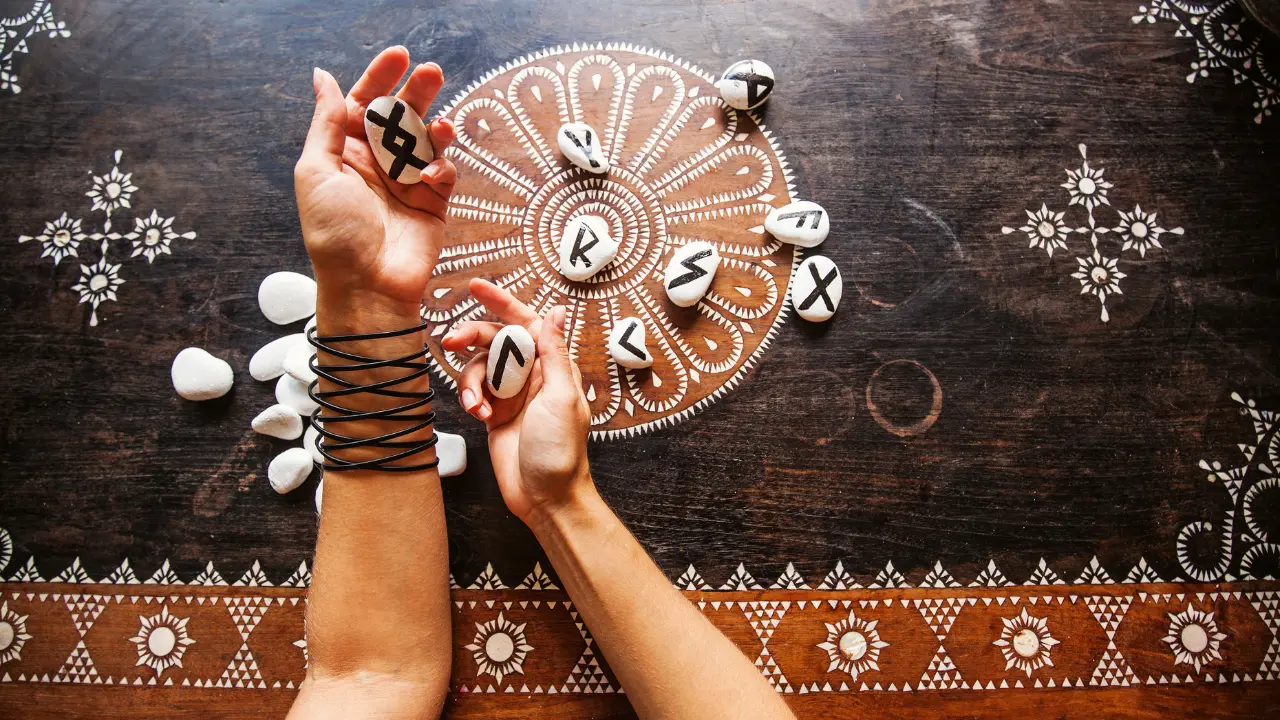
Runic Divination distinguishes itself from common fortune-telling by operating as a diagnostic tool rather than a predictive one. While fortune-telling implies a fixed, immutable future that strips the subject of agency, runic inquiry functions as a meteorological report for the soul. The adept analyzes the current atmospheric pressure of Wyrd to determine probable outcomes, granting the querent the data necessary to alter their course or brace for impact.
In the Northern Tradition, the act of reading runes—often termed Runamal—is not a conversation with a deity but a direct interface with the causal machinery of the universe. The Völva (seeress practicing Seiðr) or modern Vitki acts as the translator, decoding the friction between the querent’s past actions and their current environment. This practice rests on the understanding that the future is not a destination but a consequence.
Most contemporary systems rely on the 24-character Elder Futhark, divided into three structural groupings known as Ættir. This diagnostic method echoes the first-century observations of Roman historian Tacitus, who recorded Germanic tribes casting marked wooden slips onto white cloths.
Metaphysics of Wyrd and Orlog
To interpret the staves accurately, one must grasp the distinct mechanics of Orlog and Wyrd, concepts often clumsily conflated as “fate.” In practice, the thread of Wyrd acts as a feedback loop where current decisions (Verdandi) immediately reshape future obligations (Skuld). Thus, drawing a volatile rune like Kenaz alongside a heavy Orlog stave indicates an opportunity to transmute ancestral patterns through conscious, targeted action.
Orlog: Ancestral Sediment
Orlog (literally “Primal Layers” or “Primal Law”) represents the accumulated weight of the past. It is the sediment at the bottom of the Well of Urd. This includes ancestral heritage, genetic predispositions, and the unchangeable consequences of past actions. When a reading reveals heavy Orlog (often indicated by runes like Nauthiz or Hagalaz), it signals parameters that cannot be negotiated, only endured or managed.
Wyrd: The Active Weaving
Wyrd is the active process of weaving these layers into the present moment. Presided over by the Norns—Urd (That Which Was), Verdandi (That Which Is Becoming), and Skuld (That Which Should Be)—Wyrd is fluid. It represents the intersection of the querent’s will with the momentum of Orlog. A skilled reader identifies where the threads are loose enough to be re-tied. The “future” in this system is merely Skuld—a debt or obligation that is likely to manifest if the current trajectory remains unaltered.
Casting Mechanics and Tools
The physical operation of runic divination relies on the principle of synchronicity: the belief that the random fall of the staves reflects the orderly pattern of the macrocosm at that exact second.
Stall (Casting Cloth)
You establish the parameters of the universe by laying down the casting cloth (Stall). This white linen or leather surface delineates the sacred space (Vé) from the mundane table. It represents the plane of manifestation. Runes that fall “face up” are active and visible in the querent’s reality; those that fall “face down” (Merkstave) represent hidden influences, energetic blockages, or unconscious drives that operate in the shadow.
Casting vs. Drawing
Distinguish between “casting” and “drawing.” Casting involves throwing a handful of runes onto the cloth, allowing their spatial relationships (clusters, angles, distances) to form a geometric map of the situation. This mimics the chaotic scattering of stars or debris. Drawing involves pulling individual runes from a bag/pouch. This linear method forces a narrative structure but loses the nuances of spatial interaction.
Traditionalists carve these symbols on native hardwoods like yew, ash, or birch, linking the physical vehicle of the oracle directly to the botanical taxonomy of Yggdrasil. The somatic weight and tactile feedback of these organic materials during a blind pull from a leather pouch enhance the practitioner’s neural resonance with the staves.
Reading Protocols and Ethical Transaction
When you interpret the oracle for another, you function as a hollow bone—a vessel for information without personal bias.
The integrity of the reading depends on the Gebo principle: a gift demands a gift. Divination consumes Önd (spiritual energy). If you read without an exchange—whether monetary, material, or energetic—you risk draining your own Megin or creating an energetic debt. The transaction closes the circuit and grounds the information. Furthermore, the reader must possess the fortitude to deliver “doom”—a term that historically meant “judgment” or “fate,” not necessarily disaster. If the runes indicate Isa (Stagnation) or Thurisaz (Conflict), you must articulate this friction clearly, avoiding the “toxic positivity” that plagues modern New Age readings.
Before engaging the oracle, practitioners often employ Galdr—the vocal intonation of rune names—to clear psychic static from the reading space. Additionally, staining the carved staves with red ochre or one’s own bodily fluids permanently binds the tool’s energetic signature to the reader’s personal matrix of Megin.
Structural Architecture: The Three Ættir
The 24 staves of the Elder Futhark are not a random sequence, but a tripartite evolutionary journey divided into three groups of eight, called Ættir.
Freya’s Ætt (first eight runes) governs the physical plane, survival, and basic earthly manifestation, framing questions about material assets or primal force.
Heimdall’s Ætt (middle eight runes) introduces external friction, crisis, and cosmic laws, providing diagnostic insight into psychological trials and spiritual transformations.
Tyr’s Ætt (concluding eight runes) addresses societal order, justice, and ultimate integration, guiding the querent through the collective or transpersonal dimensions of their situation.
Spreads and Layouts
Different questions require different spreads to resolve the resolution of the answer.
The Single Draw
Used for a binary “Yes/No” or a daily focus. You reach into the pouch, touch the runes until one feels “hot” or “heavy” (a somatic signal of resonance), and pull it. This provides the keynote frequency of the day.
The Three Norns Spread
This linear layout places three runes from left to right:
- Urd (Position 1): The past influences and the root cause of the query.
- Verdandi (Position 2): The present situation and the active forces.
- Skuld (Position 3): The likely outcome if the current action continues. This is the standard diagnostic tool for understanding the trajectory of a problem.
The Nine Worlds Cast
A complex environmental scan. The cloth is visualized as a map of Yggdrasil. You cast a handful of runes (or draw nine) and place them according to the Nine Worlds schema (e.g., Midgard in the center for the physical reality, Helheim at the bottom for the unconscious/ancestors, Asgard at the top for spiritual guidance). This shows how the issue reverberates across all planes of existence.
When analyzing complex layouts, look for physical touching or overlapping between adjacent staves, which indicates immediate, compounding causal friction. If a rune lands upside down or inverted, interpret it as a Merkstave—representing the blocked, internal, or challenging expression of that stave’s primary force.
The Modern Blank Rune Controversy
Introduced in the early 1980s by author Ralph Blum, the “blank rune” (often called the Odin rune) remains a point of deep division between modern intuitive readers and reconstructionist Vitki. Traditionalists reject the blank stave, pointing out that historical runic inscriptions and classical manuscripts never featured empty blocks, as the runes themselves represent specific sounds and active cosmic forces rather than a void. If your manufactured set contains a twenty-fifth blank tile, leave it out of the casting pouch or keep it strictly as a spare replacement for lost staves.