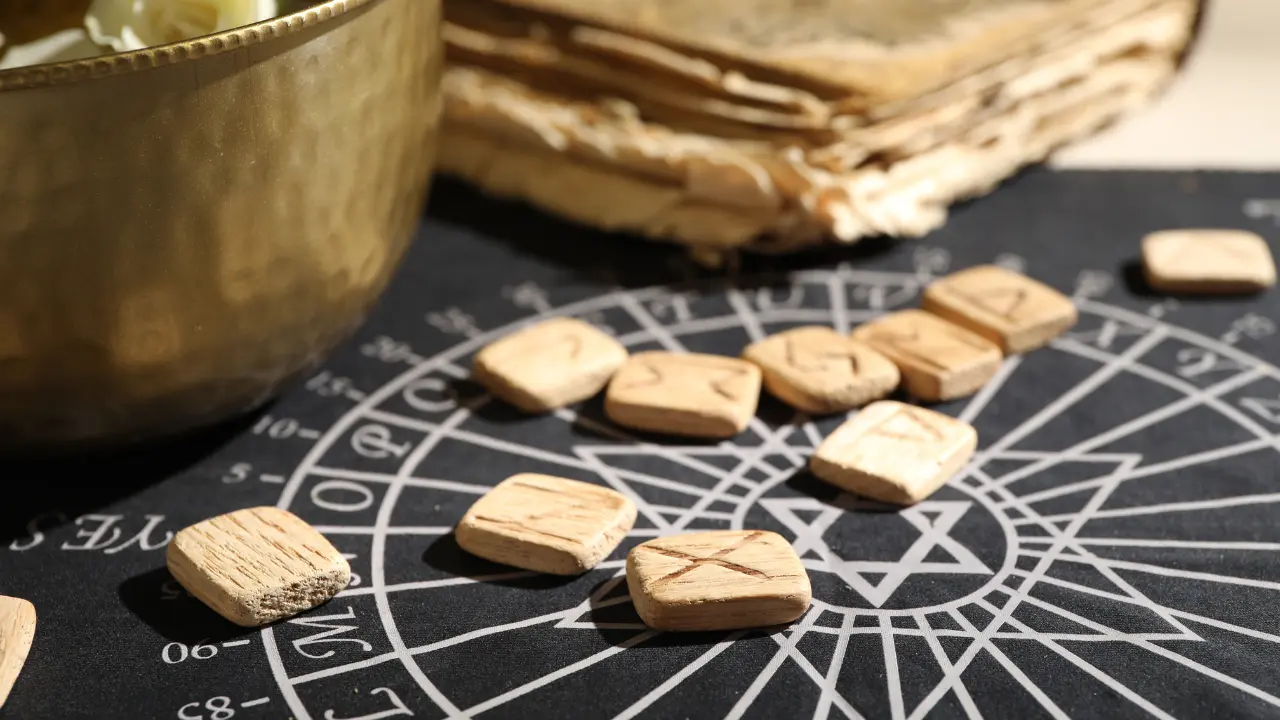
In the Northern Tradition, a rune is never just a letter; it is also a number. The Elder Futhark functions as an alphanumeric code where every stave carries a specific numerical coordinate known as its golden number. For the magickal adept, Runic Numerology is not merely about fortune-telling; it is a method of acoustic and energetic engineering. By analyzing the mathematical sum of a word or a name, the Vitki can dismantle its vibrational architecture and rebuild it.
This practice parallels Greek Isopsephy or Hebrew Gematria, operating on the principle that words with the same numerical value share a “sympathetic essence.” If the name of a person and the name of a specific curse sum to the same number, the resonance between them is unobstructed.
The Golden Numbers (1–24 Ranking)
The sequence of the Futhark is fixed. Fehu is the alpha (1) and Othala (…or Dagaz, depending on the tradition, though 24 is standard for Othala in the Uthark theory) is the omega.
| Rune | Value | Rune | Value | Rune | Value |
|---|---|---|---|---|---|
| Fehu | 1 | Hagalaz | 9 | Tiwaz | 17 |
| Uruz | 2 | Nauthiz | 10 | Berkano | 18 |
| Thurisaz | 3 | Isa | 11 | Ehwaz | 19 |
| Ansuz | 4 | Jera | 12 | Mannaz | 20 |
| Raidho | 5 | Eihwaz | 13 | Laguz | 21 |
| Kenaz | 6 | Perthro | 14 | Ingwaz | 22 |
| Gebo | 7 | Algiz | 15 | Dagaz | 23 |
| Wunjo | 8 | Sowilo | 16 | Othala | 24 |
The Root Number
Unlike Western Numerology, which aggressively reduces everything to a single digit (e.g., 24 = 2+4 = 6), Runic Magick typically respects the Raw Sum or reduces it only to the range of 1–24 to find the “Ruling Rune.”
Question: Do we reduce numbers?
In traditional practice, the raw number holds the power (e.g., 108). However, finding the modulo 24 (the remainder when divided by 24) allows you to map a large sum back to a specific rune to determine the hidden nature of the word.
Calculating Rune Sums
To determine the rune sum of a name, one must first transliterate it into the phonetic sounds of the Elder Futhark.
- Example: “THOR”
- TH: Thurisaz (3)
- O: Othala (24)
- R: Raidho (5)
- Sum: 3 + 24 + 5 = 32.
To analyze the number 32:
- Raw Power: 32.
- Reduction (Modulo 24): 32 – 24 = 8.
- Result: The hidden soul of the name “Thor” resonates with Rune 8 (Wunjo – Joy/Harmony). This reveals the protective, community-building aspect of the god, distinct from his destructive Thurisaz nature.
The Sacred Architecture of 3 and 9
The numbers 3 and 9 form the structural spine of Norse cosmology.
- The Triad (3): Represents the process of manifestation (Urd, Verdandi, Skuld) and the three Aettir. Spells are often chanted three times to “set” them.
- The Ennead (9): The number of completion and the cosmos (Nine Worlds). Odin hung on the tree for nine nights.
- Operational Usage: In Galdr, repeating a chant nine times creates a “Cycle of Power.” In knot magic, nine knots seal the intent. A working that does not adhere to multiples of 3 or 9 risks dissonance with the Northern current.
Runic Coding and Cryptography
Historically, runemasters used Cipher Runes to hide messages in plain sight or to heighten the magical charge by forcing the mind to engage deeply with the puzzle.
The Aett/Position System
Most runic ciphers function on a coordinate system: (Aett Number) : (Rune Number).
- Fehu’s Aett: 1
- Hagalaz’s Aett: 2
- Tyr’s Aett: 3
To encrypt Thurisaz (3rd rune of the 1st Aett), the code is 1:3.
Tent and Branch Runes
These visual ciphers look like trees or fish bones.
- Tent Runes: X-shapes where the arms on the left indicate the Aett (1, 2, or 3) and the arms on the right indicate the position (1-8).
- Branch Runes: A vertical line where branches on the left/right serve the same coordinate function.
Question: How were runes used to hide messages?
By carving a series of “trees” or “fish,” a Viking could write an entire sentence that looked like mere decoration to the illiterate, but spoke clearly to the Erilaz. This technique is powerful for creating Sigils that are visible yet indecipherable to the uninitiated.