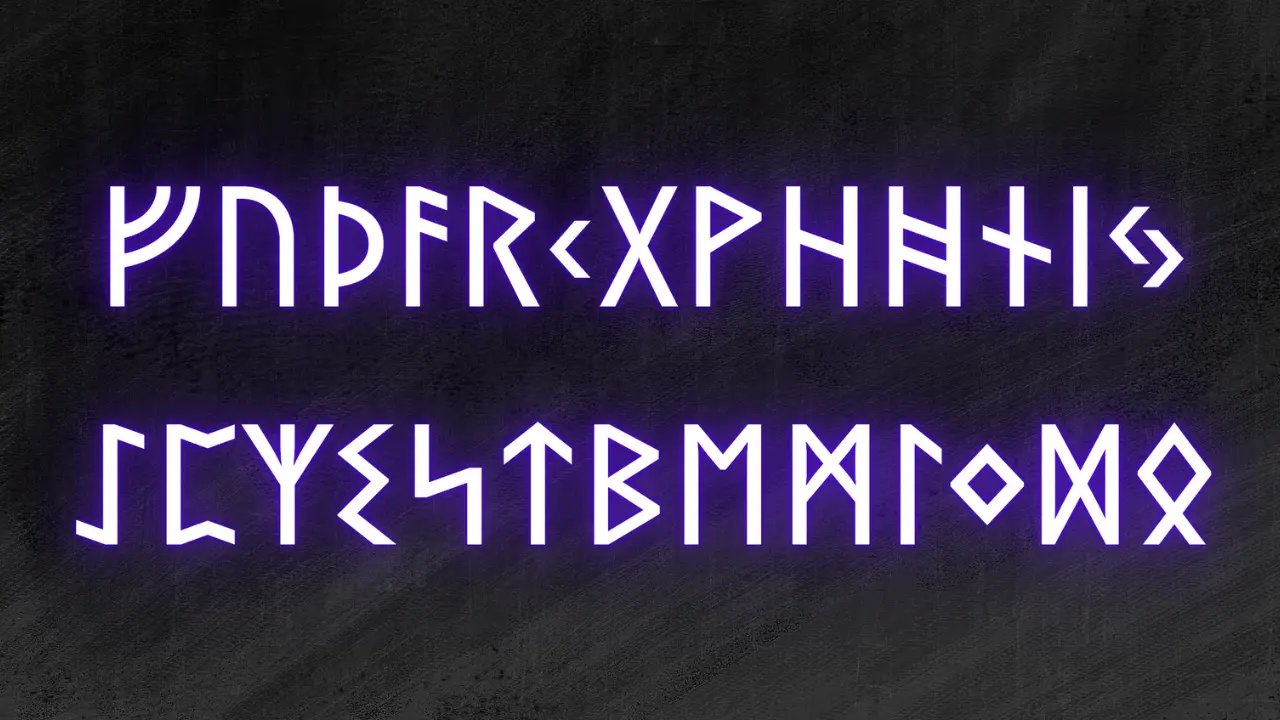
The Elder Futhark represents the oldest confirmed form of the runic scripts, utilized by Germanic tribes for approximately six centuries during the Roman Iron Age and the Migration Period. Epigraphic evidence scatters across a vast geographic footprint, spanning from the Scandinavian heartland down through the continental Germanic territories and eastward along the Gothic migration routes toward the Black Sea.
This writing system comprises a fixed sequence of 24 characters, functioning both as a phonetic alphabet for the Proto-Germanic language and as a series of ideograms representing distinct cosmological concepts. Originating likely in the 1st or 2nd century AD within the contact zones between Germanic peoples and the Roman Empire, the script serves as the foundational “Mother Row” from which all subsequent variants, including the Anglo-Saxon Futhorc and Younger Futhark, descended. Mastery of this system is a prerequisite for the serious study of Runic Magick, as it encodes the archaic dialect and worldview of the pre-Viking era ancestors.
The Structure of the 24-Character Row
The sequence of the Elder Futhark is rigid and non-arbitrary, distinguishing it markedly from the Mediterranean alphabets (ABC) derived from Phoenician scripts. The row begins with Fehu (cattle/wealth) and concludes with Othala (inheritance) or Dagaz (day), depending on the specific archaeological find. This order is known as the Futhark, an acronym formed by the first six phonemes: F, U, Th, A, R, and K.
These 24 staves are organized into three distinct groups known as Aettir (singular Aett), a term translating to “family,” “generation,” or “group of eight.” This tripartite division is fundamental to the internal logic of the system, often interpreted in esoteric circles as a progression through three levels of existence or initiation.
- Freya’s Aett (First Aett): Encompasses the first eight runes (Fehu through Wunjo). These characters generally denote primal forces, physical survival, and the initial creation of order.
- Heimdall’s Aett (Second Aett): Contains the second eight runes (Hagalaz through Sowilo). This group is characterized by elemental disruption, necessity, and the forces of resistance that test human resilience.
- Tyr’s Aett (Third Aett): Comprises the final eight runes (Tiwaz through Othala/Dagaz). These symbols relate to the human social order, justice, spiritual transformation, and the synthesis of the preceding forces.
In a functional context, each rune operates as a logogram. While the character Isaz represents the phonetic sound “I”, it simultaneously conveys the concept of “Ice” and, by extension, stasis or concentration. This dual utility allowed Erilaz (rune masters) to encode complex metaphysical intent into brief inscriptions on weapons, jewelry, and stones.
The structural variation within the row is illustrated by historical finds, which reveal regional or temporal sequence swaps. In the middle of the alphabet, the Kylver Stone places Perthro before Eihwaz, whereas the Vadstena and Grumpan bracteates place Eihwaz before Perthro. At the end of the row, a second flip occurs: the Kylver Stone puts Dagaz before Othala, whereas the bracteates invert this order to Othala then Dagaz. The bracteates also introduce an entirely new structural formatting element absent from the Kylver Stone: explicitly dividing the script into three groups of eight (Aettir) using distinct separation dots.
Linguistic Reconstruction and Phonetic Values
Because the Elder Futhark predates significant manuscript culture, the names of the runes are not preserved in direct contemporary texts. Linguists and philologists reconstruct these names using the comparative method, triangulating data from later sources such as the Old English Rune Poem, the Norwegian Rune Poem, and the Abecedarium Nordmannicum.
A reconstructed name is linguistically marked with an asterisk (*). For example, the Old Norse name Ur and the Old English name Ur allow scholars to reconstruct the Proto-Germanic form *Uruz. This process restores the full bisyllabic or trisyllabic pronunciation that would have been vibrant during the 2nd century.
| Rune | Proto-Germanic (Reconstructed) | Phoneme | Meaning |
| ᚠ | Fehu | /f/ | Livestock, Wealth |
| ᚢ | Uruz | /u/ | Aurochs, Water, Dross |
| ᚦ | Thurisaz | /θ/ | Giant, Thorn |
| ᚨ | Ansuz | /a/ | God, Oak, Ash |
| ᚱ | Raidho | /r/ | Ride, Journey |
| ᚲ | Kaunan/Kenaz | /k/ | Ulcer, Torch |
| ᚷ | Gebo | /g/ | Gift |
| ᚹ | Wunjo | /w/ | Joy |
These reconstructed forms are preferred in modern magick rituals to access the “root” vibration of the symbol, bypassing the linguistic drift that occurred in later centuries.
Prominent Archaeological Artifacts
Although the known corpus of Elder Futhark inscriptions numbers around 350 finds scattered across Scandinavia and continental Europe, only a select few are critical for establishing the exact alphabetical sequence and the script’s chronological boundaries. The artifacts detailed below represent a curated selection of the most foundational epigraphic evidence. While not an exhaustive catalog of all runic discoveries, these specific finds provide the tangible proof for the “where” and “when,” anchoring the structural theory of the runic row in historical reality.
Meldorf Fibula
The Meldorf Fibula, discovered in Dithmarschen, Germany, dates to approximately 50 AD. The inscription on this brooch is the subject of intense academic debate; it may represent Proto-Runic or Latin characters. If accepted as runic, it places the genesis of the system in the 1st century, closely linked to the Roman frontier.
Vimose Comb
The Vimose Comb (c. 160 AD), found on the island of Funen, Denmark, bears the inscription Harja. This remains the oldest undisputed runic inscription. Harja is interpreted as a male personal name or an agent noun meaning “Warrior” or “Comb-one.” The artifact demonstrates that even in its earliest phase, the script was used to mark personal possession and identity on organic materials like bone.
Kylver Stone
The most critical artifact for the sequence of the row is the Kylver Stone (c. 400 AD) from Gotland, Sweden. This limestone slab was found forming the side of a sarcophagus. The inscription faces the interior of the grave, invisible to the living, and lists the full 24-rune Futhark followed by a tree-like bindrune, with the uninterpreted palindrome Sueus carved in a separate space on the slab. The placement suggests the Futhark itself functioned as a magical containment field or a bridge for the deceased, rather than a message for a human audience.
Golden Horns of Gallehus
Two gold horns from early 5th-century Denmark, discovered in Southern Jutland. The shorter horn bore the Proto-Norse inscription “ek hlewagastiz holtijaz horna tawido” (“I Hlewagastiz Holtijaz made the horn”). This represents one of the earliest complete sentences in Elder Futhark and the oldest preserved example of Germanic alliterative verse. The original horns were stolen and melted down in 1802.
Einang Stone
A 4th-century runestone from Vestre Slidre, Norway, standing at its original location on a grave mound overlooking the Valdres valley. The inscription reads “(Ek go)ðagastiz runo faihido” (“(I, Go)dguest painted the runes”). It is the oldest known runestone still in situ and may contain the earliest mention of the word Runo (rune) in runic inscriptions.
Vadstena Bracteate
A gold C-bracteate from circa 500 AD, discovered in Vadstena, Sweden in 1774. The artifact features a complete listing of the 24 Elder Futhark runes, explicitly divided by dots into three groups of eight (the Aettir). The inscription reads “fuþarkgw; hnijïpzs; tbemlŋod,” demonstrating the tripartite structure that became standard in runic tradition. The original was stolen in 1938 and remains missing. As mentioned before, the order of some characters slightly varies in comparison to the Kylver Stone.
Grumpan Bracteate
A 6th-century gold bracteate found in Västergötland, Sweden in 1911. Like the Vadstena bracteate, it contains a full sequential listing of the Elder Futhark divided into three Aettir using rows of dots as separators. Just like the Vadstena Bracteate, this artifact shows minor variations in rune order compared to the Kylver Stone—The bracteates list Eihwaz first, then Perthro (in the middle of the sequence), and Othala first, then Dagaz (at the end of the sequence).
Transition to Later Systems
The dominance of the Elder Futhark waned in the 8th century due to the linguistic phenomenon known as syncope. As Proto-Norse evolved into Old Norse, unstressed vowels were lost, causing the language to contract and its phonology to shift. Paradoxically, the 24-rune system was reduced to the 16-character Younger Futhark in Scandinavia, requiring individual runes to represent multiple sounds. During this transition, the Younger Futhark diversified into distinct stylistic variations, traditionally categorized as long-branch and short-twig scripts. While older scholarship labeled these as “Danish” and “Swedish-Norwegian” regional variants, modern runologists view them primarily as functional adaptations: long-branch functioned as a bold, monumental script for formal stone monuments, while short-twig served as a streamlined shorthand for everyday communication carved on wood or bone. Apart from these two variants, a third, less popular one also existed: Hälsinge runes, also known as staveless runes.
Simultaneously, Germanic migrations to the British Isles established the script there, where it expanded into the Anglo-Saxon Futhorc (reaching up to 33 characters) to accommodate the evolving sounds of Old English. While the Elder Futhark ceased to be a living script by roughly 800 AD, it was deciphered by scholars in the 19th century. In contemporary modern esoteric practice, it serves as the foundational system for many forms of runic divination and magic, though historically, magical inscriptions were also composed using the Younger and Anglo-Saxon rows.