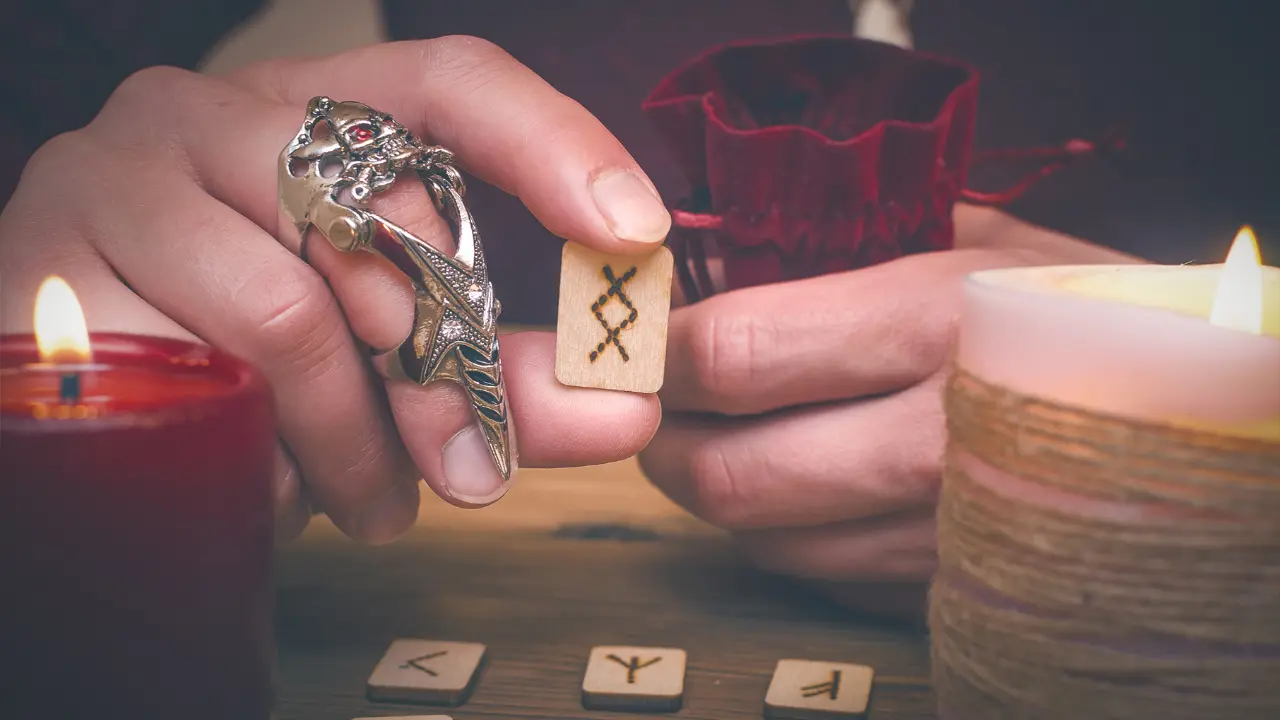
In Runic Magick, the act of inscription—known as Risting (from Old Norse rista, to carve)—is a surgical intervention into the fabric of reality. The adept does not simply write a spell; they cut it. This physical severing of the grain represents the imposing of the magus’s will upon the chaotic potential of the material world. The resulting object, termed a Taufr (talisman), is not an inert charm but a programmed entity, possessing a rudimentary consciousness and a specific directive to alter Wyrd.
To create a functional Taufr, the mage must master the triad of material, method, and activation. A rune drawn on paper with a ballpoint pen holds negligible charge compared to one carved into consecrated Ash with a ritual blade and reddened with life-force. The friction, the resistance of the wood, and the sacrifice of blood or ochre are the thermodynamic costs required to ground the magickal current.
Material Selection: The Corporeal Vessel
The material carrier serves as the body for the runic spirit. The adept must select a substance whose natural resonance aligns with the intent of the working. Using yew for a fertility charm would be a catastrophic misalignment, introducing necrotic energy into a generative working.
| Material | Primary Association | Elemental Alignment | Recommended Use Case |
|---|---|---|---|
| Ash | Connection/Cosmos | Air/Spirit | General workings, communication, linking realms (Yggdrasil connection). |
| Yew | Death/Endurance | Earth/Water | Protection, banishing, necromancy, binding, longevity. |
| Oak | Strength/Authority | Fire/Earth | Prosperity, legal victory, physical health, grounding. |
| Birch | New Beginnings | Earth/Water | Healing, fertility, purification, protection of children. |
| Bone | Spirit/Ancestry | Spirit | Cursing, spirit binding, accessing the dead. |
| Stone | Permanence | Earth | Warding property, long-term anchoring spells. |
Preparation
Before the knife touches the surface, the material must be hallowed. For wood, this involves sanding it to a pristine smoothness, removing the “wild” nature of the tree and creating a tabula rasa. This physical purification mirrors the mental clearing of the magus.
The Seax: The Iron Will
The primary tool of the rune-carver is the seax. Historically a utility knife or sword, in magick it represents the discriminatory faculty of the intellect—the ability to divide, define, and shape.
Iron and Steel
The blade must be iron or steel. In folklore, “cold iron” is apotropaic—it repels evil spirits and wights. By carving runes with iron, the adept is not only shaping the wood but simultaneously banishing any interfering energies from the incision. The seax should be kept razor-sharp; a dull blade requires excessive force, leading to slips that can mar the rune shape. In Runic Magick, a mis-carved rune creates a distorted frequency, necessitating the destruction of the entire piece.
The Mechanics of Inscription
Risting is a ritual act. The magus typically vibrates the Galdr (name) of the rune continuously while carving it, synchronizing the sonic vibration with the physical cut.
The Stroke and Friction
Cuts should be deliberate and deep. The vertical strokes (staves) are carved first to establish the structure, followed by the diagonal branches. Traditionally, cutting towards the body draws energy in (invocation), while cutting away projects energy out (evocation). The physical resistance of the wood generates heat—microcosmic need-fire—which acts as the spark of ignition for the spell.
Handling Shavings
The shavings produced during risting are impregnated with the magickal charge. They cannot be idly discarded. If the spell is beneficial, they may be burned to release the energy or carried in a sachet. If the working is baleful or banishing, they should be buried off-property or cast into running water to disperse the energy.
Reddening: The Blood Link
A carved rune is structurally complete but energetically dormant. To wake it, it must be “reddened.” This process mimics the circulation of blood, transforming the dead wood into living tissue.
Blood vs. Ochre
The most potent method is the use of the magus’s own blood, typically obtained via a diabetic lancet from a finger. This creates a sympathetic link, tying the Taufr directly to the caster’s Hamingja and Önd. For workings where a biological link is undesirable (e.g., cursing or selling an item), red ochre mixed with linseed oil is the traditional substitute. The pigment is rubbed into the grooves, highlighting the glyph and sealing the intent. Modern eclectic witches may use dragon’s blood ink, but the principle of “sacrifice” (giving substance to the symbol) shall remain.
Awakening and Consecration
The final phase is the “birth” of the talisman. The object is finished, reddened, and charged, but it is not yet alive.
The Infusion of Önd
The adept holds the Taufr in both hands and performs a deep inhalation, gathering Önd in the lungs. This breath is then forcefully exhaled over the object (or directly onto it), often accompanied by the spoken intent. This mimics the myth of Odin breathing life into the first humans, Ask and Embla.
Naming and Sealing
The object is given a name—not “wealth charm,” but a specific moniker like “gold-fetcher” or “shield-biter.” This defines its separate existence. Finally, the Taufr is wrapped in cloth (simulating a womb) and left to incubate in darkness for a set period (often three or nine nights) before being deployed. This allows the energies to stabilize and the “glue” of the magick to set.