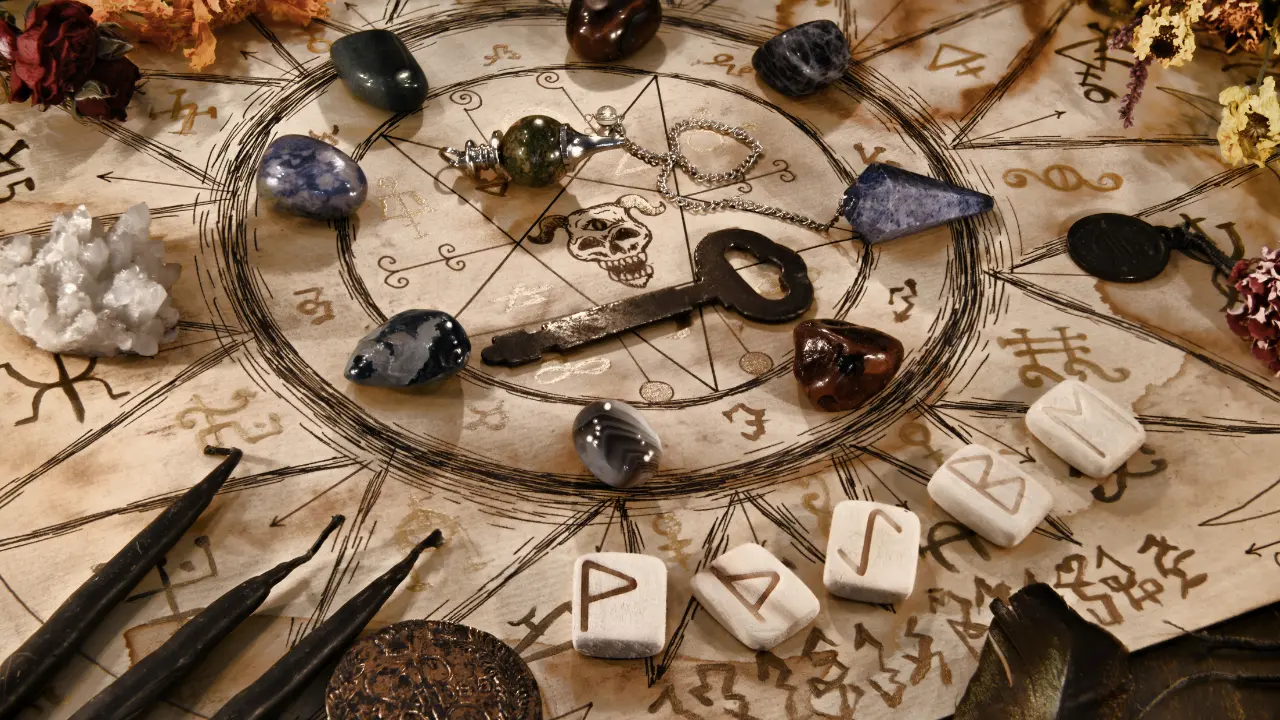
Modern-day witchcraft is an operative spiritual and psychological craft where an adept uses ritual, divination, and natural correspondences to direct willpower and manifest change. The eclectic witch path represents an individualized framework within contemporary occultism that synthesizes techniques from diverse esoteric systems rather than adhering to a single rigid dogma. In my own work combining Tarot divination, crystal grids, candle spellwork, and Runic Magick, eclecticism provides the flexibility to select whatever method yields measurable results.
What Is Modern-Day Witchcraft and Who Is a Modern Witch
Modern-day witchcraft functions as a decentralized, adaptable discipline focused on personal sovereignty, environmental attunement, and intentional transformation. A modern witch is an independent mage, diviner, or folk sorcerer who engages with esoteric arts (such as herbalism, astrology, tarot reading, and energy manipulation) to navigate everyday life.
Contemporary witches span every demographic, profession, and socioeconomic background across urban and rural environments. Rather than retreating from society, today’s occultists integrate spellcraft directly into modern routines, stir intentions into morning coffee, cast sigils on digital screens, and align personal schedules with lunar phases. In my daily practice, witchcraft is neither escapist fantasy nor theatrical roleplay, but a disciplined method for sharpening intuition and conditioning the mind toward tangible goals.
Eclectic Witchcraft vs Traditional Witchcraft and Wicca
Distinguishing modern eclectic witchcraft from Wicca and traditional witchcraft clarifies how different occult paths approach initiation, liturgy, and lineage. While Wicca operates as a structured neopagan religion and traditional witchcraft preserves regional folk sorcery, the eclectic witch path prioritizes personal experimentation across multiple open traditions. Understanding these structural boundaries helps an apprentice select a framework with high ecological validity for their specific lifestyle and temperament.
Modern Eclectic Witchcraft
Modern eclectic witchcraft empowers the individual witch to build a customized magickal system from varied historical and contemporary sources. An eclectic adept might cast a prosperity spell using a green wax candle on Thursday (planetary magick), carve the Elder Futhark rune Fehu into the wax (Runic Magick), and surround the base with pyrite and cinnamon (crystal and herbal magick). The primary trade-off of eclecticism is the risk of superficial syncretism (mixing incompatible symbols without understanding their historical mechanics) or unintended cultural appropriation of closed indigenous practices like Vodou or Native American medicine rites.
Wicca and Initiatory Neopaganism
Wicca is a formal, duotheistic neopagan religion popularized in mid-twentieth-century England by Gerald Gardner and later expanded through Alexandrian, Dianic, and eclectic Wiccan branches. Wiccan initiates typically venerate a Horned God and a Triple Goddess, celebrate eight seasonal Sabbats (the Wheel of the Year), and observe strict liturgical structures within a coven or solitary shrine. All Wiccans may identify as witches, yet a vast majority of modern witches are not Wiccan and do not subscribe to Wiccan theology or coven hierarchies.
Traditional Witchcraft and Folk Sorcery
Traditional witchcraft encompasses non-Wiccan occult lineages, regional cunning craft, and historical folk magick rooted in specific landscapes and animistic cosmology. Sorcerers walking traditional paths (such as British Traditional Craft, Italian stregheria, or Appalachian folk magick) emphasize local land spirits, ancestor veneration, spirit flight (hedgeriding), and morally neutral operative sorcery. Unlike the eclectic approach, traditional craft demands strict adherence to regional folklore and historical protocols passed down through familial or initiatory transmissions.
| Feature | Modern Eclectic Witchcraft | Wicca | Traditional Witchcraft |
|---|---|---|---|
| Structure | Self-directed, customizable, non-dogmatic | Formal neopagan religion with structured liturgy | Lineage-based or regional folk sorcery |
| Theology | Secular, animistic, pantheistic, or polytheistic | Primarily duotheistic (Goddess and Horned God) | Animistic, chthonic, and ancestor-focused |
| Ethics | Personal moral sovereignty and accountability | Governed by the Wiccan Rede and Threefold Law | Pragmatic, situational ethics including baneful defense |
| Practice Style | Solitary or informal study groups | Initiatory covens or structured solitary shrines | Solitary cunning folk or closed regional covens |
| Primary Sources | Cross-cultural open occultism, tarot, runes, crystals | Gardnerian, Alexandrian, and neopagan texts | Historical grimoires, local folklore, trial records |
Does Modern Witchcraft Work and How Magickal Paradigms Operate
Evaluating whether modern witchcraft works requires examining both empirical psychological outcomes and the esoteric paradigms that govern ritual mechanics. Modern witchcraft achieves real-world transfer by aligning neurobiological priming with structured metaphysical frameworks (known in occult theory as the spirit, energy, psychological, information, and neuroscientific models). Spellwork fails when an apprentice treats ritual as a substitute for physical action or expects instant violations of physical law.
Psychological and Neurobiological Mechanisms
Empirical research in cognitive science and anthropology demonstrates that ritualized behavior directly modulates human neurobiology, attention, and emotional regulation. Studies conducted at Harvard University by Alison Wood Brooks show that performing structured rituals before high-stakes tasks measurably reduces performance anxiety and stabilizes heart rate compared to random gestures. Furthermore, correspondence systems (pairing specific scents like rosemary, colors, and tactile runes with a goal) act as multi-sensory priming networks that program the reticular activating system to spot real-world opportunities. Shadow work and bereavement rites within witchcraft also provide non-institutionalized frameworks for processing grief and resolving internal approach-avoidance conflicts.
Types of Magickal Models and Paradigms
Occult theorist Frater U.:D.: originally categorized operative magick into four distinct paradigms that explain how spellcraft interacts with reality. Other contemporary wizards have later expanded upon this idea.
- Spirit Model: This oldest animistic paradigm posits that deities, ancestors, land spirits, and astral entities exist independently and collaborate with the sorcerer through offerings, invocation, and evocation.
- Energy Model: Emerging from Franz Anton Mesmer’s animal magnetism and Eastern concepts of ki or prana, this framework treats the witch as a conduit who raises, directs, and grounds subtle biofield energies through crystals, herbs, and visualization.
- Psychological Model: Drawing from Sigmund Freud, Carl Jung, and Austin Osman Spare, this model asserts that rituals, tarot archetypes, and symbols communicate directly with the human subconscious to alter behavior and perception.
- Information Model: This cybernetic paradigm views reality as a programmable matrix where concentrated intent and sigils transmit non-local information across probability fields, independent of space and time.
- Neuroscientific Model: Neuromancy is a parascientific model of magick, often used by Daniel Domaradzki. It attempts to explain occult phenomena via more-or-less accurate neuroscientific (or alike) theories. It is not literal science but rather an alternative to the psychological model, relating more to the hardware (the human brain and nervous system) rather than the software (the non-physical mind).
Aesthetics and Operative Reality
Contrasting commercialized occult aesthetics with operative reality helps witches avoid consumerist traps and algorithmic misinformation. While social media platforms popularize a dark, bohemian visual identity, authentic witchcraft relies on internal discipline, mental conditioning, and verifiable record-keeping rather than wardrobe or expensive props. Discerning adepts separate theatrical presentation from functional esoteric mechanics.
The Modern Witch Aesthetic vs Operative Dress
Modern witches dress in ordinary everyday clothing suitable for their jobs, climates, and lifestyles. Although the romanticized witch aesthetic (featuring black velvet, wide-brimmed hats, silver pentacles, and amethyst pendants) can serve as a deliberate psychological trigger to shift an adept into a ritual mindset, clothing holds zero inherent magickal power. In my own practice, I read Tarot or cast runic bindrunes just as effectively in gym clothes or jeans as I do in ceremonial attire.
Bridging Eclectic Witchcraft With Chaos Magick
Bridging eclectic witchcraft with Chaos Magick transforms intuitive folk craft into a rigorous, results-oriented experimental system. Pioneered in the late 1970s by Peter J. Carroll (author of Liber Null & Psychonaut) and Ray Sherwin, Chaos Magick strips away rigid dogma and treats belief itself as an operative variable. When an eclectic witch adopts the mindset of a Chaote, they stop asking whether a symbol is objectively true and start asking whether it produces the desired outcome.
Chaos Magicians utilize a technique called paradigm shifting, which allows a Chaos Mage to inhabit a specific belief system fully during a ritual and discard it immediately afterward. Working alongside a Chaos Magus at Chaos Magick Forge taught me how seamlessly traditional witchcraft tools integrate with Chaote methodology. For example, an eclectic witch can use inhibitory or excitatory gnosis (altered states of awareness achieved through meditation, chanting, or breathwork) to charge a custom bindrune or a graphic sigil, blending folkloric correspondences with postmodern meta-belief.
How to Become a Modern Witch as a Beginner
Becoming a modern witch requires self-directed study, sensory training, and consistent experimentation rather than formal permission or expensive tools. An apprentice builds a sustainable eclectic practice through structured mental conditioning, foundational divination, and empirical journaling. Following a sequential protocol prevents information overload and establishes reliable operative habits.
- Establish a daily mental conditioning routine using ten minutes of breathwork, mindfulness meditation, and sensory visualization to train focus and energetic awareness.
- Create a magickal grimoire or Book of Shadows in a physical notebook to record spell ingredients, lunar phases, emotional states, and objective real-world results.
- Select one primary divination system (such as a standard 78-card Tarot deck or a set of 24 Elder Futhark runes) and study its symbolic architecture through daily single-draw reflections.
- Practice basic energy hygiene through grounding (visualizing excess tension draining into the earth), centering, and cleansing your living space with sound, salt water, or herbs like rosemary.
- Design and execute low-stakes beginner spells (such as a candle spell for focus or an herbal charm bag for restful sleep) using household items before purchasing specialized occult supplies.
- Audit your grimoire logs after thirty days to identify failure modes, refine personal correspondences, and pair every magickal working with concrete mundane action.
Treating your grimoire like a laboratory notebook ensures long-term growth on the eclectic path. When a working fails to manifest, an experienced witch analyzes whether the intention was ambiguous, whether internal psychological resistance blocked the outcome, or whether mundane pathways were neglected. Mastery in modern witchcraft emerges from this continuous cycle of study, ritual execution, and honest self-assessment.