Core shamanism is a modern, synthesized system of shamanic practices developed by the American anthropologist Michael Harner in the late 1970s. This framework extracts and standardizes universal shamanic principles from diverse indigenous cultures, removing specific cultural contexts to make the methodologies accessible to contemporary Western practitioners. The Foundation for Shamanic Studies (FSS), established by Harner, serves as the primary institution for preserving indigenous knowledge and providing modern training in these methodologies.
Origins and Institutional Development
The origins and institutional development of this modern spiritual framework stem from academic field research and the subsequent desire to adapt indigenous healing practices for contemporary society. Historical evolution involves the systematic analysis of global animistic traditions to identify shared components, leading to the creation of a structured educational organization dedicated to preservation and instruction.
Michael Harner and the Cross-Cultural Methodology
Anthropologist Michael Harner initiated the development of this cross-cultural methodology following his extensive fieldwork among the Conibo people of the Peruvian Amazon and the Shuar of Ecuador. Cross-cultural analysis revealed consistent patterns in how indigenous healers entered altered states and interacted with spiritual entities. This comparative approach relies on the premise that underlying mechanisms of shamanic work operate independently of specific cultural dogmas. The publication of his seminal book, The Way of the Shaman, formalized these concepts for a general audience.
The establishment of the Foundation for Shamanic Studies provided a formal institutional structure for this cross-cultural methodology. The foundation originated as the Center for Shamanic Studies in 1979 before officially incorporating as a non-profit organization in 1985. Institutional directives focus on funding field research and providing financial support to indigenous populations to ensure the survival of their traditional practices.
Key historical contributors shaped the institutional development of this framework.
| Contributor | Primary Role | Institutional Focus |
|---|---|---|
| Michael Harner | Founder | Anthropological synthesis |
| Sandra Ingerman | Former Educational Director | Curriculum expansion |
| Susan Mokelke | President | Global program integration |
Universal Shamanic Principles
The theoretical foundation of the practice relies on a specific set of universal shamanic principles governing consciousness, spatial orientation, and spiritual interaction. Practitioners utilize specialized auditory techniques to alter their cognitive states and navigate a tripartite map of the spiritual universe to retrieve information and facilitate healing.
Non-Ordinary Reality
The concept of non-ordinary reality defines the specific altered state of consciousness where practitioners interact with spiritual entities. This terminology differentiates the trance state environment from the ordinary, waking reality of daily physical existence. Navigation within this invisible landscape allows practitioners to bypass conscious logical constraints to access intuitive and spiritual repositories of knowledge.
Shamanic Cosmology
Shamanic cosmology maps this invisible landscape into three distinct, universally recognized regions. The lower world typically presents as an earthly, nature-based realm inhabited by power animals and earth spirits. The upper world features ethereal, celestial landscapes occupied by human-form spiritual teachers and guides. The middle world represents the spiritual and energetic aspect of our present physical reality, utilized primarily for obtaining information about current earthly events or locating missing objects.
Drum Journeying and Sonic Driving
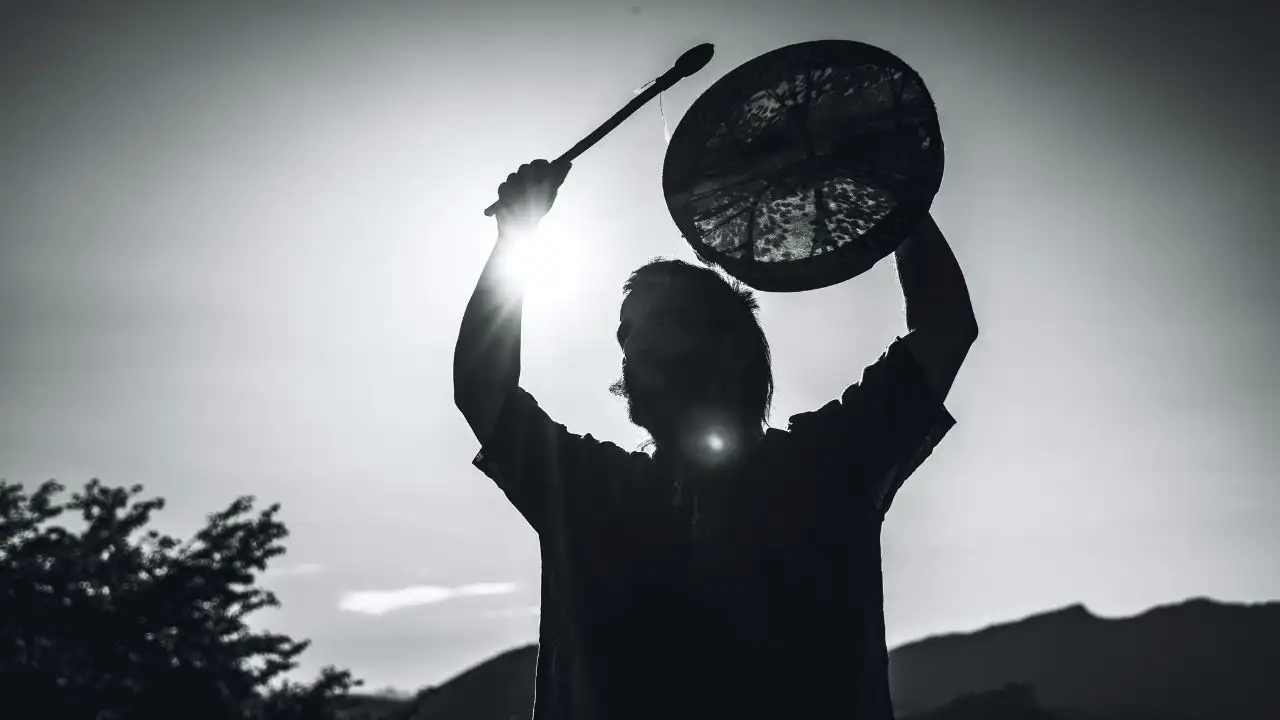
The practice of drum journeying constitutes the primary mechanism for transitioning into the cosmological realms. Auditory stimulation through sonic driving alters brainwave frequencies, typically inducing a theta state conducive to visionary experiences. Practitioners use a steady, monotonous rhythm to facilitate the safe and controlled shift between ordinary and non-ordinary states of consciousness.
Equipment utilized for sonic induction remains minimal by design to ensure global accessibility. Standard implements used for rhythmic auditory stimulation include:
- Frame drums constructed from animal hide
- Synthetic drums designed for varying humidity levels
- Rattles made from gourds or dried rawhide
- Wooden beaters with heavily padded heads
Healing Methodologies and Modern Training
Practical application of the methodology focuses on restorative energetic interventions and structured modern training pathways. Contemporary practitioners learn standardized procedures to address spiritual illnesses through specific energetic techniques and ethical client interactions.
Extraction Healing and Soul Retrieval
Restorative energetic interventions address distinct forms of spiritual illness through highly targeted procedures. Extraction healing addresses spiritual intrusions, where practitioners locate and remove misplaced, dense energetic masses from a client’s spiritual body. The practitioner extracts these localized blockages and neutralizes the removed energy in a basin of water.
Soul retrieval, heavily popularized and refined by Sandra Ingerman, addresses soul loss resulting from severe physical or emotional trauma. The practitioner journeys into the non-ordinary realms to locate fragmented portions of the client’s vital essence. Upon locating these fragments, the practitioner returns them to the client’s energetic body to restore psychological and spiritual wholeness.
Standardized Rituals in Contemporary Education
The transmission of these complex techniques occurs through modern training programs utilizing standardized rituals. Educational curriculum progresses systematically from introductory weekend workshops to advanced, multi-year initiatory programs. The pedagogical approach emphasizes direct, experiential learning over theoretical lecture, requiring students to validate the techniques through personal practice and peer observation.
Contemporary education in standardized rituals relies heavily on strict ethical guidelines and clear practitioner boundaries. Foundational ethical tenets taught in modern training programs include:
- Obtaining explicit waking consent before initiating healing procedures
- Maintaining strict confidentiality regarding visionary experiences
- Avoiding diagnostic medical terminology during client consultations
- Refraining from performing unsolicited spiritual interventions
Educational progression in modern training programs follows a standardized sequence designed to build necessary foundational skills.
| Program Level | Core Focus | Prerequisite |
|---|---|---|
| Basic Workshop | Journeying techniques | None |
| Extraction Training | Removing intrusions | Basic Workshop |
| Advanced Training | Multidimensional healing | Multiple workshops |