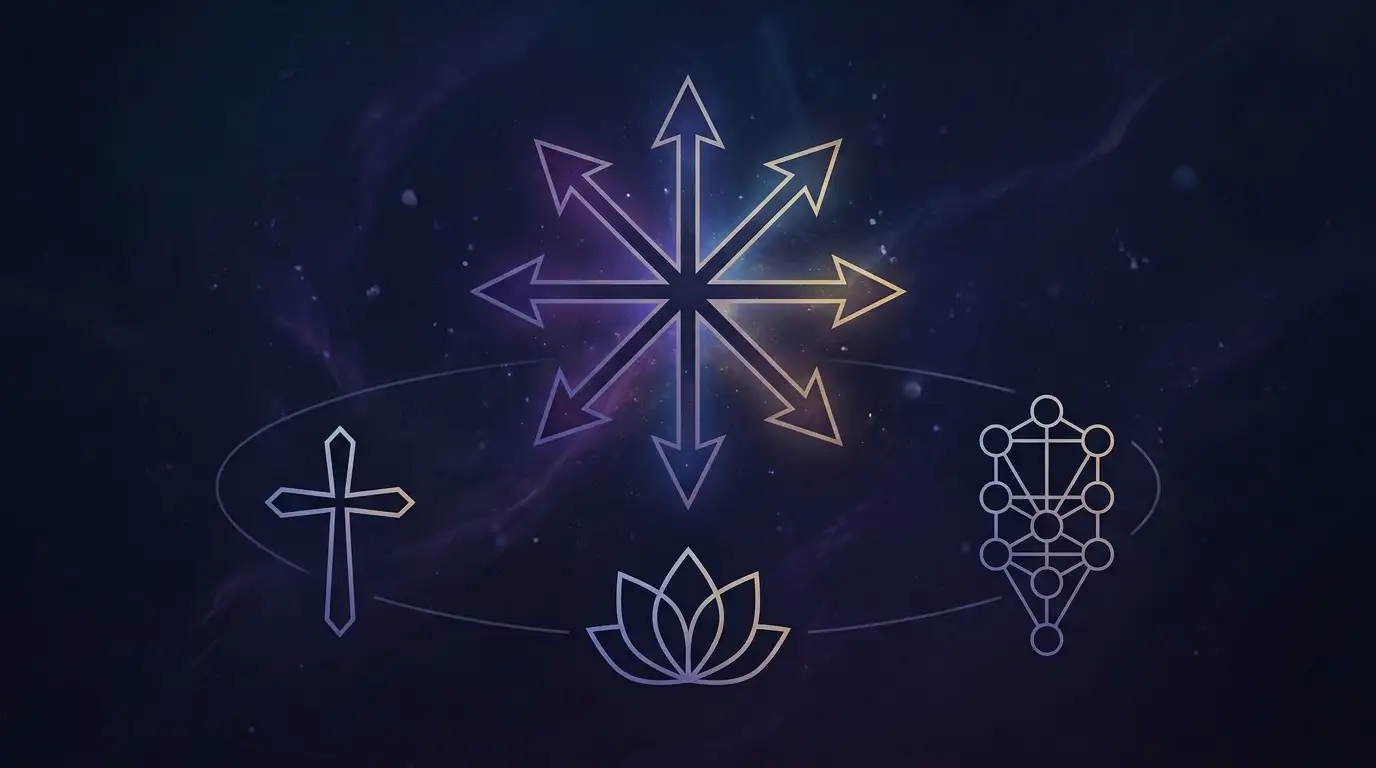
Chaos Magick interfaces with major world religions not out of devotion, but for sheer magickal utility. The Chaos Mage views religious paradigms like Christianity, Buddhism, and Kabbalah as psychological frameworks that can be temporarily entered, stripped of dogma, and utilized to generate concrete results. Instead of viewing these spiritual paths as mutually exclusive, absolute truths, the Chaote treats them as software programs to be booted up, run for a specific spell or developmental phase, and shut down once the work is complete. This results-based approach allows the adept to harness the intense psychological currents of world religions without becoming trapped in their moral or theological restrictions.
Paradigm Shifting: Belief as a Tool in Mainstream Religions
Paradigm shifting is the foundational methodology that allows a Chaos Sorcerer to adopt any mainstream religious worldview for tactical advantage. This psychological mechanism operates on the premise that belief is not a static truth but a plastic tool used to manipulate reality. Under this framework, a Chaos Adept can temporarily become a devout Catholic, a Zen monk, or a Kabbalistic scholar to exploit the specific energy currents generated by those lineages. Once the objective is achieved, the mage discards the belief system to prevent dogmatic calcification.
The Mechanics of Belief Flexibility
Belief flexibility requires the Chaos Magician to deliberately suspend disbelief to access the magickal currents of a chosen religion. An adept must cultivate a state of psychological plasticity, which allows them to fully invest their emotions and mind into a temporary spiritual framework. For example, when invoking the power of the Holy Spirit, the Chaos Sorcerer does not merely pretend to believe; they actively inhabit the headspace of a devout Christian, triggering genuine physiological and emotional responses. This deep immersion is what unlocks the spiritual infrastructure built by millions of worshippers over centuries.
Slipping between these paradigms prevents the Chaos Magus from becoming trapped in a single worldview, which is a common hazard in traditional occultism. Traditional grimoire systems require lifelong vows and rigid cosmological alignments, but Chaos Magick bypasses these restrictions by emphasizing results over adherence. A sorcerer might utilize a Catholic mass to charge a talisman on Sunday, then adopt a completely atheistic, quantum-physics paradigm on Monday to banish any lingering psychic residues. This fluid movement ensures that the subconscious mind remains highly responsive to different symbolic languages without developing dogmatic blind spots.
Pragmatic Deception and Voluntary Insanity
Pragmatic deception is the conscious act of deceiving oneself into believing a temporary reality to achieve gnosis. A Chaos Wizard refers to this practice as voluntary insanity or “as-if” thinking, where the mind behaves as though a specific religious system is the absolute truth. To heal a sick relative, a Chaos Sorcerer might adopt the Christian belief in divine grace, operating with absolute faith for the duration of the prayer. This temporary, hyper-focused state bypasses the conscious censor, allowing the intent to plunge directly into the subconscious mind where magickal manipulation occurs.
The conscious mind naturally resists contradictory beliefs, making self-deception a skill that must be trained through rigorous discipline. An apprentice Chaos Mage might start by shifting between small, non-threatening belief structures before attempting to inhabit massive religious paradigms. Over time, this training enables the sorcerer to adopt radical worldviews at a moment’s notice, leveraging the absolute conviction of the fanatic without suffering the intellectual limitations of true dogma. The ultimate goal is to remain the master of one’s beliefs, utilizing them like tools from a toolbox rather than letting them dictate one’s identity.
Christian Chaos Magick: Egregores, Saints, and Prayer Mechanics
Christian Chaos Magick leverages the immense psychic architecture of the world’s largest religion to achieve specific, results-oriented outcomes. This sub-tradition does not require personal piety or moral submission to Christian dogma; it treats Christian symbols, prayers, and entities as highly active energetic currents. Through interacting with the vast Christian egregore, utilizing saints as specialized servitors, and deconstructing prayer as a method of gnosis, a Chaos Sorcerer can channel immense spiritual power.
Feeding the Christian Egregore
The Christian egregore is a colossal, multi-century thoughtform fueled by the collective worship, emotion, and belief of billions of people. A Chaos Magician recognizes that this psychic reservoir is incredibly potent and easily tapped if one knows how to speak its symbolic language. Instead of building a personal spirit from scratch, the Chaote hooks into this pre-existing powerhouse to fuel their rituals. For example, using the sign of the cross, holy water, or traditional liturgy can instantly trigger deep subconscious associations, providing a massive boost of energy to the sorcerer’s intent.
Working with Saints as Specialized Servitors
Saints within the Catholic and Orthodox traditions function as specialized, pre-packaged servitors with highly defined spheres of influence. Rather than spending weeks creating and charging a custom sigil for safe travel, a Chaos Sorcerer can simply petition Saint Christopher. The saint already possesses a massive, established energetic network, which the mage accesses through traditional offerings like candles, incense, or novenas. This approach allows the sorcerer to secure rapid results by working with entities that have centuries of belief behind them.
A Chaos Adept might utilize several historical figures within this paradigm:
- Saint Jude for desperate and seemingly impossible situations
- Saint Anthony for locating lost items or hidden knowledge
- Saint Christopher for protection during travel and physical movement
- Saint Expedite for rapid and urgent results in material matters
Deconstructing Prayer as Gnosis and Intent
Christian prayer mechanics can be stripped of their subservient tone and reprogrammed as highly effective techniques for reaching gnosis. A Chaos Magician views repetitive prayers, such as the Rosary or the Jesus Prayer, as auditory mantras designed to silence the conscious mind. Chanting these prayers in a rhythmic, repetitive state allows the adept to enter a light trance, lowering brainwave activity to a state where the subconscious becomes highly receptive. Once this state of gnosis is achieved, the mage inserts their specific intent, effectively using the structure of Christian devotion to bypass psychic resistance and launch their magickal will into the cosmos.
Buddhist Philosophy and the Elimination of Lust of Result
Buddhist philosophies of mindfulness and non-attachment align closely with the Chaos Magick doctrine of eliminating the lust of result. This conceptual crossover allows a Chaos Sorcerer to utilize Eastern psychological techniques to solve the common problem of magickal interference caused by conscious desire. Integrating Zen and Vajrayana concepts helps a Chaos Mage quiet the analytical mind, release expectation, and achieve the vacant, indifferent state necessary for successful spellcasting.
Non-Attachment and the Zen Mindset
Non-attachment, or anatta (not-self) and sunyata (emptiness) in Buddhist terms, provides the theoretical foundation for the state of disinterested interest in Chaos Magick. A Chaos Magician must care deeply about the ritual while performing it, yet remain completely indifferent to whether the result manifests afterward. Zen Buddhism offers practical methods for cultivating this dual state of mind, teaching the sorcerer to observe desires without identifying with them. When a mage can view their wishes as passing clouds rather than urgent needs, the subconscious is freed to execute the magickal command without the crippling interference of doubt or anxiety.
The Mechanics of Forgetting the Sigil
Forgetting the sigil is a central requirement in Chaos Magick that mirrors the Buddhist practice of letting go of attachment to outcomes. Once a Chaos Adept designs, charges, and fires a sigil, any continued conscious thought about the desire creates lust of result, which acts as a psychological brake on the spell. To circumvent this, the sorcerer uses mindfulness techniques to actively banish the memory of the sigil from the conscious mind. Treating the desire with Zen-like indifference allows the magician to let the seed of intent sink deep into the subconscious, where it can germinate without conscious meddling.
An apprentice can systematically train the mind to release outcomes through a specific four-stage process:
- Formulating the intent and creating the sigil with high emotional focus
- Charging the sigil in a state of single-pointed gnosis
- Banishing the ritual through laughter or physical exertion
- Observing any arising desires with detachment, letting them dissolve naturally
Mindfulness as a State of Magickal Gnosis
Mindfulness meditation, or samatha, functions as a highly reliable method for achieving inhibitory gnosis in Chaos Magick. While many Chaos Wizards utilize excitatory states (like sex, pain, or sensory overload) to reach gnosis, the quiet, focused awareness of Buddhist meditation offers a clean, sustainable alternative. Focusing single-mindedly on the breath or a sensory point enables the sorcerer to silence the internal monologue, creating a void of pure consciousness. This state of emptiness is the perfect launchpad for a sigil or a telepathic command, as there are no competing thoughts to distort the magickal signal.
Stripping the Kabbalah: Non-Dogmatic Structural Maps
Stripping the Kabbalah of its theological dogmas allows a Chaos Magician to utilize its complex structural maps as a modular system for organizing and executing magick. Originally a mystical Jewish system of cosmology and contemplation, the Kabbalah has been adopted and deconstructed by Western occultists for generations. The Chaos Mage takes this a step further by treating the Tree of Life not as a literal divine hierarchy, but as a flexible, non-dogmatic blueprint of the human mind and the universe.
Decoupling the Tree of Life from Orthodoxy
Decoupling the Tree of Life from its religious origins allows the Chaos Sorcerer to utilize the ten Sephiroth (divine emanations) as psychological archetypes rather than literal divine entities. In this context, Malkuth is not just the physical earth under divine rule, but the baseline physical state of the adept, while Kether represents the unmanifest void of pure potential. The mage uses these spheres as convenient storage folders or conceptual filing cabinets to organize different spiritual states, entities, and energies. This modular approach enables the sorcerer to map any system, from the Greek pantheon to pop-culture icons, onto the Kabbalistic framework for easy manipulation.
A Chaos Magician gains several structural advantages when using this decoupled system:
- It provides a universal template for mapping disparate pantheons and belief structures
- It offers a step-by-step pathway for safe psychological exploration and shadow work
- It enables mathematical encryption of intent using alphanumeric systems
- It bridges the physical world and the unmanifest void through logical transitions
Alphanumeric Coding and Alchemical Pathways
Alphanumeric coding, specifically the Kabbalistic practice of Gematria, provides the Chaos Magician with a mathematical tool for decoding and encoding intent. Translating words into numerical values allows the sorcerer to find hidden connections between seemingly unrelated concepts, bypassing the logical filters of the conscious mind. The mage can also use these numerical values to construct highly abstract sigils, talismanic grids, or mantras that the subconscious mind can digest without triggering intellectual resistance. This mathematical approach strips the mysticism from the Kabbalah, turning it into a functional tool of spiritual engineering.
The Kabbalah as an Operating System
The Kabbalah functions as an incredibly robust, adaptable operating system that can run various spiritual software programs. A Chaos Sorcerer does not need to believe in Yahweh or the Hebrew creation myth to make use of the Tree of Life’s structural pathways. Instead, the adept treats the paths connecting the Sephiroth as pathways of conscious energy, utilizing them to guide their mind through different states of awareness. This structural map acts as a universal translator, allowing the magician to translate techniques from Christian mysticism, Buddhist mindfulness, and shamanic sorcery into a unified, workable system.
Comparing Religious Utilities in Chaos Magick
Understanding these distinct dynamics allows the adept to dynamically shift between them to maximize the efficiency of their results-based practice. Each spiritual tradition offers unique strengths, from the raw emotional power of Christian egregores to the mental discipline of Buddhist mindfulness and the structural precision of Kabbalistic maps. By analyzing these paradigms side-by-side, a sorcerer can select the correct tool for the specific task at hand.
| Paradigm | Primary Magickal Utility | Primary Concept Leveraged | Practical Technique |
|---|---|---|---|
| Christianity | High-energy egregore and saint manipulation | Devotional prayer and intercession | Saint petitioning and ritual gnosis |
| Buddhism | Psychological deconditioning and focus | Non-attachment to outcomes | Mindful void meditation and sigil dispersion |
| Kabbalah | Structural mapping and alphanumeric coding | Tree of Life emanations | Gematria and modular system building |