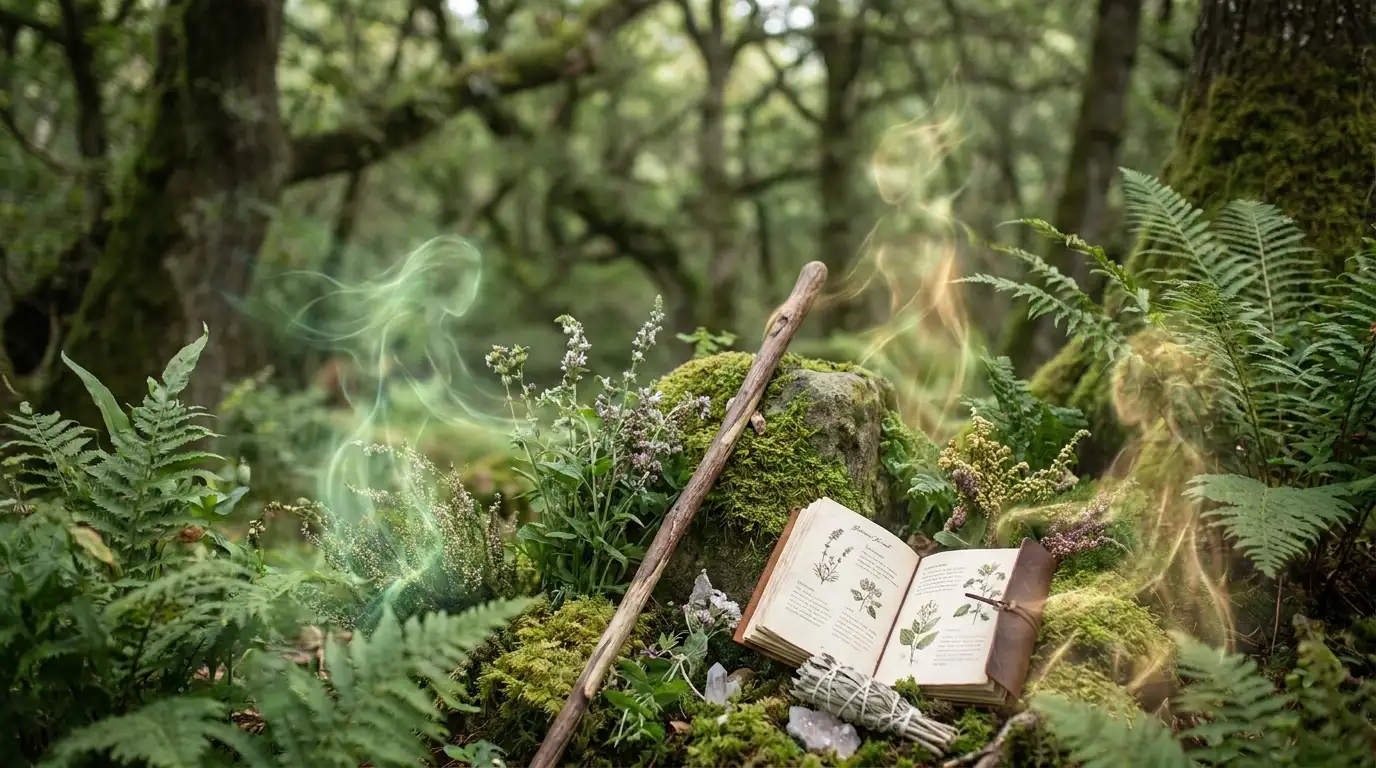
The natural world operates as a complex matrix of sentient awareness, where flora functions not merely as biological material, but as conscious entities capable of profound interaction with human practitioners. In animistic and shamanic traditions, these entities are categorized into three distinct relational groups: plant spirits represent the localized vital force residing within individual botanicals; green allies serve as collaborative partners in everyday magical and medicinal workings; and master teachers function as highly evolved non-human intelligences that guide practitioners through deep spiritual transformation and cosmic initiation. Engaging with these forces requires a synthesis of rigorous botanical knowledge, disciplined spiritual practice, and profound ecological respect.
Plant Consciousness and Communication
Plant consciousness refers to the inherent sentience, memory, and communicative capacity of the botanical kingdom. This animistic paradigm shifts the perception of plants from passive, biological automata to active, intelligent participants in the surrounding ecosystem. Practitioners recognize that vegetal intelligence operates on vibrational frequencies distinct from human cognition, requiring altered states of awareness for successful interaction.
Shamanic Herbalism and Ethnobotany
The intersection of spiritual discipline and scientific observation forms the foundation of effective plant work. Shamanic herbalism integrates the energetic properties of a plant with its physical phytochemistry, viewing disease as an imbalance of both spirit and physiology. Ethnobotany provides the empirical framework, documenting how indigenous cultures have historically cultivated, prepared, and revered local bioregional flora. By studying ethnobotanical records, contemporary practitioners reconstruct fragmented folkloric practices and ensure the culturally respectful application of indigenous medicinal plants.
Methods of Plant Communication
Plant communication bypasses standard linguistic structures, relying instead on somatic responses, subtle energy shifts, and visionary states. To establish a reciprocal dialogue with a botanical entity, practitioners utilize specific, disciplined techniques:
- Dream incubation: Sleeping with dried herbal material under a pillow to induce plant-guided lucid dreaming.
- Organoleptic testing: Sitting in meditation while slowly tasting a drop of tincture or chewing a raw leaf to decode its energetic signature.
- Drumming and trance: Utilizing steady rhythmic percussion to lower brainwave frequencies, enabling the practitioner’s astral body to interact with the plant’s auric field.
- Offerings and reciprocity: Providing water, tobacco, or compost to a living plant before harvesting its parts, establishing an energetic contract.
Green Allies and Tree Spirits
Green allies are accessible, everyday plants that form enduring, symbiotic relationships with magical practitioners. Unlike the overwhelming force of a master plant, a green ally acts as a steadfast companion, lending its specific energetic frequency to spellcraft, protection, and daily healing. These alliances are built over time through cultivation, observation, and frequent ritual integration.
Tree Spirits and Dryads
Trees possess massive, slow-moving energetic fields that anchor spiritual energy into the physical earth. Tree spirits hold ancestral memory and act as the ancient guardians of local woodlands. In European folklore, these localized intelligences were often conceptualized as dryads—female nature spirits intrinsically bound to specific species, particularly the oak. The destruction of a tree historically equated to the death of its corresponding dryad, highlighting the fragile interdependency between physical form and spiritual essence in animistic thought.
The World Tree and Yggdrasil
At the macrocosmic level, trees serve as the ultimate structural metaphor for reality itself. The world tree represents the axis mundi, the central pillar connecting the terrestrial plane with the celestial and chthonic realms. In Norse cosmology, Yggdrasil stands as the colossal ash tree whose roots and branches bind the Nine Worlds together. Shamanic practitioners routinely utilize the energetic blueprint of the world tree during trance work, traveling down its roots to access the Lower World of animal guides, or ascending its branches to reach the Upper World of celestial teachers.
Master Plants and Dietas
Master plants possess complex, highly structured spiritual architectures and demand rigorous protocols of engagement. These entities do not merely assist; they initiate, test, and rewire the practitioner’s energetic anatomy. Working with a master teacher requires absolute submission to the plant’s specific energetic frequency and teaching style.
Traditional Amazonian Dietas
The primary methodology for integrating the knowledge of a master plant is the traditional dieta. Originating in the Amazon basin, the dieta is an ascetic period of physical isolation, strict dietary restriction (typically eliminating salt, sugar, oils, spices, and sexual activity), and the repeated ingestion of a specific botanical brew.
During this vulnerable state, the practitioner’s energetic body opens, allowing the plant spirit to merge with their consciousness. The plant transmits its healing songs, known as icaros, which the curandero later uses to summon the plant’s energy during healing ceremonies. Without the discipline of the dieta, the practitioner consumes the physical chemistry but fails to secure the spiritual allegiance of the master teacher.
Entheogens and Visionary Teachers
Entheogens are psychoactive plants and fungi ingested specifically to generate a profound experience of the divine. These visionary teachers temporarily dismantle the ego, forcing the practitioner into direct, unmediated contact with the spirit world. They contain potent alkaloids that alter neurochemistry, acting as biochemical keys to locked dimensions of reality.
Ayahuasca, San Pedro, and Peyote
The most revered psychoactive sacraments originate from the indigenous cultures of the Americas. Ayahuasca, an Amazonian decoction blending the Banisteriopsis caapi vine with the DMT-containing Psychotria viridis shrub, acts as a fierce, purgative maternal intelligence. It cleanses trauma and reveals the hidden energetic web of reality.
In the Andes, the mescaline-bearing San Pedro cactus (Trichocereus pachanoi, also known as Huachuma) offers a different frequency. It is typically described as a masculine, expansive, and heart-opening teacher. Further north, Peyote (Lophophora williamsii) serves as the central sacrament of the Native American Church, facilitating grounded, communal healing and deep connection to the earth’s resonant frequency.
Psilocybin and Amanita muscaria
The mycological kingdom provides highly alien, network-based intelligences. Psilocybin mushrooms dissolve rigid psychological structures, offering hyper-dimensional teachings rooted in the concept of universal interconnectedness. Conversely, the iconic red-and-white Amanita muscaria (fly agaric) operates on completely different pharmacological pathways involving muscimol and ibotenic acid. This historically significant fungus, tied to Siberian shamanism, induces states of macropsia, micropsia, and profound bodily dissociation, requiring precise preparation to mitigate its inherent toxicity.
| Entheogen / Teacher | Primary Active Alkaloid | Shamanic Application | Energetic Signature |
|---|---|---|---|
| Ayahuasca | DMT, Harmala alkaloids | Purgation, trauma release, astral travel | Maternal, serpentine, subterranean |
| San Pedro (Huachuma) | Mescaline | Heart activation, grounding, emotional clarity | Paternal, solar, expansive |
| Psilocybin Mushrooms | Psilocybin, Psilocin | Ego dissolution, network thinking, cosmic insight | Fungal, cosmic, collective |
| Amanita muscaria | Muscimol, Ibotenic acid | Trance state, size distortion, systemic reset | unpredictable, ancient, somatic |
The Poison Path and Baneful Herbs
The poison path represents the esoteric practice of working with toxic, potentially lethal flora. This specialized branch of green magic requires meticulous dosage control, advanced pharmacological knowledge, and a fearless psychological disposition. Baneful herbs govern the domains of the underworld, spirit communication, binding, and shadow integration.
Solanaceae and Flying Ointments
The Nightshade family (Solanaceae) contains the most prominent botanical allies of traditional European witchcraft. Plants such as belladonna, datura, henbane, and mandrake contain powerful tropane alkaloids that induce profound delirium and anticholinergic toxicity when ingested.
It is believed that historically, some practitioners used to extract these lipophilic alkaloids into animal fats, creating transdermal flying ointments. Applied to mucosal membranes, these salves bypassed the first-pass liver metabolism, inducing states of profound astral projection, shapeshifting, and participation in the sabbatic trance. The poison path demands rigorous caution; these chthonic spirits are tricksters that quickly overpower the uninitiated.
Vibrational Medicine and Energetic Herbalism
For practitioners seeking gentle, non-toxic alignment with plant intelligence, vibrational medicine offers a completely safe alternative. This modality isolates the energetic blueprint of a plant without extracting its physical biochemistry.
Energetic herbalism utilizes flower essences, hydrosols, and homeopathic dilutions to treat the subtle energy body rather than the physical organism. By floating a blossom in spring water under direct sunlight, the practitioner transfers the flower’s specific vibrational frequency into the water matrix. When ingested, this liquid acts upon the human aura and chakras, dissolving emotional blockages, shifting psychological patterns, and facilitating slow, steady spiritual development guided by the gentle intelligence of the plant spirit.