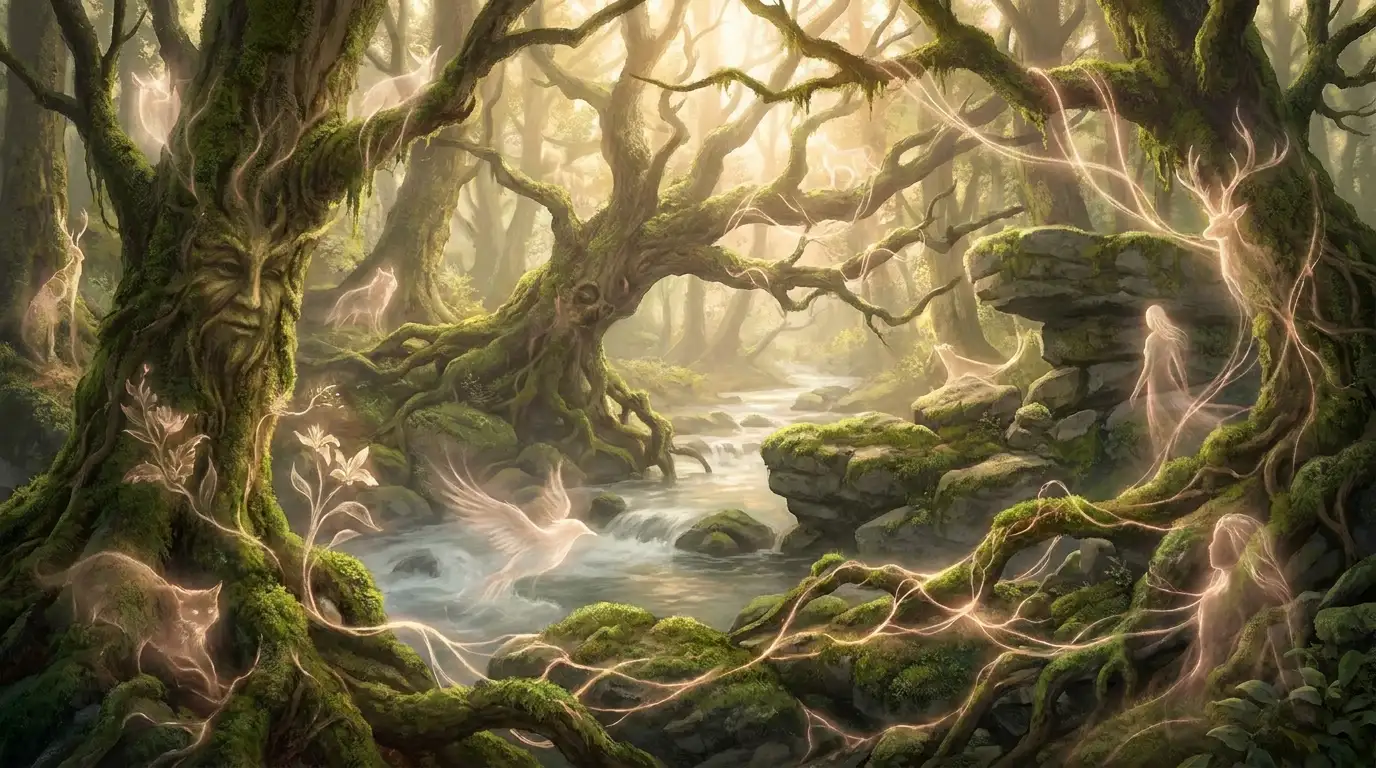
Animism represents the foundational ontology recognizing that all phenomena within the natural world possess inherent spiritual agency, individualized consciousness, and vitality. The spirit ecology of the natural world maps the complex network of energetic exchanges, alliances, and boundaries existing among humans, non-human persons, and the subtle environments they co-inhabit. Through this framework, the cosmos operates as a deeply interconnected living universe, where organic matter, inorganic substances, and atmospheric phenomena function as active participants within a unified multidimensional ecosystem.
Worldview, Ontology, and Epistemology
An animistic worldview systematically dismantles anthropocentric paradigms by redefining how knowledge is acquired, processed, and validated. The epistemology of this tradition relies on direct revelation, intuitive communion, and the empirical observation of subtle forces. Knowledge is not extracted from passive subjects but negotiated through reciprocal communication with sentient entities populating the landscape.
The Living Universe and Panpsychism
The concept of a living universe positions the cosmos as a conscious, self-regulating organism rather than a mechanistic collection of dead matter. This perspective intersects with panpsychism, a philosophical stance positing that mind or a mind-like aspect is a fundamental and ubiquitous feature of reality. However, practical animism diverges from theoretical panpsychism. While the latter suggests consciousness is a property of physical matter, animism assigns distinct personhood, specific character traits, and autonomous volition to rivers, mountains, and trees.
Hylozoism and Vitalism
Historical frameworks attempting to articulate this inherent aliveness include hylozoism and vitalism. Hylozoism, rooted in ancient Greek philosophy, asserts that all matter is intrinsically alive and dynamic. Vitalism narrows this focus, suggesting that life processes are driven by an immaterial force, a vital spark independent of physical and chemical laws. In shamanic practice, this force manifests as subtle energy, requiring practitioners to develop sensory mechanisms capable of perceiving the flow and stagnation of vitality within the local environment.
The Spirit Model and Relational Spirituality
The spirit model serves as the primary operational paradigm in core shamanism, indigenous traditions, and folk magic. This model dictates that illnesses, weather patterns, ecological shifts, and localized fortune result directly from the actions of autonomous spirit beings. Mastery within this model demands strict adherence to the protocols of relational spirituality, where human practitioners must maintain equitable alliances, negotiate treaties, and perform reparations with the unseen biosphere.
Earth-Based Spirituality and the Web of Life
Practitioners of earth-based spirituality ground their metaphysical operations in the immediate, tangible ecosystem. Rituals correspond to solar, lunar, and agricultural cycles, acknowledging the physical environment as the primary theater of spiritual evolution. The web of life represents the structural integrity of these combined relationships. It is an intricate mesh of interdependence where the vitality of an ecosystem dictates the strength of its local spirits, and conversely, the health of the spiritual domain ensures physical fertility and biological diversity.
Spiritual Taxonomy and Entity Classification
Categorizing the diverse intelligences of the environment requires a precise spiritual taxonomy. Because an animistic landscape contains countless sentient layers, practitioners must utilize robust entity classification systems to safely navigate interactions, diagnose energetic imbalances, and petition the correct local forces during ritual operations. Any change enacted in spiritual dimension is never insignificant for the other constituents.
Nature Spirits and Elemental Forces
Nature spirits govern specific geographical parameters, acting as the presiding authorities over distinct locations. These localized entities function as the genius loci, demanding localized protocols of respect and offering. Elemental forces differ significantly from localized spirits. They represent the raw, unrefined expressions of earth, air, fire, and water. While a nature spirit might inhabit a specific ancient oak tree, an elemental force manifests as the destructive power of a forest fire or the kinetic energy of a prevailing wind. What is more, as far as my experience is concerned, all natural phenomena and architecture possess their own specific collective spirit, which, certainly, can be tamed by an entity of a higher consciousness.
Object Consciousness
The parameters of animism extend beyond biological organisms to include object consciousness. Tools, megaliths, crystals, and crafted artifacts possess stable awareness. This consciousness can be intrinsic, born of the material’s geological formation, or it can be cultivated. Ritual implements gain localized agency through repeated human attention, absorbing an energetic signature that allows the object to participate actively in magical workings. Therefore, it is strongly advisable to receive any corporeal goods with careful consideration.
Energetic Interconnectedness and Magical Mechanics
The operational mechanics of an animistic ecosystem rely on continuous energetic interconnectedness. Every physical action generates a measurable ripple across the local spiritual ecosystem, and every spiritual shift eventually precipitates physical consequences, as was mentioned before. This bidirectional flow of influence forms the mechanical basis for traditional spellcraft and environmental remediation.
Sympathetic Magic and Contagion Magic
Magic within an animistic framework operates primarily through defined laws of association. Sympathetic magic utilizes the principle of similarity, expressed in the traditional adage similia similibus curantur. A practitioner manipulates a corresponding microcosm—such as an effigy or a symbolic representation—to enforce a change upon the macrocosm. Contagion magic functions on the premise of persistent linkage. Entities, biological matter, or objects once in physical contact retain a permanent energetic tether. Hair, blood and other body fluids, soil, or water sourced from a specific environment allows a practitioner to transmit force across vast spatial distances, manipulating the source through the severed fragment.
Spiritual Ecology in Practice
Applied spiritual ecology demands ethical interaction with both the seen and unseen biosphere. Practitioners treat environmental degradation not merely as a biological crisis, but as a severe metaphysical violation that displaces nature spirits and fractures the energetic grid of the region.
| Biological Ecology Concept | Spiritual Ecology Equivalent | Interaction Mechanism |
|---|---|---|
| Symbiosis | Spirit Alliance | Mutual energetic feeding; reciprocal offering exchanges. |
| Territoriality | Domain Boundary | Erecting wardings; localized spirit appeasement. |
| Keystone Species | Apex Entity | Honoring the primary regional guardian or ancestral spirit. |
| Parasitism | Energetic Attachment | Extraction of vitality by opportunistic entities; requires banishing. |
Understanding the natural world through this lens transforms passive observation into active participation. The environment ceases to be a backdrop for human activity and reveals itself as a complex society of visible and invisible intelligences. Healing the earth, therefore, requires a dual approach: applying physical conservation methods while simultaneously addressing the wounded spiritual ecology through direct, animistic engagement. Such a correlation creates greater opportunities for humans to shape their physical surroundings, as well as associated events.