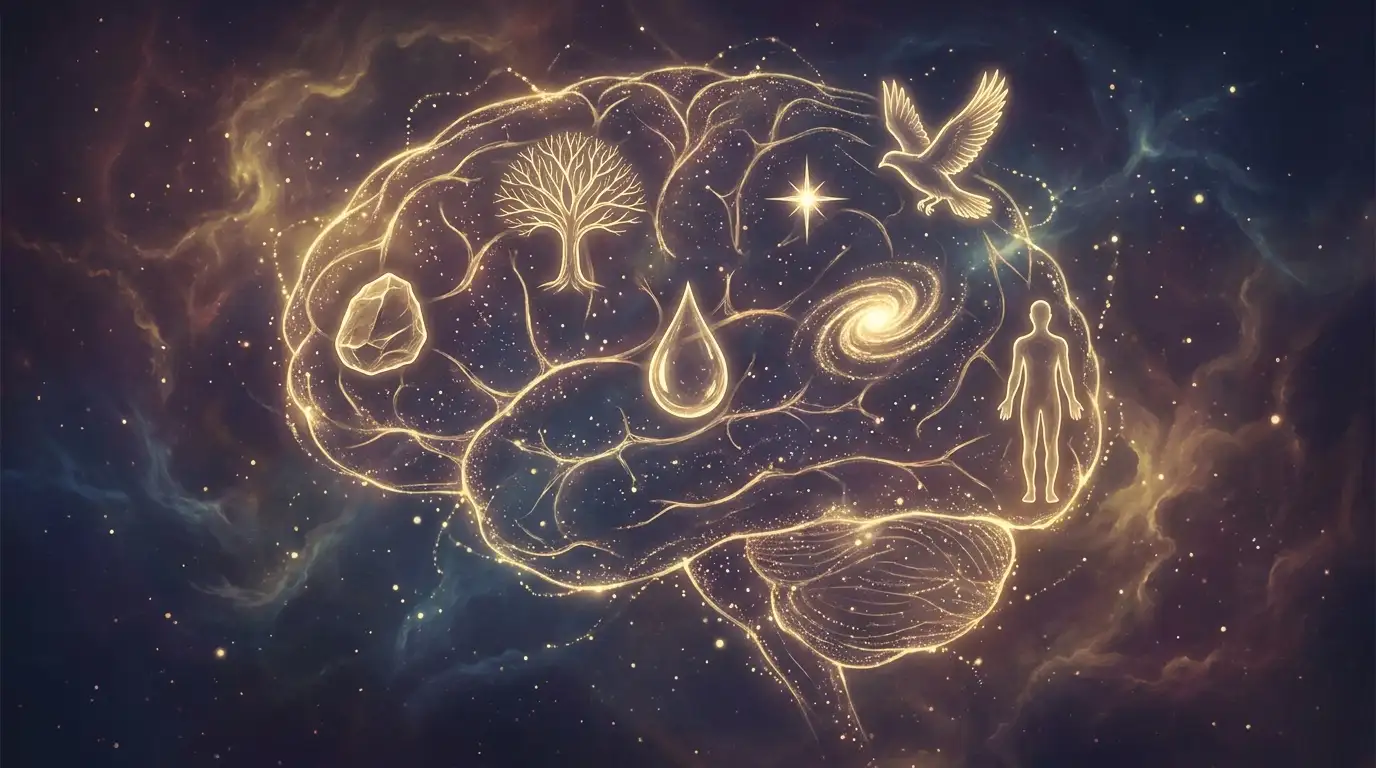
Panpsychism is the philosophical and ontological proposition that mind, soul, or consciousness is a primal, ubiquitous feature of all things. In the context of shamanic traditions, this theoretical framework materializes as a deeply practical animistic worldview. Universal consciousness permeates biological organisms, geological formations, and celestial bodies, establishing a continuous web of spiritual interconnectedness. Shamans, esoteric practitioners, and animists utilize this fundamental cosmic architecture to facilitate healing, divination, and ecological balance.
Foundational Concepts of Panpsychism and Animism
The premise that awareness saturates the physical universe supports both formal philosophical panpsychism and indigenous spiritual systems worldwide. These frameworks categorically reject the Cartesian dualism that separates conscious subjects from inert objects. Instead, they propose a unified reality governed by universal consciousness. This ontological approach redefines the fundamental nature of existence, asserting that the presence of spirit in matter is an objective, functional reality rather than a poetic metaphor.
The Animistic Worldview in Shamanic Traditions
The animistic worldview assumes that all phenomena possess a distinct, individual spiritual essence. Spiritual animism forms the methodological point of all core shamanic practice. Practitioners cross into non-ordinary reality to interact directly with the spiritual dimensions of the material world. Within this operational paradigm, object consciousness dictates that seemingly inanimate physical entities—including stones, rivers, meteorological events, and human-made artifacts—possess an interior life, memory, and agency, which, as I have experienced, sometimes leads the object to reject its brand-new owner. Shamans perceive the biosphere not as an aggregation of dead matter, but as a dynamic, living ecosystem populated by active participants engaged in a shared spiritual community.
Universal Consciousness and Spirit in Matter
Universal consciousness functions as the foundational substrate of all cosmic reality. It dictates that awareness is not an emergent property restricted to complex biological neurological systems, but an inherent, irreducible quality of matter itself. The literal embodiment of spirit in matter bridges the macrocosm and the microcosm. Indigenous cosmologies have historically recognized this ubiquitous sentience, treating the physical universe as a dense manifestation of a vast, intelligent, and highly communicative spiritual network.
Vital Force across Cultural Paradigms
Diverse cultural, esoteric, and spiritual traditions identify a foundational energetic base that animates the physical world and sustains biological life. This vital force acts as the dynamic, moving expression of universal consciousness, flowing continuously through all organic and inorganic structures. Understanding these specific cultural terminologies provides a comparative framework for how universal energy operates, circulates, sustains life, and facilitates spiritual interconnectedness across differing cosmological systems.
Manifestations of Prana, Qi, and Mana
The concept of a universal energy field appears under various specific classifications depending on geographic and cultural origins. In Vedic traditions, this force is termed prana, representing the vital, cosmic breath that sustains physiological respiration and esoteric vitality. Traditional Chinese Medicine and Daoist philosophy refer to it as qi (or chi), the essential circulating life force whose precise balance and flow through bodily meridians dictate health, harmony, and structural integrity. In Polynesian and Melanesian cultures, mana denotes a cultivatable spiritual power, efficacy, or authoritative energy that resides within specific human beings, natural objects, and geographic locations.
| Terminology | Cultural Origin | Core Functional Definition |
|---|---|---|
| Prana | Vedic / Hindu | Sustains physiological respiration and metaphysical vitality. |
| Qi | Daoist / TCM | Circulates through bioenergetic meridians to maintain health. |
| Mana | Polynesian | Cultivates authoritative spiritual power and ecological efficacy. |
Modern Interpretations: Science and Spirituality
The gradual convergence of modern scientific theories with ancient shamanic principles offers comprehensive new paradigms for understanding objective reality. Concepts drawn from theoretical quantum physics and advanced environmental philosophy increasingly parallel the traditional animistic understanding of a conscious, interconnected universe. This interdisciplinary intersection validates the functional mechanics of energetic resonance and provides a contemporary, empirical vocabulary for describing the living Earth.
Quantum Entanglement and Energetic Resonance
Quantum entanglement describes a verified physical phenomenon where subatomic particles remain inextricably interconnected, ensuring that the physical state of one instantly influences the state of another, regardless of spatial distance. In shamanic healing frameworks, this physical reality mirrors the esoteric principle of energetic resonance. Distant healing, soul retrieval, and trans-dimensional spiritual communication occur through an underlying, non-local web of energetic connection. Both scientific and shamanic paradigms suggest a unified non-local reality where absolute separation is a sensory illusion, validating the shamanic experience of altering physical reality via interactions in the spirit world.
Deep Ecology and Sacred Ecology
Deep ecology represents a modern environmental philosophy that promotes the inherent, intrinsic worth of all living beings and ecosystems, explicitly regardless of their instrumental utility to human needs. When this philosophy is integrated with active shamanic practice, it naturally evolves into sacred ecology. This specific framework recognizes the Earth (Gaia) as a highly conscious, macro-level living entity. Sacred ecology demands strict ethical interaction with the physical environment, grounded heavily in the recognition of universal consciousness and the inherent spiritual rights of the broader ecological network.
Shamanic Spiritual Entities and Sentient Landscapes
Shamanic traditions actively engage with a heavily populated, highly intelligent universe. The geographic environment is not merely a static, unthinking backdrop for human activity, but an interactive, responsive network of conscious beings. Operating effectively within this paradigm requires the practitioner to navigate complex relationships with diverse spiritual entities and to recognize the localized intelligence permanently embedded within specific topographies.
Engaging with Non-Human Persons
Anthropological literature and core shamanic terminology frequently classify active spiritual beings as non-human persons. These shamanic spiritual entities encompass a broad taxonomy of consciousness:
- Animal spirits: Archetypal power animals providing protection, guidance, and specific instinctual wisdom.
- Plant devas: The localized consciousness and healing intelligence residing within botanical lifeforms and medicinal entheogens.
- Elemental forces: The governing spiritual energies dictating the behavior of earth, air, fire, and water.
- Ancestral spirits: The persisting energetic signatures and consciousness of deceased human practitioners and lineage holders.
These entities possess distinct personalities, independent volition, and specialized knowledge. Shamanic practitioners deliberately enter altered states of consciousness to communicate, negotiate, and collaborate directly with these non-human persons for purposes of clinical and spiritual healing, community divination, and maintaining cosmic balance.
The Intelligence of Sentient Landscapes
The physical geographic environment operates as a living, breathing organism composed entirely of sentient landscapes. Mountains, ancient forests, cave systems, and specific bodies of water hold intense localized consciousness, acting as vast repositories for historical, energetic, and spiritual memory. Shamans interact with these terrestrial formations by observing natural omens, performing energetic land clearings, and executing ritual offerings to local territorial guardians. Acknowledging and serving these sentient landscapes remains vital for understanding the broader, practical implications of spiritual animism. It firmly anchors the highly abstract philosophical concept of panpsychism into tangible, localized, and actionable Earth-based practices.