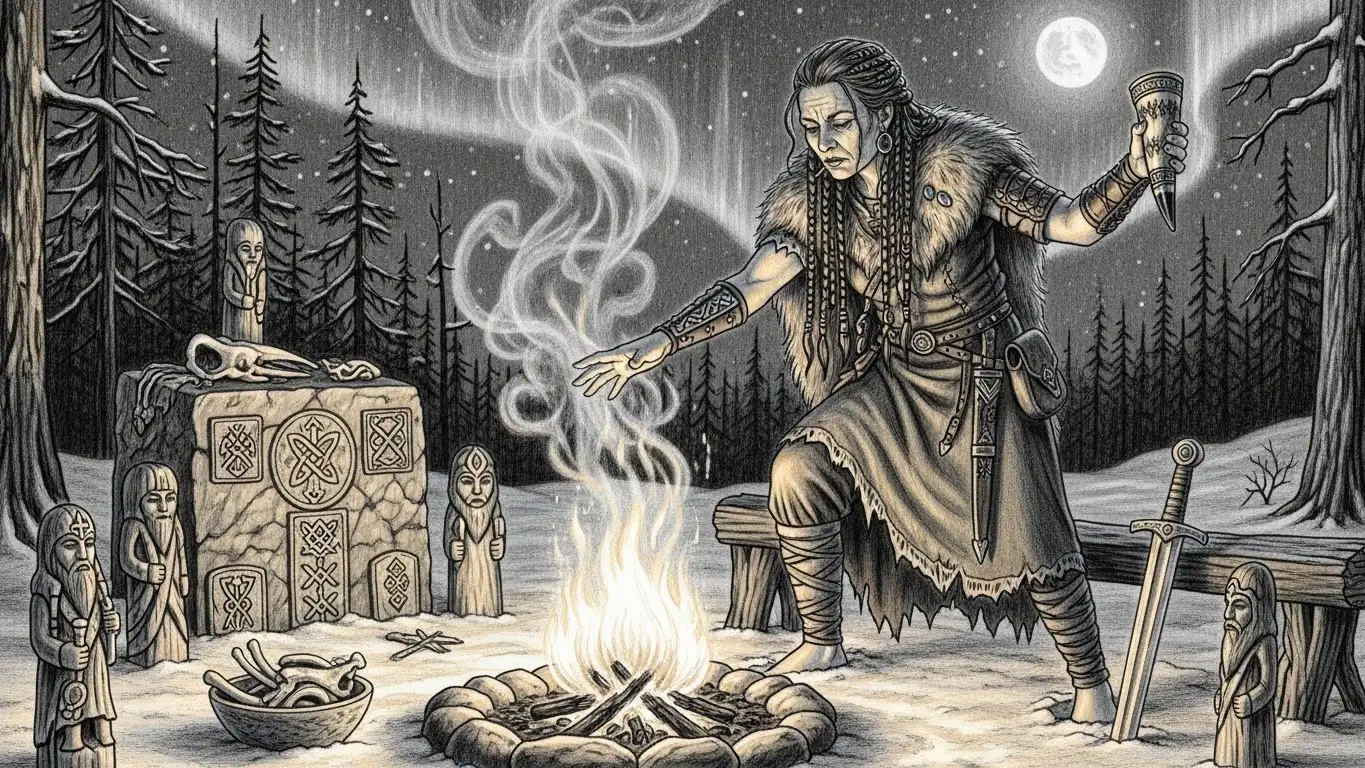
In the Northern Tradition, the Blót is the primary engine of ceremonial Runic Magick. Etymologically linked to “blood,” it is strictly a transactional ritual designed to strengthen the bond between the adept and the spiritual ecology. Unlike prayer, which is a petition, a Blót is an energetic exchange: the magus provides physical resources (energy/matter), and the entities provide Megin (power/luck) or Wyrd-alteration in return.
To perform effective enchantment within this paradigm, one cannot simply stand in a living room and chant; one must construct a Vé—a sacred enclosure where the laws of physics are temporarily suspended in favor of the laws of magick. This ritual structure creates a “clean room” environment, separating the ordered sanctity of the Innangard from the chaotic noise of the Utangard.
Establishing the Vé (The Sacred Enclosure)
The creation of the Vé is the first act of will. It carves out a pocket of reality dedicated solely to the working. This is not merely about privacy; it is about containment.
The Hammer Rite (Hamarsmark)
The most common method of hallowing is the Hammer Rite. Facing each cardinal direction (typically starting North), the adept traces the sign of the Hammer (an inverted T shape, invoking Thor or Thurisaz) in the air. This is an act of martial banishing. It pushes back hostile wights and creates a perimeter of defense.
- North: “Hammer in the North, hallow and hold this holy stead.”
- East/South/West: Repeated accordingly.
- Center: The hammer is traced overhead (for the Sky/Aesir) and below (for the Earth/Vanir).
Circumambulation
Following the hallowing, the magus often walks the perimeter of the space sunwise (deosil) carrying fire (a candle or torch) or the Hlauttein (sprinkling twig). This “treads the mill,” spinning the energy of the circle and establishing the boundary between the mundane and the holy.
The Mechanics of the Hlautbolli
Central to the Blót is the Hlautbolli (Offering Bowl). In terms of magickal enchantment, this vessel functions as the capacitor. It holds the liquid medium—usually mead, ale, or cider—which will absorb the energy raised during the rite.
The Hlauttein and Asperging
The Hlauttein is a twig, traditionally of evergreen (fir or spruce) to represent eternal life, used as an aspergillum. During the ritual, the magus dips the twig into the charged liquid in the bowl and sprinkles it over the altar (Stallah), the tools, and the participants. This act, known as “reddening,” distributes the blessed energy (now infused with the power of the gods) onto the physical plane. It creates a sympathetic link, binding the Vé, the tools, and the adept into a single energetic circuit.
Offerings and Deific Correspondences
The fuel for the Blót is the offering. The eclectic witch understands that the offering must sympathetically match the frequency of the entity being invoked. Offering light, fruity wine to Thor (a god of labor and muscle) creates a dissonance; he requires substance.
| Entity | Domain | Traditional Offering | Modern Eclectic Offering |
|---|---|---|---|
| Odin | Wisdom, Magick, War | Wine, mead, ale. | High-quality red wine, dark stout, whisky, tobacco. |
| Thor | Protection, Strength | Meat, dark beer, bread. | Porter/Stout, hearty meals, physical exercise dedicated to him. |
| Freyja | Love, Seidr, War | Sweet mead, pork, amber, flowers. | Sweet cider, honey, jewelry, perfume, erotic energy. |
| Freyr | Peace, Prosperity | Grain, bread, antlers. | Barley wine, organic produce. |
| Landvaettir | Local Spirits | Cream, porridge, butter. | Milk, coins, bird seed. |
| Ancestors | Lineage/Memory | Food from their era, water. | Family recipes, coffee, whiskey, photos. |
The Sumbel: Verbal Enchantment
While the Blót is the sacrifice, the Sumbel is the verbal working. It is a ritual toast where the cup is passed (or raised), and words are spoken over the liquid. In the Northern cosmology, words spoken over the Horn are heavy; they sink into the Well of Urd and become Orlog.
The Three Rounds
- First Round: To the Gods. The magus hails the deity, establishing the vertical connection.
- Second Round: To the Ancestors/Heroes. The adept honors those who came before, drawing on their Hlaut (heritage/luck).
- Third Round: The Bragafull (promise-cup). This is the round of the oath or the spell. The adept states their intent clearly: “I shall achieve [goal] by [time].” By drinking the mead after speaking, the magus internalizes the oath, making it a part of their physical substance. This is a potent form of self-geas or binding spell.
Closing the Rite
The ritual concludes with the Libation. The remaining liquid in the Hlautbolli—now supercharged with the energy of the Blót and the words of the Sumbel—is not drunk but poured directly onto the earth (or into a dedicated bowl to be poured outside later). This is the final transaction: the energy is grounded into the soil to manifest in Midgard. The magus declares “It is done,” thanks the entities, and formally dissolves the Vé, returning the space to the mundane timeline.