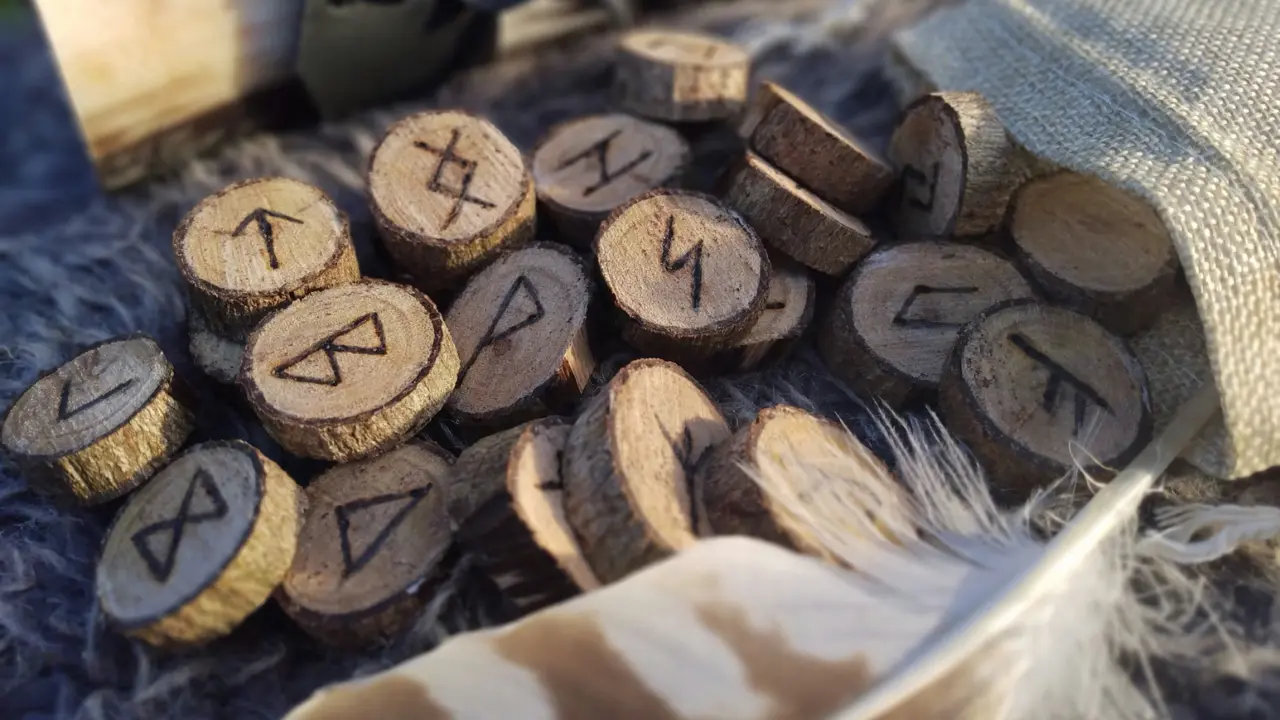
To understand Runic Magick, one must distinguish between the historical evolution of the script and its mythological genesis. While archaeology traces the shapes to Italic alphabets, the esoteric tradition traces the soul of the runes to a single, transformative initiatory ordeal: the self-sacrifice of the god Odin. This narrative, preserved in the Hávamál, describes a shamanic ordeal of such intensity that it shattered the barriers between the mundane and the divine, allowing the All-Father to perceive the underlying code of reality. The runes were not invented; they were ripped from the void through pain and focused will.
The Hávamál and the Rúnatal Narrative
The primary source for this myth is the Rúnatal (Rune-Tale), a section within the Hávamál (“Sayings of the High One”).
The text describes Odin hanging on a “windswept tree”—universally identified as Yggdrasil—for nine distinct nights. This duration is numerologically significant, as nine is the number of the worlds and a number of completion in Norse cosmology. The phrase “myself given to myself” (sjálfur sjálfum mér) defines the nature of this ritual. It was not a sacrifice to an external deity for favor, but a recursive loop of energy where the sacrificer and the recipient were identical. This dissolution of the subject-object dichotomy is a hallmark of high mysticism.
Comprising stanzas 138 to 145 of the Hávamál, the Rúnatal section recounts Odin’s self-sacrifice on Yggdrasil. Within this sequence, stanza 138 explicitly states that no one knows from what roots the windswept tree rises, emphasizing the cosmic, primeval scale of the World Tree.
The Shamanic Initiation on Yggdrasil
The ordeal was physical and brutal. Odin states he was “wounded with a spear” (his own weapon, Gungnir) and given “no bread and no horn.” This deliberate deprivation mirrors the fasting and mortification practices found in global Shamanic traditions intended to induce altered states of consciousness.
The climax of the ritual occurs when Odin peers downward into the abyss below the tree. He does not gently receive the wisdom; the text says he “took them up, screaming”. The act of seizing the runes was a violent cognitive breakthrough. The “scream” represents the release of the ego and the vibration of the first Galdr (magical chant), anchoring the runic symbols into the physical voice.
Following this breakthrough, Odin recalls learning nine mighty chants from his maternal uncle—the famed son of the giant Bölþorn. This ancestral transmission triggered a physical and intellectual resurrection, enabling the All-Father to grow, thrive, and multiply word from word.
The Well of Urd and the Norns
The roots of Yggdrasil dip into the Well of Urd, the reservoir of cosmic potential. It is here that the Norns dwell. These three powerful female entities—Urd (That Which Is/Past), Verdandi (That Which Is Becoming/Present), and Skuld (That Which Should Be/Future/Debt)—are the true custodians of the runes.
In the mythos, the Norns do not merely weave fate; they carve it. They cut runic staves into wood and drop them into the well, layering the destiny (Orlog) of gods and men. Odin’s sacrifice allowed him to hack into this system. He did not gain power over the Norns, but he gained the literacy to read their carvings and the capacity to cut his own, thereby influencing the flow of Wyrd.
This destiny-shaping act is attested in stanza 20 of the Eddic poem Völuspá, which specifies that the Norns carve marks upon wooden staves (Skíði) to establish laws, determine the fates of men, and declare the life spans of mortals.
Þaðan koma meyjar (Thence come maidens)
margs vitandi (much knowing)
þrjár ór þeim sal (three from that hall)
er und þolli stendr; (which stands under the tree;)
Urð hétu eina, (Urð they called one,)
Verðandi aðra, (Verðandi the second,)
—skáru á skíði— (—they carved on wood—)
Skuld ina þriðju; (Skuld the third;)
þær lög lögðu, (they laid down laws,)
þær líf kuru (they chose life)
alda börnum, (for the children of ages,)
örlög seggja. (the fates of men.)
The Mead of Poetry (Oðrerir)
The acquisition of runes is intrinsically linked to another myth: the Mead of Poetry. While runes represent the structure of magick (the letters/staves), the Mead represents the flow or inspiration (Óðr).
The Mead was created from the blood of the wise being Kvasir, mixed with honey. It was hoarded by the giant Suttungr inside a mountain. Using shape-shifting and guile, Odin seduced the giant’s daughter, Gunnlöð, and drained the entire hoard of mead in three immense drafts from the vessels Óðrerir, Boðn, and Són. This substance grants the drinker the ability to compose poetry and wield scholarship. In Runic Magick, this signifies that technical knowledge of the symbols (the Runes) is useless without the ecstatic, fluid force of inspiration (the Mead) to activate them.
The Runecaster’s Creed: Stanza 144
A fundamental blueprint for historical runic ritual is outlined in stanza 144 of the Hávamál, often called the Runecaster’s Creed. It presents a series of eight diagnostic questions:
Veistu, hvé rísta skal? (Knowest thou how one shall carve?)
Veistu, hvé ráða skal? (Knowest thou how one shall read?)
Veistu, hvé fáa skal? (Knowest thou how one shall stain?)
Veistu, hvé freista skal? (Knowest thou how one shall test?)
Veistu, hvé biðja skal? (Knowest thou how one shall ask?)
Veistu, hvé blóta skal? (Knowest thou how one shall sacrifice?)
Veistu, hvé senda skal? (Knowest thou how one shall send?)
Veistu, hvé sóa skal? (Knowest thou how one shall destroy?)
This formal catechism shifts runic work from intellectual study to a visceral, active cycle of marking, coloring with pigment, and sacrificial exchange.
The Ljóðatal: The Eighteen Spells
Following the acquisition of the runes, the Hávamál lists eighteen specific spells or songs (the Ljóðatal) that Odin mastered. These are not recipes but descriptions of power. They include charms for healing, blunting enemy weapons, breaking fetters, stopping arrows in flight, and calming waves.
The 18th spell remains a secret, serving as an unshared hoard of power that Odin closely guards to maintain his cosmic monopoly on supreme wisdom. This catalog of supernatural abilities demonstrates that the ultimate goal of Odin’s self-sacrifice on the tree was the acquisition of highly practical, reality-bending tools to command authority, protect his allies, and preserve his divine sovereignty.
This magickal catalog spans stanzas 146 to 164 of the poem. Its twelfth spell is especially famous, granting Odin the ability to color and carve runes that compel a hanged corpse on a gallows to walk and speak, reinforcing his connection to his own self-hanging and his role as the Gallows-God (Hangatýr).
The Cosmic Scribes of the Realms
The esoteric scope of runic literacy spans far beyond human reach. Stanza 143 of the Hávamál establishes the runes as a pan-cosmic language, listing the specific figures who carved them for each race. Odin carved among the Æsir, Dáinn for the elves, Dvalinn for the dwarfs, and Ásviðr for the giants. The narrator then concludes the stanza with the phrase, “I carved some myself,” highlighting the mysterious nature of the speaker. This cosmic distribution reveals that Runic Magick operates as a structural law shared across all sentient realms.