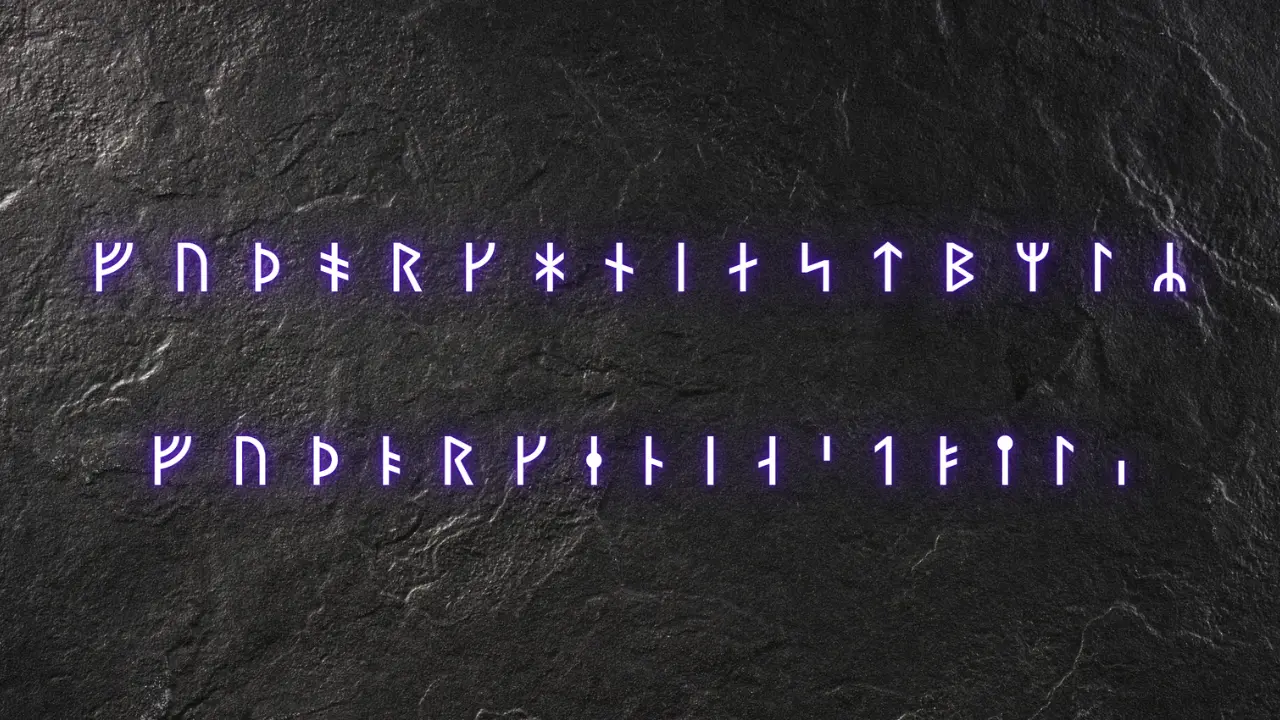
The Younger Futhark marks the era where the runic script ceased to be a purely magical curiosity and became the engine of the Viking Age. Emerging around 800 AD, this system represents a radical departure from the ancestral Elder Futhark. While the Elder row was characterized by phonetic precision and esoteric symmetry, the Younger row was defined by ambiguity and efficiency. It was a script forged for a society that was building ships, trading across continents, and carving monuments that needed to be read by the masses. The transition to the Medieval Runes (or Futhork) centuries later demonstrates the remarkable adaptability of this system, as it mutated to survive the encroaching dominance of the Latin alphabet and the Christian church.
The Great Reduction: 24 to 16 Runes
To the uninitiated, it seems backward that a culture would reduce its alphabet while its language (Old Norse) was becoming more complex. Yet, between the 7th and 8th centuries, the Norse did exactly that, culling the 24 runes down to just 16.
This shift was driven by Syncope—a linguistic phenomenon where unstressed vowels were swallowed up by the language. Trisyllabic words became monosyllabic. As the language condensed, the script followed suit. The result was a system of Phonetic Compression:
- The Ur rune (ᚢ) now represented /u/, /o/, /v/, and /y/.
- The Iss rune (ᛁ) covered /i/ and /e/.
- The Kaun rune (ᚴ) stood for /k/, /g/, and /ng/.
This ambiguity meant that reading runes required active interpretation. The reader had to know the context to decide if ᚴᚢᚾᚢᚴᚱ (kunukr) meant “King” or something else entirely. It shifted the burden of clarity from the writer to the reader.
The Two “Fonts” of the Viking Age
The Younger Futhark was not a monolith. It manifested in two distinct graphic forms, often described by runologists as analogous to modern “fonts” or typefaces.
| Long-branch Runes | Short-twig Runes |
|---|---|
| ᚠ ᚢ ᚦ ᚬ ᚱ ᚴ ᚼ ᚾ ᛁ ᛅ ᛋ ᛏ ᛒ ᛘ ᛚ ᛦ | ᚠ ᚢ ᚦ ᚭ ᚱ ᚴ ᚽ ᚿ ᛁ ᛆ ᛌ ᛐ ᛓ ᛙ ᛚ ᛧ |
Long-branch Runes (also known as Danish Runes) were the formal script. Characterized by full-length vertical staves, these were the “Times New Roman” of the Viking world. They were primarily used for monumental inscriptions on granite runestones, designed to be visible, durable, and prestigious.
Short-twig Runes (also known as Swedish-Norwegian or Rök Runes) were the functional script. In this variant, the vertical staves were often truncated or removed, and the branches were simplified. This was the “Cursive” of the era—a rapid-fire script designed for carving into wood (which resists curved lines) or scratching onto bone. A trader marking his goods or a messenger carrying a rune-stick would almost exclusively use Short-twig.
In the region of Hälsingland, an even more extreme variant emerged: Staveless Runes. These characters omitted the vertical lines entirely, relying solely on the angle and position of the “branches” to convey meaning. This functioned as a sophisticated stenography or cipher, implying that runic literacy in some areas was high enough to support a “shorthand” code.
Literacy and Daily Usage
For decades, historians believed runic literacy was restricted to a priestly class of Erilaz. The archaeological discoveries at Bryggen in Bergen, Norway, shattered this myth. Following a fire in 1955, archaeologists uncovered hundreds of wooden rune-sticks preserved in the mud.
These were not magickal spells. They were the SMS text messages of the 12th and 13th centuries.
- “Gyda says you should go home.”
- “Darling, kiss me.”
- Business tags attached to sacks of yarn or dried fish.
These finds prove that the Younger Futhark and its medieval descendants were the working script of the common people. Literacy was likely functional and widespread—farmers, merchants, and women used runes to navigate daily life, separate from the Latin literacy of the clergy.
Medieval Runes and the Latin Interaction
As Christianity took hold in Scandinavia (c. 1000–1100 AD), the runic script faced an existential threat: the Latin alphabet. Latin was the script of God, the Church, and the King’s law. It possessed a precision that the ambiguous 16-rune Younger Futhark lacked.
The Norse response was the invention of Dotted (Stung) Runes. By placing a dot (or “sting”) on a rune, carvers could split its phonetic value.
- Tiwaz (T) + dot = D.
- Kaun (K) + dot = G.
- Bjarkan (B) + dot = P.
This innovation expanded the character count to roughly 27, allowing runes to match the Latin alphabet letter-for-letter. This hybrid system, known as the Medieval Futhork, allowed the runic tradition to survive for another three centuries, utilized in everything from the legal text of the Codex Runicus (c. 1300) to church bells and grave slabs.
The End of the Runic Era
Despite the adaptation of dotted runes, the administrative power of the Latin script eventually won out. By the 15th century, runes had largely disappeared from official use, retreating into the realm of Folk Magick and rural tradition. In isolated pockets like Dalarna, Sweden, a variant known as Dalecarlian Runes continued to be used for calendars and private notes well into the 19th century, a final echo of the Viking Age’s most enduring technology.