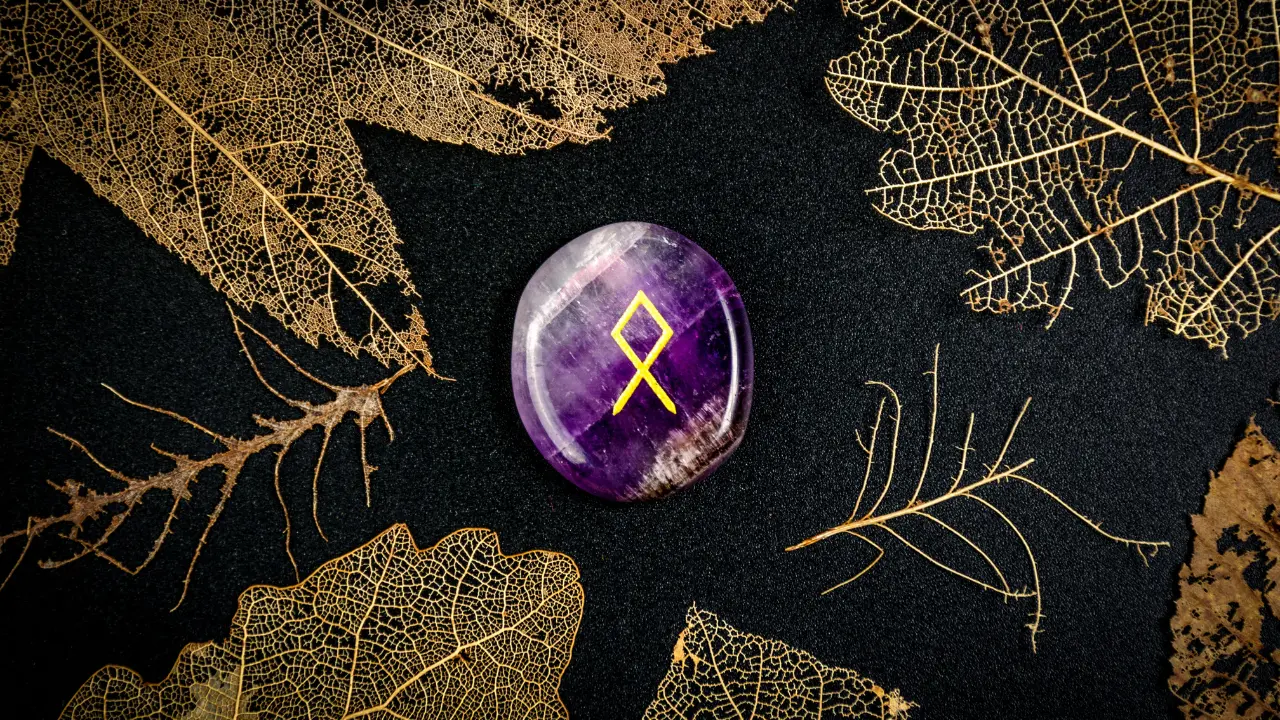
Within Runic Magick, protection is rarely about hiding. The Norse worldview was martial and fatalistic; therefore, runic defense mechanisms are designed not merely to block harm but to redirect it, absorb it, or actively punish the aggressor. Whether guarding a home against malevolent spirits (Landvaettir) or shielding the psyche from modern negativity, the Elder Futhark offers a sophisticated arsenal of Apotropaic tools. The effective Vitki understands that true safety comes from a blend of awareness (Algiz), endurance (Eihwaz), and reactive force (Thurisaz).
| Rune | Translation | Defense Type | Mechanism | Modern Application |
|---|---|---|---|---|
| Algiz | Elk/Sedge | Passive/Alert | Connection to the Divine; expanding the aura to sense threats. | Warding the home; intuition; “Early Warning.” |
| Eihwaz | Yew Tree | Endurance | Absorb and ground; spiritual toughness; non-reaction. | Protection against curses; stabilizing energy. |
| Thurisaz | Thorn/Giant | Active/Aggressive | The “Thorn Hedge”; inflicting damage on the attacker. | Breaking hexes; “Return to Sender” spells. |
| Isa | Ice | Blocking | Freezing the situation; creating a wall of indifference. | “Gray Rocking”; stopping harassment; invisibility. |
| Othala | Estate | Boundary | Defining the perimeter; “Us vs. Them.” | Property protection; family safety. |
The Primary Defensive Trinity
While many runes can be employed defensively depending on intent, three stand out as the pillars of runic warding. Each operates on a different energetic frequency, dealing with threats in a distinct manner.
Algiz: The Sanctuary and Divine Connection
Algiz (or Elhaz) is the quintessential rune of protection, but it is often misunderstood as a simple shield. Visually representing the Elk-sedge grass or the antlers of the elk, its primary function is Awareness. An elk survives not by fighting the wolf, but by smelling it miles away.
Magickally, Algiz works by expanding the practitioner’s sensory field and strengthening their connection to the Fylgja (guardian spirit) or the divine. It creates a “Sanctuary” space. If you are standing in the center of Algiz, you are in the eye of the storm. It does not stop the war, but it ensures you are not a casualty of it. It is best used for general spiritual hygiene and maintaining a link to one’s Higher Self during times of crisis.
Eihwaz: The Unbreakable Spine
If Algiz is the radar, Eihwaz is the bunker. Associated with the Yew Tree—the wood from which the best Viking bows were made—this rune represents resilience and the Axis Mundi. The Yew is toxic, evergreen, and incredibly hard; it bends but does not break.
In a defensive context, Eihwaz provides the power of “Grounding.” When under psychic attack, the instinctive reaction is often fear or scattering. Eihwaz counters this by rooting the practitioner deep into the underworld and high into the heavens. It makes the aura dense and impenetrable. It is the rune of the “Spiritual Spine”—the ability to endure hardship without losing one’s structural integrity.
Thurisaz: The Thorn Hedge
Thurisaz is the most dangerous of the defensive runes because it is Active Defense. It translates to “Thorn” or “Giant.” A thorn hedge does not just stop an intruder; it hurts them.
This rune embodies the chaotic, reactive force of the god Thor. It is the “Porcupine Defense.” When Thurisaz is projected outward, it acts as a breaker of hostile magic. It shatters incoming curses and reflects malice back to the source. However, it requires precise control; an undirected Thurisaz can create conflict in the magician’s own life. It is the weapon drawn, not the shield raised.
Historical Apotropaic Usage
The Germanic peoples did not view magic as separate from daily life. Apotropaic (evil-averting) magic was woven into the fabric of their material culture. The most common evidence of this is the Bracteate—thin gold medallions worn as amulets during the Migration Period.
Many of these artifacts bear the runic formula ALU (Ansuz, Laguz, Uruz). While the exact translation is debated, it is widely accepted as a charm word for protection and consecration, effectively meaning “Magic/Protection/Ale.” Inscriptions were also carved on the inside of shield bosses and on sword scabbards. The logic was tactile: by gripping the runes, the warrior activated them. Threshold magic was also prevalent; carving runes like Othala or Algiz on doorposts served to filter the spirits entering the dwelling, ensuring only those with “Frith” (peace/friendship) could pass.
Constructing Shield Bindrunes
A Bindrune involves layering or combining multiple runes into a single sigil to create a complex energetic circuit. For protection, the goal is to combine the awareness of Algiz with the boundary of another rune.
One classic construction is the “Secure Home” bindrune:
- Start with Othala (The Estate/Home) as the base.
- Project an Algiz rune from each of the four corners (or the top roof) of the Othala.
- This creates a sigil that defines the property (Othala) and sets up a radar/defense array (Algiz) facing outward in all directions.
It is crucial to differentiate these practical bindrunes from the Icelandic Staves (Galdrastafir) like the Helm of Awe (Aegishjalmur). While powerful, the Helm of Awe is a much later medieval invention designed to strike terror into enemies, rather than a purely protective Elder Futhark construction.
Modern Defensive Applications
In the modern era, the threats are less often physical raiders and more often psychological stress, “energy vampires,” or digital harassment. Runic defense is remarkably adaptable to these contexts.
Isa (Ice) is particularly effective for “Gray Rocking”—a psychological technique used to deal with narcissists or harassers by becoming uninteresting and unresponsive. Visualizing a wall of Isa runes between oneself and the aggressor cools the emotional heat and creates a barrier of indifference.
For the home, many Eclectic Witches use “Reddening” rituals. This involves carving defensive runes (like Elhaz or Eihwaz) onto wooden stakes or stones and painting them with red ochre (or a drop of one’s own blood for a strong link). These warding stones are then buried at the four corners of the property, creating an energetic fence that mirrors the ancient “Land-taking” rituals of the Norse settlers.