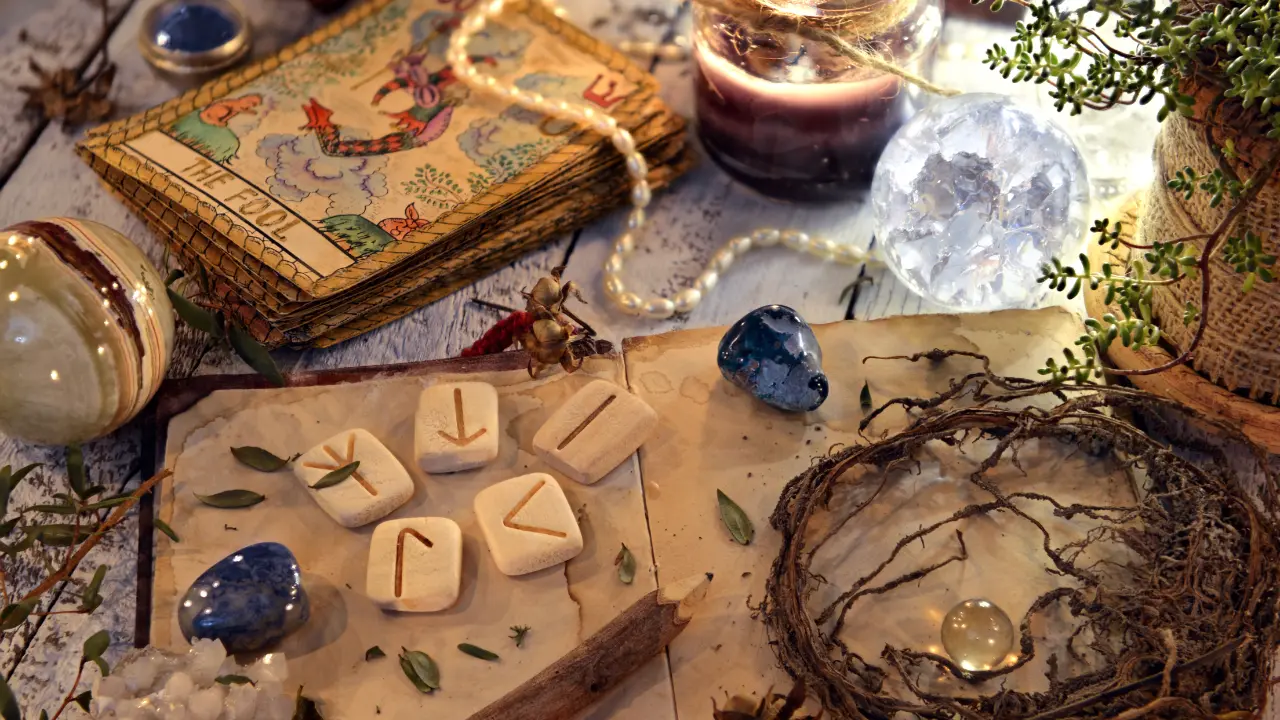
Rune Casting differs fundamentally from card-based methods in its reliance on kinetic chaos. While cards are shuffled and placed in static positions, runes are traditionally thrown onto a prepared surface, allowing the physics of the fall to determine their relationships. The adept does not merely read the symbol; they read the distance, the angle, and the clusters formed by the staves. This kinetic element mimics the chaotic interplay of Wyrd, where events collide and scatter rather than adhering to a rigid grid.
For the modern Vitki, mastery involves understanding both the “Free Cast” (interpreting clusters) and the “Grid Layout” (assigning positions). The choice of method depends on the complexity of the query: a single rune cuts through noise for a quick answer, while the Nine Worlds layout provides a comprehensive MRI of the querent’s entire spiritual ecosystem.
Divination Mechanics
In Runic Divination, the physical setup of the cast establishes the boundary of the reading. Without a defined perimeter, the energy dissipates.
The Stall (Casting Cloth)
The Stall is a white linen or leather cloth that acts as the canvas of manifestation. It separates the sacred space (Vé) from the mundane table. In kinetic casting, the cloth represents the “Field of Probability.” Runes that fall off the cloth are considered “Out of Play” or outside the current influence of Wyrd.
Directional Alignment
Traditional casting often mandates facing North, towards the pole star (Polaris), which represents the fixed pivot of the cosmos and the element of Ice/Magnetism. This aligns the reader with the Norns and the Well of Urd. However, some eclectic practitioners prefer facing East to align with the rising sun (Sowilo) for questions regarding new beginnings, health, or illumination. The magus must consciously choose the direction to tune the frequency of the reading.
The Single Rune Pull (Odin’s Rune)
The simplest diagnostic is the single draw, often termed “Odin’s Rune.” This is not a prediction but a frequency check.
The adept reaches into the pouch, stirring the runes to activate Önd (breath/spirit) and break static energy. A single stave is drawn to represent the “Keynote” of the situation. This method is best for binary questions (“Should I proceed?”) or daily guidance. If Thurisaz is pulled, the day requires defensive caution; if Wunjo, it invites social connection. It cuts through analysis paralysis by providing a singular focal point.
The Three Norns Spread
While superficially similar to the “Past-Present-Future” spread of Tarot, the Three Norns layout operates on the principle of stratification rather than linearity.
- Urd (That Which Was): This is not just “the past”; it is the Orlog or root cause. It is the sediment that created the current terrain.
- Verdandi (That Which Is Becoming): This is the active present moment where the querent has agency. It is the weaving process.
- Skuld (That Which Should Be): This is not a fixed future. It is the debt or consequence that inevitably follows if Verdandi is not altered.
Distinct from Tarot
In Tarot, the “future” card is often read as an event arriving from the outside. In Runic Magick, Skuld is read as an extrusion of Urd. You cannot change Skuld without addressing Urd. The reading focuses on the bleed between the positions—how the trauma of the past (Urd) is actively sabotaging the present action (Verdandi).
The Nine Worlds Layout
For deep psycho-spiritual analysis, the Nine Worlds layout maps the runes onto the cosmology of Yggdrasil. The Vitki visualizes the cloth as the World Tree or physically draws the zones. A rune is drawn for each world to diagnose that specific aspect of the querent’s life.
| World | Domain of Inquiry | Example Interpretation |
|---|---|---|
| Asgard | Higher Self, Divinity, Spiritual Purpose. | Ansuz: A calling to teach or communicate. |
| Alfheim | Mental Faculty, Inspiration, Intellect. | Kenaz: A breakthrough idea or clarity. |
| Vanaheim | Peace, Balance, Organic Growth. | Jera: Patience is required; slow growth. |
| Midgard | Physical Reality, Day-to-Day Life, Ego. | Fehu: Financial matters are central. |
| Muspelheim | Passion, Action, Drive, Conflict. | Sowilo: Burning success or burnout. |
| Niflheim | Rest, Stagnation, Unconscious Blockages. | Isa: A need to pause or emotional freezing. |
| Jotunheim | External Forces, Chaos, Challenges. | Hagalaz: Sudden disruption from outside. |
| Svartalfheim | Subconscious, Formation, Resources. | Uruz: Raw potential needing shaping. |
| Helheim | Ancestors, Deepest Hidden Issues, Death. | Othala: Ancestral inheritance or trauma. |
This layout allows the magus to see where a problem lies. A querent might be financially successful (Midgard shows Fehu) but spiritually bankrupt (Asgard shows Nauthiz). It provides a holistic MRI of the soul complex.