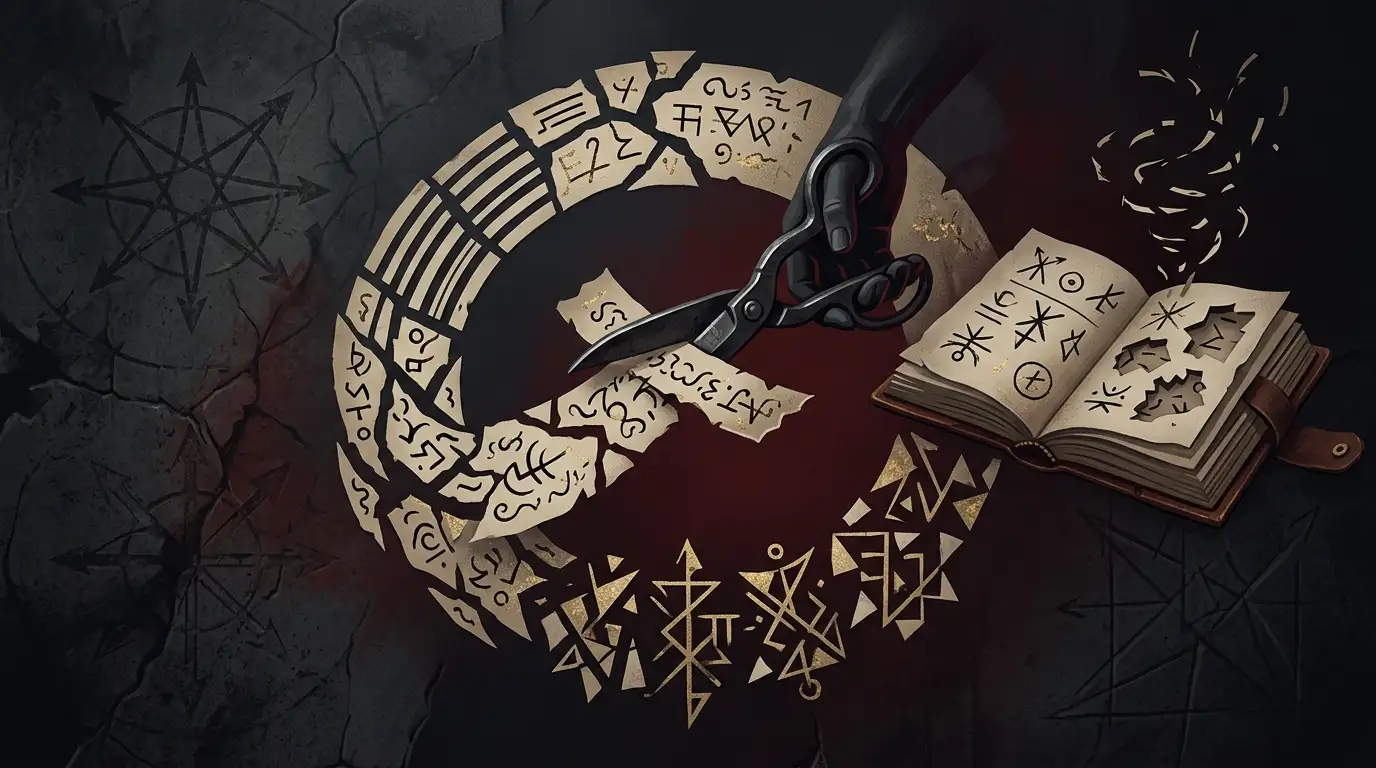
The cut-up technique (sometimes referred to as découpé) in Chaos Magick is an active ritual method used to bypass the analytical conscious mind, generate unpredictable spell instructions, and synthesize highly abstract sigils. Originally popularized as a literary device, this process involves physically slicing apart linear texts, images, or audio recordings and reassembling them randomly. For a Chaos Magician, this practice serves as a practical tool to dismantle established habits of belief and tap directly into the subconscious. This guide details how Chaos Mages can adapt, implement, and experiment with the cut-up technique in their own workings.
From Literary Subversion to Ritual Tool
The transition of the cut-up method from a surrealist writing exercise to an active tool of Chaos Magick reflects the system’s foundational philosophy of treating belief and language as mutable constructs. The technique was originally pioneered by Dadaists like Tristan Tzara and later formalized in 1950/60s by artist Brion Gysin and author William S. Burroughs. Burroughs famously asserted that “when you cut into the present the future leaks out,” suggesting that randomizing text could serve as a form of active divination. For the Chaos Mage, this philosophy is highly practical, turning a simple pair of scissors into an instrument of metaphysical liberation.
Adapting literary subversion into a ritual context allows a Chaos Magician to actively destabilize their conscious reality tunnels. Early occult experimenters like Genesis P-Orridge and various Chaos Magick Adepts saw the cut-up method as a direct way to hack the “word lines” of societal control. Instead of relying on traditional, rigid grimoires, these Chaos Wizards realized that scrambling texts could unlock the hidden, fluid potential of any written system. This adaptation changed how modern Chaos Sorcerers view spell design, moving away from dogmatic scripts toward dynamic, chaotic spontaneity.
| Aspect | Literary Cut-Up | Chaos Magick Cut-Up |
|---|---|---|
| Primary Objective | To break artistic writer’s block and generate unexpected prose | To bypass the conscious mind and manifest a specific intent |
| Materials | Newspapers, novels, poems, typed essays | Grimoires, letters of intent, magical journals, images |
| Primary Actor | The creative ego searching for artistic spontaneity | The subconscious mind acting through the state of gnosis |
| Ultimate Result | A novel, poem, or song lyric | A functional spell, sigil, or divinatory revelation |
Dismantling the Psychic Censor and Breaking Semantic Loops
Dismantling the psychic censor is the primary psychological objective of the Chaos Magick cut-up, as it allows the magician to implant their desires directly into the subconscious. The conscious mind has an analytical filter (the psychic censor) that actively rejects magickal intentions because they conflict with our rational expectations. Linear language keeps this censor highly active, maintaining a structured perception of what is possible. Scrambling text or images breaks these predictable loops, overwhelming the rational mind and creating a temporary state of cognitive silence.
Breaking these semantic loops with randomized cut-ups allows the Chaos Magician to achieve a light state of gnosis. When a Chaos Wizard looks at a scrambled piece of writing, the ego struggles to find immediate meaning, which momentarily suspends disbelief. This suspension provides a brief window of receptivity, allowing the underlying intent to slip past the guardian of the conscious mind without triggering doubt.
Exploiting the psychic censor through randomized patterns also turns the cut-up technique into a highly effective divinatory medium. When the logical mind is presented with fragmented information, the subconscious projection mechanism takes over to find patterns, much like reading tea leaves or tarot cards. The resulting synchronicities that emerge from the scrambled text often reveal hidden truths that the analytical mind would normally block or rationalize away.
Practical Workflows for Randomized Spell Instructions
Creating randomized spell instructions using the cut-up technique provides an objective workflow for the Chaos Mage seeking to execute completely unexpected and spontaneous rituals. Using random generation forces the Chaos Apprentice or Chaos Adept to adapt to the unexpected, which is the very essence of working with Chaos. The physical act of slicing, shuffling, and pasting elements creates a physical link between the magician’s hand and the chaotic forces of the universe. This randomized process can be broken down into a simple, reliable workflow:
- Select the source materials, which can range from highly complex occult grimoires to mundane instruction manuals, personal journal entries, or old letters.
- Physically cut the selected texts into vertical or horizontal strips, or divide them into a grid of four distinct quadrants.
- Mix the individual text pieces thoroughly in a physical container or spread them face down on a flat working surface.
- Draw the pieces randomly and arrange them into a brand-new, linear sequence without reading them beforehand.
- Read the newly formed sequence aloud to discover your customized ritual instructions.
- Execute the instructions literally, no matter how unusual or nonsensical they might seem, to fully commit your belief to the chaotic outcome.
Executing randomized spell instructions helps the Chaos Sorcerer detach from the lust of result. Because the instructions are constructed by chance, the magician’s conscious ego has no emotional attachment to the specific phrasing. The ritual becomes an act of pure play, which is highly conducive to successful manifestation. For example, a randomized instruction like “burn the blue circle while laughing at the north” bypasses the logical mind’s skepticism, allowing the magickal energy to flow freely.
Creating Novel Sigil Configurations with Cut-Ups
Designing novel sigil configurations with the cut-up technique offers an alternative to traditional Spareian sigilization by utilizing visual and textual deconstruction. While standard sigil magick relies heavily on removing vowels and duplicate letters, the cut-up method allows a Chaos Magician to visually shatter their intents into raw geometric fragments. This process physically isolates the desire from its semantic representation, making it far easier to bypass conscious recognition.
The Visual Cut-Up Sigil
The visual cut-up sigil method involves taking pre-drawn symbols, occult diagrams, or paintings and slicing them into geometric shapes. A Chaos Mage can draw a highly detailed representation of their desire, then cut that drawing into equal squares. Shuffling these squares and reassembling them randomly produces a highly abstract, completely unrecognizable glyph. This randomized artwork can then be charged during gnosis without the conscious mind recalling the original image.
Text-Based Cut-Up Sigils
Text-based cut-up sigils are constructed by combining multiple statements of intent into a scrambled pool of linguistic parts. A Chaos Wizard can write down three distinct desires on separate strips of paper. Slicing these sentences into individual words or syllables and mixing them creates a randomized vocabulary. Selecting several of these random fragments allows the magician to form a new, nonsensical word to use as a mantra, or merge the letters into a single graphic glyph. This approach is particularly effective for complex workings where multiple, interrelated outcomes are sought simultaneously.
Multi-Media Cut-Ups: Playback Technique and Visual Glitching
Implementing multi-media cut-ups expands the Chaos Mage’s toolkit beyond written text into the realms of audio playback and digital glitch art. William S. Burroughs and his close associates, such as Genesis P-Orridge, experimented with audio tape recorders to disrupt local realities. Modern Chaos Magicians have adapted these analog methods into the digital age, using software to scramble sound, video, and image files. These multimedia techniques serve as excellent tools for environmental charging or destabilizing stagnant energy in a specific space.
“Audio playback cut-ups” originally involve recording the ambient sound of a targeted environment, mixing the tape with other sounds, and playing it back to cause disruption. Burroughs famously used this (and named it the playback technique) to target commercial establishments, recording their sounds and playing the scrambled audio back at subliminal levels to manifest chaos or force a relocation. For a Chaos Sorcerer, this operates as a form of auditory curse or enchantment, shifting the local probability field through sensory dissonance.
Digital visual glitching allows a Chaos Magician to apply the cut-up philosophy to modern screens and digital photos. Slicing digital images of targets, sigils, or sacred spaces and running them through glitch generators creates highly kinetic, visual representations of chaos. These glitched files can be uploaded online, projected during rituals, or used as digital talismans, ensuring that the magickal intent is constantly radiating in an unrecognizable, post-modern format.