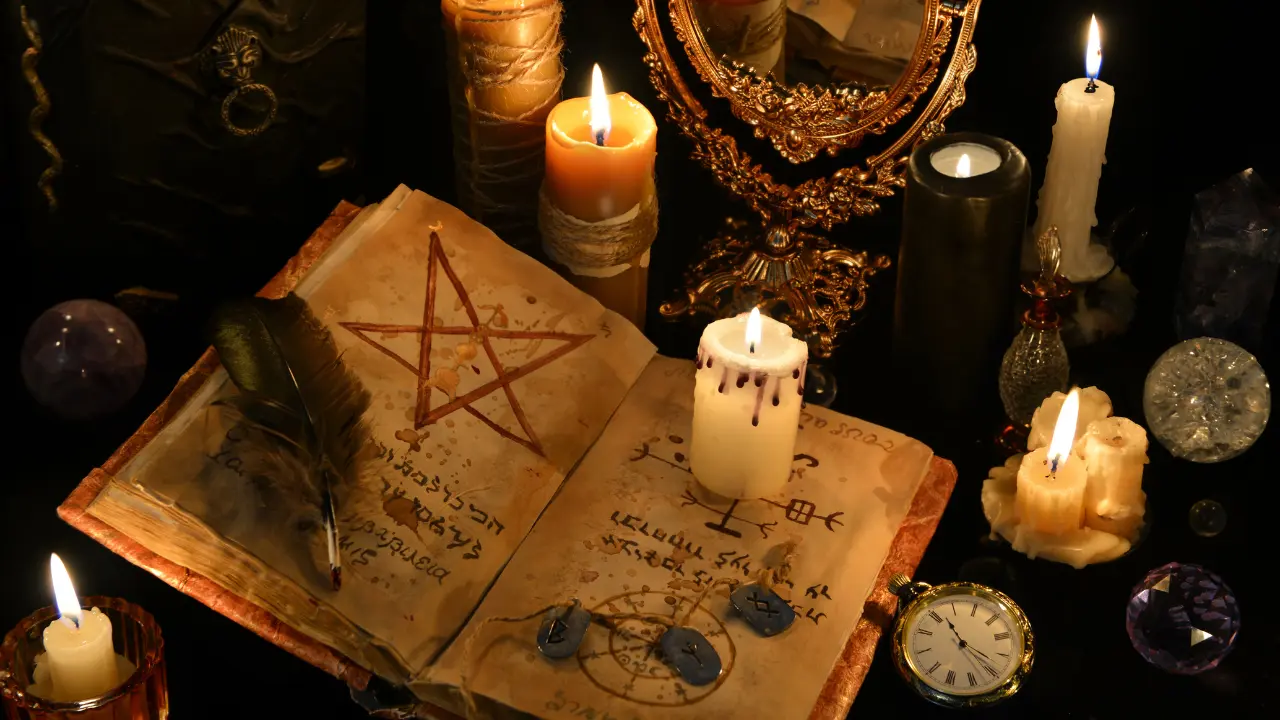
Modern witchcraft tools, altars, and the modern witch’s grimoire form the physical apparatus used by an occult adept to direct willpower, structure ritual space, and document experimental spellcraft. While an experienced sorcerer can execute magick through visualization and breath control alone, physical implements act as energetic condensers and somatic triggers that accelerate trance induction. Organizing your working surface and recording ritual outcomes transforms sporadic folk spellcasting into a repeatable esoteric discipline.
Operative Mechanics of Modern Witchcraft Tools
Modern witchcraft tools function as externalized extensions of the mage’s nervous system and subtle biofield rather than stage props possessing independent supernatural power. Every ritual instrument serves a specific directional or alchemical role, either projecting concentrated intent outward or containing summoned forces within a bounded vessel.
Functions of the Wand, Athame, Chalice, and Cauldron
Traditional and eclectic witches divide their primary working instruments according to how each material conducts or severs energetic currents. Whereas wood and copper channel and invite sympathetic spirits, cold iron and steel command, divide, and banish unwanted influences.
| Ritual Implement | Elemental Current | Material Composition | Primary Operative Use |
|---|---|---|---|
| Wand | Fire or Air | Hardwood, copper wire, crystal tip | Directing biofield energy and invoking benevolent spirits |
| Athame | Fire or Air | Double-edged black-handled steel blade | Casting the circle, severing cords, commanding unruly entities |
| Boline | Earth | White-handled curved steel knife | Physical harvesting of herbs, carving wax candles and sigils |
| Chalice | Water | Silver, brass, glass, or ceramic cup | Holding libations and conducting magnetic, receptive currents |
| Cauldron | Spirit and Water | Three-legged cast iron pot | Burning petitions, brewing infusions, scrying with dark water |
Consecration and Energetic Conditioning
Consecrating a new ritual implement strips away manufacturing residue and imprints the object with your personal magickal objective. Follow this four-step protocol before introducing any instrument to your working space:
- Cleanse the physical surface using a saline wash, smoke from burning incense, or sustained acoustic vibration from a brass bell.
- Ground and center your awareness, then project subtle energy from your dominant hand directly into the material while stating its exact operative purpose aloud.
- Pass the implement through the four elemental representations on your altar (incense smoke, candle flame, salted water, and soil or pentacle disk) to align its structure.
- Seal the consecration with an anointing oil (such as olive oil infused with myrrh and cinnamon) and store the item wrapped in natural silk or linen to prevent energetic cross-contamination.
Constructing a Functional Modern Witchcraft Altar
Setting up a functional modern witchcraft altar establishes a localized microcosm where the witch manipulates sympathetic correspondences to alter macrocosmic probabilities. A high-performing altar prioritizes ergonomic flow, fire safety, and directional polarity over decorative clutter.
Classical occult architecture divides the working surface into a projective (solar, masculine, or electric) right side holding candles, incense, and blades, balanced against a receptive (lunar, feminine, or magnetic) left side holding the chalice, bowls, and scrying mirrors. The center remains clear as an active working zone for dressing candles, charging talismans, or laying out Tarot spreads. Witches operating in studio apartments, shared dormitories, or restrictive households achieve identical efficacy using portable micro-altars (such as a pocket tin housing birthday candles, a quartz point, a miniature vial of salt, and a sewing needle serving as a miniature athame) that pack away immediately after the rite.
The Modern Witch’s Grimoire, Book of Shadows, and Magickal Planner
Maintaining a structured grimoire, Book of Shadows, and magickal planner preserves an adept’s accumulated occult knowledge and prevents repetitive ritual failures. Separating static reference data from active experimental logs keeps your system organized as your repertoire expands.
Grimoire vs Book of Shadows Architecture
Although novices often use the terms interchangeably, a grimoire is a curated textbook of proven formulas, correspondence tables, and spirit signatures, whereas a Book of Shadows is a personal laboratory diary recording raw ritual experiences and divination readings. Meanwhile, a magickal planner tracks upcoming astrological elections, lunar phases, and planetary hours for scheduling future workings. Binding your working notes inside a disc-bound notebook or three-ring binder (rather than a sewn leather journal) eliminates perfectionism anxiety and allows you to reorganize pages by category as your craft matures.
Encoding Intent With Symbols and Sigils
Modern witches condense complex written petitions into abstract graphic sigils and cipher alphabets to bypass the conscious mind’s analytical resistance (what Austin Osman Spare termed the psychic censor). To construct a monogram sigil, the sorcerer writes a clear statement of intent in the present tense, deletes repeating letters, and fuses the remaining characters into a single glyph. When I want to protect sensitive grimoire entries from casual observers, I transcribe the ritual formulas using the Theban alphabet (the Witch’s Alphabet popularized in Heinrich Cornelius Agrippa’s Three Books of Occult Philosophy) or encode the intent into a planetary Kamea (magick square) before charging the symbol in a state of gnosis.
Empirical Spell Tracking Like a Chaos Magician
Adopting the empirical record-keeping methodology of a Chaos Magician turns subjective witchcraft into a verifiable science of probability engineering. Inspired by Peter J. Carroll’s Liber Null & Psychonaut, a Chaote logs every single ritual variable to isolate what actually produces real-world manifestation versus what is mere superstition. Record these specific data points in your Book of Shadows for every working:
- Date, exact time, planetary hour, and current lunar phase.
- Physical and mental baseline of the operant (fatigue levels, emotional state, diet, and focus quality).
- Specific paradigm, entities invoked, physical materials, and gnosis technique used.
- Target deadline for manifestation and concrete mundane pathways opened to support the spell.
- Post-ritual audit documenting the exact date of completion, degree of accuracy, or identified failure modes (such as lust for result or ambiguous phrasing).