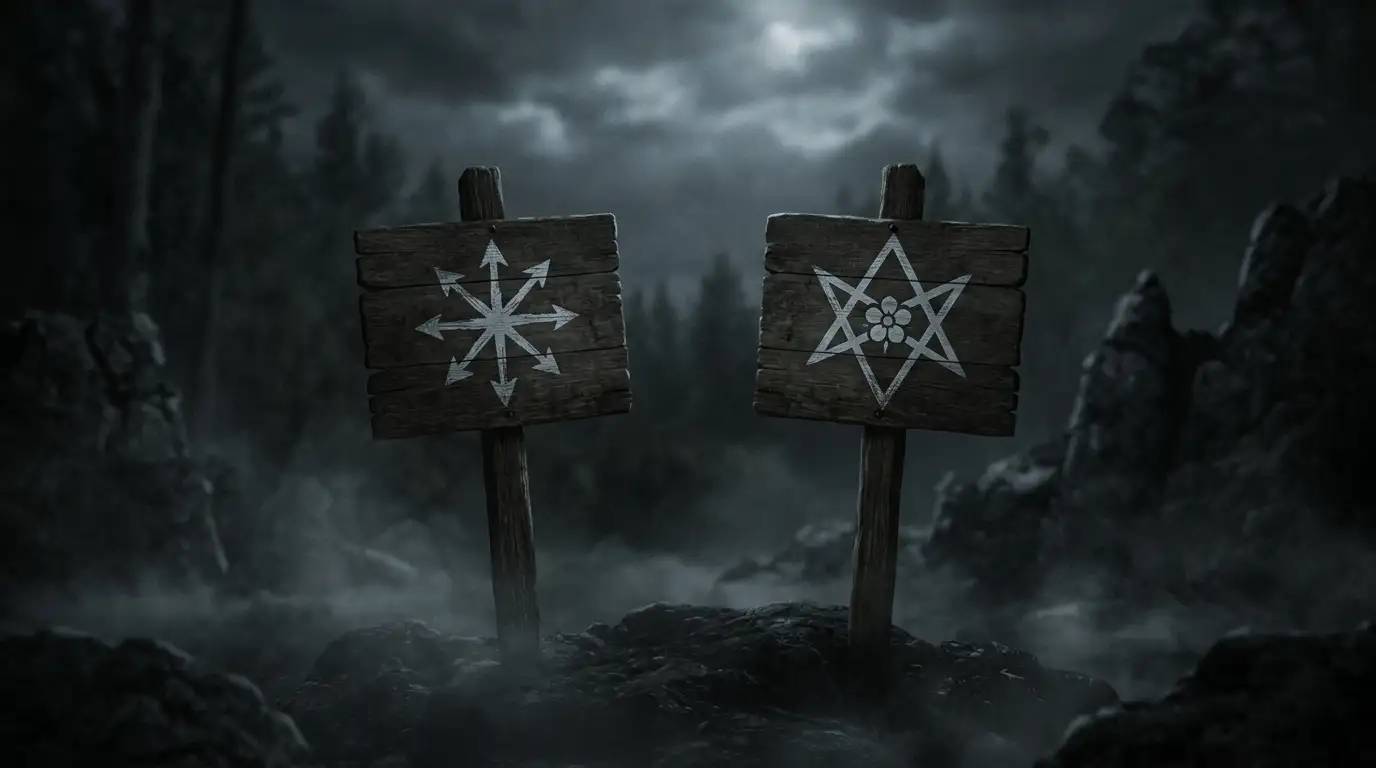
Understanding the relationship between Chaos Magick and Thelema requires examining how a wizard approaches belief and reality. While both of these systems broke away from traditional Western religious dogma and prioritized the individual will, they are structurally and philosophically distinct. Thelema, founded by Aleister Crowley in the early twentieth century, is a highly structured spiritual system centered on discovering one’s divine purpose (known as the True Will) and executing it through classical Hermetic rituals. Chaos Magick, codified by Peter J. Carroll in the late 1970s, is an eclectic meta-paradigm that treats belief itself as an active tool, discarding absolute spiritual truths in favor of whatever gets results. Ultimately, Thelema is a religion with an established cosmology, while Chaos Magick is a pragmatist’s toolkit that plunders all religions for practical sorcery.
The Divide Between Chaos Magick and Thelema
Understanding the foundational divide between Chaos Magick and Thelema requires examining how each system treats the nature of objective reality and personal belief. While both systems broke away from traditional Judeo-Christian religious restrictions, they diverge sharply on whether there is an ultimate spiritual truth to discover. Thelema presents a structured cosmological framework based on a channeled holy text, whereas Chaos Magick views all belief systems as temporary, self-created illusions utilized for practical results. This tension between a structured spiritual religion and a results-oriented meta-paradigm defines their relationship.
What is Chaos Magick?
Chaos Magick is a modern, results-oriented approach to sorcery that operates on the premise that belief is a flexible mechanism rather than an absolute truth. Originating in the UK in the late 1970s, this system encourages the wizard to adopt whatever religious or scientific paradigm is necessary to achieve their desired outcome, only to discard it once the operation is complete. Rather than relying on classical spirits or strict ritual hierarchies, a Chaos Magus focuses on achieving gnosis (an altered state of consciousness where the rational mind is bypassed). This pragmatic stance allows the adept to experiment with anything from traditional grimoires to modern pop-culture entities, making it the ultimate tool for practical self-determination.
What is Thelema?
Thelema is a spiritual philosophy and religion developed by Aleister Crowley that centers on the pursuit of one’s absolute cosmic path, or True Will. Codified in 1904 after Crowley claimed to channel a divine transmission from an entity named Aiwass, the system is governed by the central adage, Do what thou wilt shall be the whole of the Law. Thelemites engage in rigorous Hermetic ritualism, Kabbalistic study, and devotion to a specific pantheon of Egyptian-derived deities to achieve union with the divine. It is a highly individualized path that encourages disciplined study of its sacred texts and offers structured spiritual orders (such as the A∴A∴ and the O.T.O.), presenting itself as a definitive spiritual science for the New Aeon.
Points of Convergence and Divergence
Examining the direct points of convergence and divergence between these two paths reveals how they share a lineage but split on the nature of reality. Both systems champion individual autonomy, actively encourage the breaking of societal taboos to liberate the mind, and utilize altered states of consciousness. However, they part ways when it comes to cosmology. Thelema is centered on an individual’s personal cosmic alignment, known as the True Will, treating its sacred texts and entities as specific symbolic formulas for self-discovery rather than objects of forced dogma. Conversely, Chaos Magick rejects any absolute spiritual architecture entirely, treating all gods, demons, and cosmic laws as temporary, self-created programs designed to manipulate probability.
| Comparison Area | Thelema | Chaos Magick |
|---|---|---|
| Nature of Belief | Alignment with a single religious framework | A temporary tool adopted and discarded at will |
| Primary Goal | Discovery and execution of the True Will | Practical results and personal liberation |
| Sacred Text | The Book of the Law channeled by Aiwass | None; any grimoire is a temporary guide |
| Ritual Structure | Rigorous and traditional ceremonial formulas | Fluid, eclectic, and highly individualized |
| Source of Power | The Egyptian deities and the Great Work | Kia, chaos, gnosis |
Peter J. Carroll vs. Aleister Crowley: Two Approaches to Magickal Theory
Analyzing the differences between Peter J. Carroll and Aleister Crowley highlights the evolution of modern wizardry from theatrical mysticism to a psychological, science-aligned model. Crowley spent his life constructing an elaborate Hermetic system that relied on spiritual lineages, angelic communications, and hierarchy. Carroll, conversely, stripped away the spiritual elitism and reorganized sorcery into a practical framework based on probability, quantum physics, and cognitive states. Comparing these two spiritual leaders reveals a shift from seeking cosmic authority to realizing individual agency.
Aleister Crowley’s Systematic Hermeticism
Crowley’s systematic Hermeticism was designed to provide a highly structured, objective path for the wizard to achieve union with the divine. He synthesized elements of the Golden Dawn, the Kabbalah, and Eastern yoga into a comprehensive curriculum governed by his proprietary spiritual orders (the A∴A∴ and O.T.O). To Crowley, the spirits, gods, and planes of existence were parts of a grand cosmic architecture that required exact formulas, precise planetary hours, and classical incense to navigate safely. He demanded that his initiates keep exhaustive diaries, viewing the magickal record as a scientific logbook of objective, repeatable spiritual progress.
Peter J. Carroll’s Mathematical Psychonautics and the Aether
Peter J. Carroll’s mathematical psychonautics replaced the traditional gods of antiquity with equations and psychological states, moving the practice of sorcery into the scientific age. His work in Liber Null & Psychonaut established that the specific flavor of the ritual matters far less than the intensity of the magician’s focus. Carroll introduced a three-dimensional model of time and theorized about the aether as a probabilistic medium through which human consciousness interacts with physical reality. He saw the ultimate spark of consciousness as Kia, an unmanifest, indefinable self-awareness that operates within the chaotic sea of infinite possibilities.
Austin Osman Spare vs. Aleister Crowley: Subconscious Sigils vs. Ceremonial Excess
The historical friction between Austin Osman Spare and Aleister Crowley reflects the classic conflict between institutional occultism and raw, individualistic sorcery. Crowley represented the wealthy, bourgeois establishment of ceremonial magick, operating within expensive temples and demanding submissive devotion from his disciples. Spare, a working-class prodigy and brilliant artist, quickly grew disgusted with this theatrical posturing and opted for a minimalist, internal approach. Their split created the very foundations of what would eventually become the Chaos Magick current.
The Brief Alliance and the Ideological Rift
The brief alliance and eventual ideological rift between these two men occurred during Spare’s short tenure as a probationer in Crowley’s A:.A:. order (around 1909). While Crowley initially recognized Spare’s artistic genius and potential as an adept, their personalities and methods clashed immediately. Spare viewed Crowley as an insincere, power-tripping egoist who used rituals as social clubs for wealthy eccentrics, famously referring to ceremonialists as unemployed dandies of the Brothels. Crowley retaliated by dismissing Spare’s techniques, labeling him a Black Brother because he refused to conform to the structured cosmology of the Great Work.
Sigilization vs. Elaborate Ritualism
Comparing sigilization with elaborate ritualism highlights the massive operational divide between Spare’s psychological sorcery and Crowley’s ceremonial theater. Crowley relied on massive investments of time, money, and classical props to trigger the necessary magickal trance (which he aligned with Hermetic formulas). Spare bypassed these external requirements entirely, developing the method of sigilization (where a desire is condensed into a stylized monogram, forgotten, and cast into the subconscious during a state of vacuity). This simple, elegant technique proved that a Chaos Mage does not need an altar, a robe, or a temple to manipulate reality.
Stripping Thelema of Dogma to Achieve Better Results
Stripping Thelema of its rigid dogma is a necessary step for any pragmatic Chaos Mage who wants to utilize its techniques without falling into cultic traps. Many modern magicians treat The Book of the Law as a literal divine revelation, transforming Crowley’s personal philosophy into an oppressive, fundamentalist religion. A realistic look at Crowley’s life reveals that he was a deeply flawed, highly troubled individual rather than an infallible cosmic prophet. Evaluating his work objectively allows a wizard to extract the functional mechanics of his system while discarding the personal madness and administrative absurdities.
The Trap of Taking Liber AL 100% Seriously
The trap of taking The Book of the Law 100% seriously becomes obvious when we compare its reception to modern fringe belief systems. When I discussed this topic personally with Peter J. Carroll (before his unexpected passing in April 2026), we both agreed that treating Aiwass as an objective, infallible cosmic entity is just as absurd as accepting Scientology’s story of Xenu. Peter mentioned to me that he knew someone who had actually met Aleister Crowley, and that person made it clear that Crowley was far from a likeable or admirable human being. He was a severe heroin addict whose lifestyle was plagued by financial opportunism as well as personal and sexual exploitation. According to those who interacted with him, the first things he often sought from his newly minted initiates were their wallets and (given his active bisexuality) their physical submission. A Chaos Magus who treats Crowley’s writings as holy scripture is blind to these historical realities, trading their own spiritual autonomy for the eccentric fantasies of a dead addict.
Deconstructing the Egregore of Aiwass
Deconstructing the egregore of Aiwass allows a Chaos Magician to interact with the entity as a useful psychological construct rather than a literal cosmic master. In the framework of Chaos Magick, a spirit is not an objective god sitting in a literal heaven, but a specialized portion of the unconscious mind or a temporary packet of information (akin to a servitor) within the aether. Stripping the fear and reverence from Aiwass allows the Chaos Magus to use the current of Liber AL vel Legis without becoming infected by the messianic delusion that ruined Crowley’s own life. Adept sorcerers understand that any entity can be summoned, used, and banished without the wizard needing to bend the knee to its associated dogmas.
What is Useful in Thelema for a Chaos Mage?
Identifying what is genuinely useful in Thelema allows a Chaos Mage to plunder a century of rigorous ritual development for immediate practical application. Crowley was an obsessive experimenter who spent decades refining techniques to alter human consciousness and focus intention. While his personal behavior was reprehensible and his cosmology was absurd, his actual magickal technology is remarkably effective when operated by a skilled wizard. Evaluating these practices through a functional lens reveals several useful tools that can be easily integrated into a modern, eclectic system.
Thelema’s Magickal Technology as a Temporary Tool
Thelema’s magickal technology behaves like a software suite that a Chaos Mage can install, run to achieve a specific goal, and then completely uninstall. An apprentice of the occult does not need to believe in Nuit, Hadit, or Ra-Hoor-Khuit as literal deities to benefit from the intense focus that their invocations produce. Treating these godforms as psychological archetypes or energetic frequencies allows the wizard to enter a state of deep gnosis without any lasting religious commitment. This approach ensures that the magician reaps the rewards of a highly disciplined, structured practice without accumulating the dogmatic baggage that often stunts a sorcerer’s growth.
Specific Practices Worth Adopting
There are several highly structured Thelemic rituals and concepts that a Chaos Magician can actively borrow to enhance their daily operations.
- The Star Ruby and Star Sapphire: These are highly effective banishing and invoking rituals that use Greek godforms and vocalizations (making them excellent alternatives to the standard Lesser Banishing Ritual of the Pentagram).
- Liber Resh vel Helios: This practice involves performing four daily adorations to the sun, which is incredibly useful for building magickal discipline, structuring the wizard’s day, and maintaining constant awareness of the subtle environment.
- Astral Projection and the Body of Light: Crowley’s detailed instructions on how to travel through the astral realm and work with the body of light are interesting guides to consider.
- The Concept of Will: While the Chaos Magician rejects the idea of a pre-determined True Will designed by cosmic forces, treating the search for one’s deepest, uncorrupted desire as a psychological self-discovery tool remains highly valuable.
Can Chaos Magick and Thelema Work Together?
Exploring how Chaos Magick and Thelema can work together reveals that these two systems are not mutually exclusive, provided they are structured hierarchically. Under the meta-paradigm of Chaos Magick, any belief system is a valid view to adopt, meaning that Thelema can be adopted as a highly effective operating system for a set period. A Chaos Mage does not need to choose between the chaotic freedom of modern sorcery and the rigorous discipline of Crowleyan ritualism. Synthesizing the two allows a wizard to enjoy the structural power of the latter while retaining the absolute freedom of the former.
Synthesizing the Two Systems
Synthesizing the two systems is best accomplished by treating Thelema as a temporary, intensive paradigm inside a larger Chaos Magick framework. A Chaote might decide to join a local lodge of the O.T.O. or practice the A:.A:. curriculum for a year or so to build discipline and absorb the extensive magickal technology developed by Crowley. Entering this system with the conscious understanding that it is a useful game prevents the magician from succumbing to the dogmatic traps and personal madness that frequently plague true believers. The structure of Thelema provides the fuel and the training ground, while Chaos Magick provides the escape hatch and the critical perspective necessary to maintain mental stability.
Practical Paradigm Piracy
Practical paradigm piracy is the ultimate expression of this synthesis, allowing the Chaos Magus to plunder the treasures of Thelema and leave the wreckage behind. Using this approach, the wizard can invoke Babalon or perform the Gnostic Mass to experience deep ecstasy, and then immediately switch to an entirely different paradigm (such as Norse runic sorcery or modern pop-culture magick) the very next day. This flexibility prevents the stagnation that occurs when an adept gets stuck in a single religious framework. In the end, the Chaos Magician views Thelema not as a holy truth to be defended, but as a toolset to be plundered for individual empowerment.