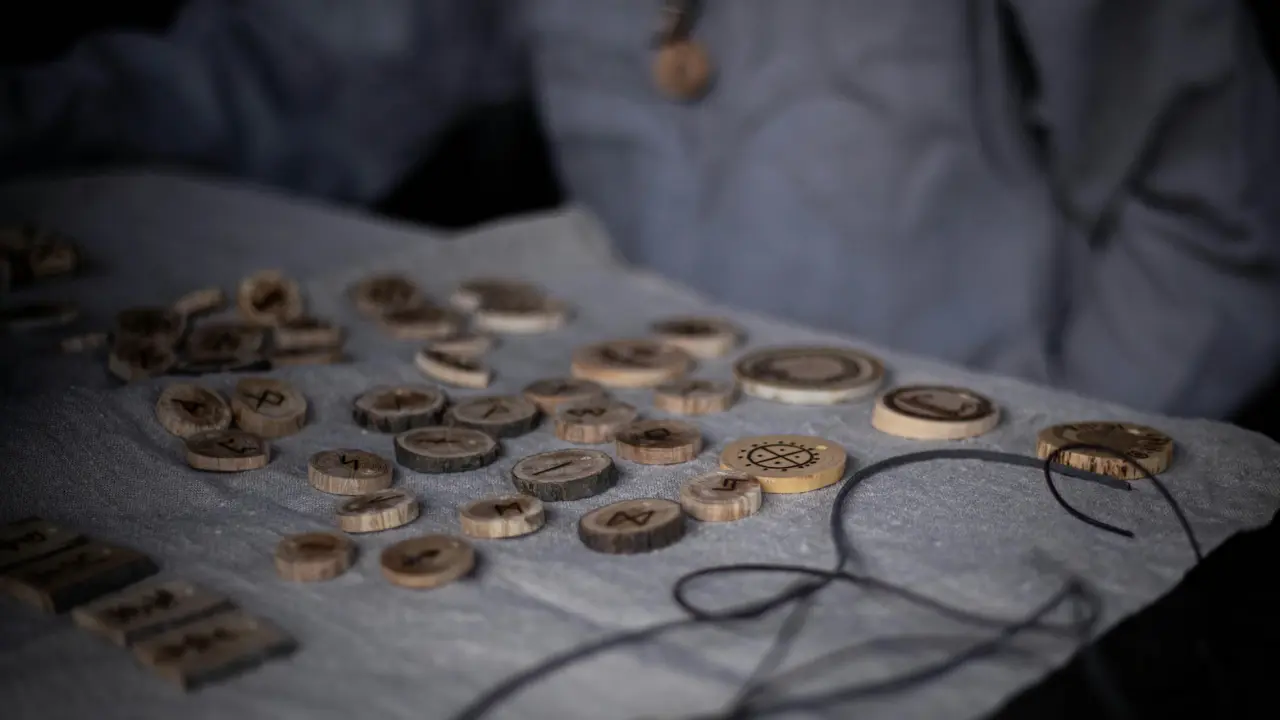
While learning the definitions of the Futhark is the first step, the true art of the Erilaz lies in interpreting the cast—the chaotic, kinetic arrangement of staves upon the cloth. Unlike a Tarot spread where positions are fixed (e.g., “This card is the past”), a rune cast is fluid. The meaning is derived not just from what the rune is, but where it landed, how it is oriented, and what it is touching.
Kinetic Analysis: Beyond the Grid
In a freestyle cast, the cloth represents the universe of the querent. The center is usually designated as the “Self” or the present moment.
Cluster Reading
Runes that land touching each other form a Binary or Trinary compound. They must be read as a single sentence. If Raido (Travel) lands touching Hagalaz (Disruption), it is not two separate events; it is a “Disrupted Journey.” If they are physically overlapping, the one on top is the dominant influence, suppressing or modifying the one beneath it.
Distance and Orientation
Runes close to the center are immediate, pressing concerns. Runes at the periphery represent distant influences or events on the horizon.
Question: How do overlapping runes modify each other?
Answer: If a heavy, static rune like Isa (Ice) lands on top of a dynamic rune like Fehu (Fire), the reading suggests “Frozen Assets” or “Blocked Cash Flow.” If Fehu is on top, it suggests “Wealth overcoming Stagnation.” The top rune is the active verb; the bottom rune is the passive object.
The Mystery of the Murk-Stave (Face-Down)
A common dilemma in casting is the rune that lands face-down. In modern parlance, these are often called Murk-Staves (dark sticks).
The Void Aspect
A face-down rune represents the unknowable or the unconscious. It is the influence of Orlog that is currently invisible to the querent.
Question: What does a cast dominated by Murk-Staves indicate?
Answer: If the majority of runes are face-down, the oracle is refusing to answer, or the situation is too chaotic to be read (“The Wyrd is clouded”). It often signals that the querent lacks self-awareness regarding the issue.
Protocol: Some adepts leave them blank (reading them as “The Void”). Others flip one key Murk-Stave to reveal the root secret. Flipping all of them defeats the purpose of the cast; you are forcing light where there is darkness.
Elemental Dignities and Modifiers
Just as planets have elemental dignities, so do runes. This layer of interpretation adds depth to “contradictory” readings.
| Element A | Element B | Interaction | Interpretation |
|---|---|---|---|
| Fire (e.g., Kenaz) | Ice (e.g., Isa) | Neutralization | Energy cancels out. Steam. High effort, zero result. |
| Fire (e.g., Sowilo) | Air (e.g., Ansuz) | Expansion | Rapid, potentially uncontrollable growth. Viral ideas. |
| Water (e.g., Laguz) | Earth (e.g., Uruz) | Nutritive | Fertility, healing, slow but solid progress. |
| Ice (e.g., Nauthiz) | Water (e.g., Perthro) | Solidification | Emotions hardening into resentment. Permanent habits. |
Conflict vs. Harmony
When interpreting a cluster, check the elements. If you have Thurisaz (Fire/Force) and Laguz (Water/Flow) together, the reading is “Boiling”—emotional turbulence or reactive anger. If you have Wunjo (Air/Joy) and Gebo (Air/Gift), the reading is “Harmonic”—a smooth, breezy exchange of ideas or affection.
Synthesis: Intuition vs. Tradition
The Vitki must balance book knowledge with Gnosis.
The Flash
Often, a rune will trigger an immediate psychic association that contradicts the traditional meaning. You might see Hagalaz and feel “Relief” rather than “Disaster.” In this context, trust the flash. The runes are the key to the subconscious; once the door is open, the book is less relevant.
Question: How do you handle contradictory runes?
Answer: If Wunjo (Joy) and Nauthiz (Suffering) appear together, do not average them out to “Okay.” Read them as a tension: “Finding joy within suffering” or “The necessity of pain to appreciate happiness.” The paradox is usually the message.
Anchoring the Oracle: The Magickal Journal
A reading is a fleeting glimpse of Verdandi. To track Wyrd, it must be recorded.
Diagramming and Feedback
Draw the layout of the cast in your journal, noting the distance and clusters. Do not just write the interpretation; write the raw data.
A Note on Stalker Runes: Over time, you will notice certain runes appearing in every reading for weeks. These are “Stalker Runes.” They indicate a major life lesson or a massive block of Orlog that is trying to process. The journal allows you to spot these long-term patterns that are invisible in a single sitting.