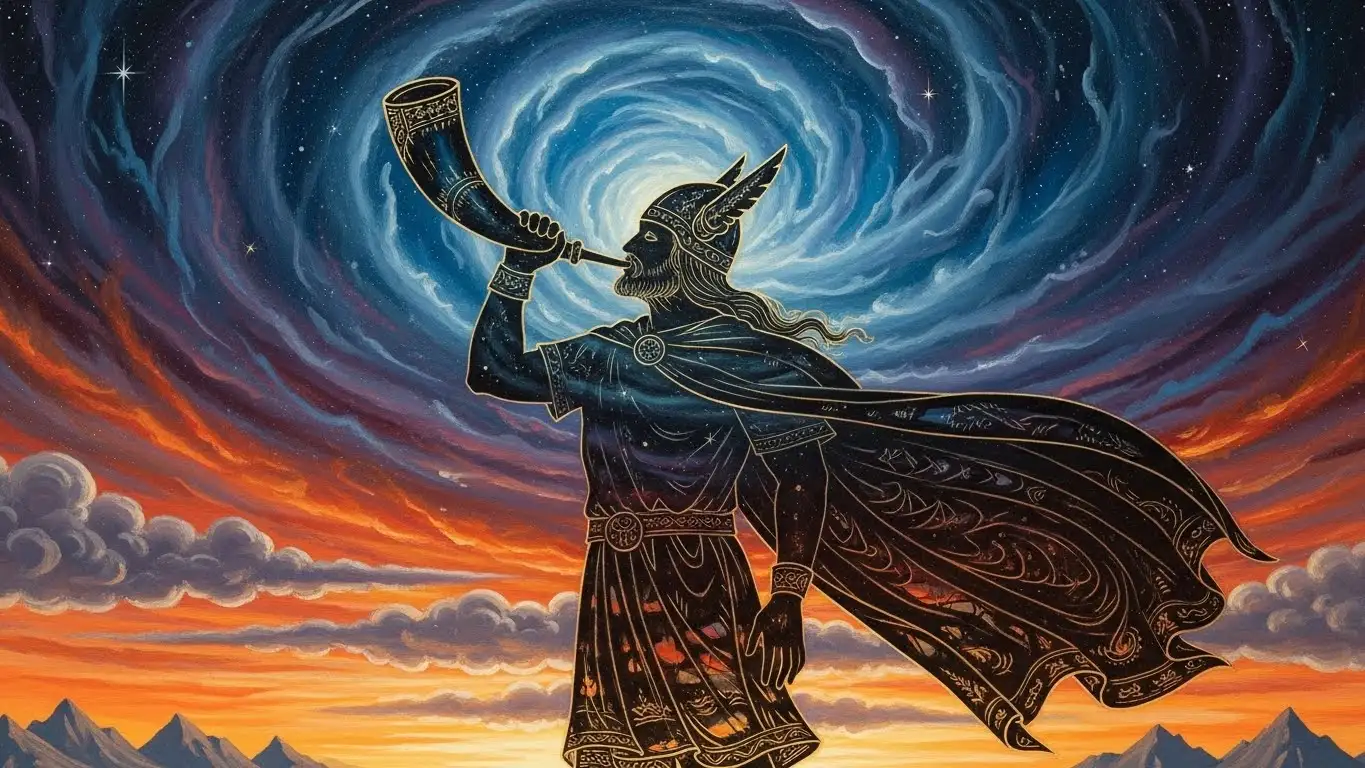
While the First Aett sings of creation and power, the Second Aett, known as Heimdall’s Aett (or Hagal’s Aett), speaks of the harsh realities that test that power. Named after the Watcher of the Gods, this octet governs the objective forces of the universe—the storms, the delays, the constraints of time, and the inevitable machinery of Fate.
In the study of runes and their symbolism, this is often referred to as the “Aett of Trial.” It forces the practitioner to confront the shadow, endure the winter, and understand that the will alone is not enough; one must also align with the cosmic rhythm. It is a descent into the underworld of the psyche, only to emerge radiant with the sun rune at the end.
| Rune | Translation | Primary Concept | Element | Tarot Correspondence (Approx.) |
|---|---|---|---|---|
| Hagalaz | Hail | Disruption/Change | Ice/Water | The Tower |
| Nauthiz | Need | Resistance/Friction | Fire | Death / 5 of Pentacles |
| Isa | Ice | Stasis/Identity | Ice | 4 of Swords / The Hanged Man |
| Jera | Year | Cycles/Harvest | Earth | Wheel of Fortune / 7 of Pentacles |
| Eihwaz | Yew Tree | Axis Mundi | All Elements | Death / The World |
| Perthro | Lot Cup | Fate/Chance | Water | Wheel of Fortune / The Moon |
| Algiz | Elk | Protection/Bridge | Air | The Star / Temperance |
| Sowilo | Sun | Success/Will | Fire | The Sun |
Hagalaz: The Radical Disruption
Hagalaz marks the abrupt entry into the Second Aett with a crash. Translating to “Hail,” it represents the impartial, destructive force of nature that can level a crop in minutes. Esoterically, however, Hagalaz is not evil; it is the necessary crisis that shatters outmoded structures.
When this rune appears, it signals that the status quo is over. The “egg” of the hailstone must shatter to release the water of life within. In magical workings, Hagalaz is the “Pattern Rune”—a seed crystal of cosmic order that descends from the heavens. It disrupts the ego’s plans to impose a higher, perhaps painful, divine order. It teaches that security is an illusion and that adaptation is the only true strength.
Nauthiz: The Friction of Necessity
If Hagalaz is the storm, Nauthiz is the huddling for warmth that follows. It translates to “Need” or “Distress.” This is the rune of restriction, delay, and the heavy hand of constraint.
Yet, within the Northern Tradition, there is a concept known as the “Need-Fire” (Niedfyr). Fire is created by rubbing two sticks together—by friction. Nauthiz teaches that resistance is the mother of strength. Without the resistance of gravity, muscles atrophy; without the resistance of Nauthiz, the soul cannot grow. It is the Shadow that defines the Light. Magickally, it is used to bind enemies or to strengthen the will by imposing self-discipline.
Isa: The Principle of Stasis
Isa is the rune of Ice. Visually, it is a single vertical line—a pillar of stillness. It represents absolute stasis, where all molecular motion ceases.
In the psychological realm, Isa is the Ego—the solitary “I” that stands apart from the collective. It acts as a dampener for volatile situations. If a situation is spinning out of control (Hagalaz), Isa freezes it. It is the rune of concentration and individual identity, but its danger lies in isolation. Too much Isa leads to emotional frigidity and a refusal to flow with the currents of life. It warns of a period where no external progress can be made, and the only journey is inward.
Jera: The Law of Cyclic Return
Jera translates to “Year” or “Harvest.” After the disruption of hail, the friction of need, and the freeze of ice, the wheel inevitably turns to spring. Jera represents the immutable law of cycles and the reward for patience.
This is the rune of “Karma” in its most literal sense: cause and effect. Unlike Fehu, which can be a sudden windfall of luck, Jera is earned success. It is the farmer who has tilled the soil, waited through the winter, and now reaps exactly what was sown. In ritual, Jera is the gently turning wheel that moves a project from the planning phase into manifestation, ensuring that the timing is correct. It reminds the magician that you cannot rush the harvest.
Eihwaz: The Axis Mundi
Eihwaz, the Yew Tree, is the spiritual spine of the runic system. Not to be confused with Ehwaz (Horse), this rune represents the Axis Mundi—the vertical pillar of Yggdrasil that connects the worlds.
The Yew is a tree of death; it is poisonous, grows in graveyards, and lives for thousands of years. Yet, it is also the tree of eternal life, remaining green through the deepest winter. Eihwaz is the rune of the Shaman’s journey. It facilitates the travel between the realm of the living and the dead. It is the mystery of endurance and the synthesis of opposites (life/death). When used in defense, Eihwaz is active and potent—it is the hunter’s bow made of yew wood, flexible yet deadly.
Perthro: The Mystery of Chance
Perthro is the most enigmatic rune in the Futhark. It is often interpreted as a “Lot Cup”—the vessel from which lots (dice/runes) are cast to determine fate. It governs the unmanifest, the unknown, and the role of “Luck.”
It is the womb of Wyrd. While Nauthiz represents the fate we must endure, Perthro represents the fate we can play. It is the variable of chance. In divination, Perthro often hides its meaning, indicating that the future is currently in flux or that a secret is being kept. It deals with the immutable laws of probability and the chaotic variables that the rational mind cannot predict.
Algiz: The Bridge to the Divine
Algiz (or Elhaz) represents the Elk, specifically the elk-sedge grass that cuts the hand when grasped. Visually, it is the figure of a human with arms raised to the heavens, functioning as a receiver for divine energy.
This is the paramount rune of protection and connection. Unlike the aggressive defense of Thurisaz, Algiz protects by alerting the magician to danger and by strengthening the link to the Hamingja (spiritual luck) and the guardian spirits (Fylgja). It acts as a bridge, grounding the higher frequencies of the gods into the physical body. It is the sanctuary, the holy grove, and the antenna of the soul.
Sowilo: The Wholeness of the Will
The Aett concludes with Sowilo, the Sun. After the dark journey through hail, need, and ice, the clouds break. Sowilo is the rune of total success, health, and the realized Will.
It represents the Higher Self shining through the ego. It is the navigator’s star. Magickally, Sowilo provides the energy to succeed in any endeavor, but it is also the lightning bolt of insight that destroys illusions. It brings clarity. Where Jera is the slow cycle of the year, Sowilo is the singular, blazing moment of noon. It is the victory of consciousness over the darkness of the unconscious.