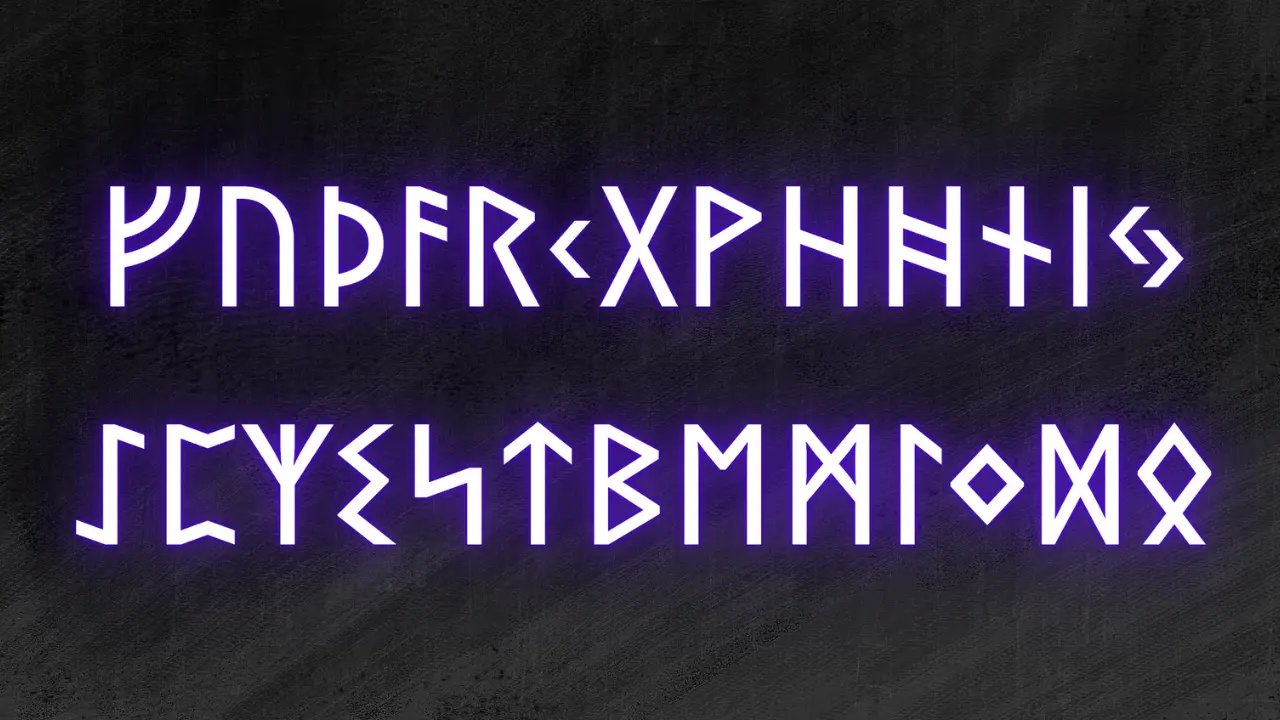
The Elder Futhark constitutes the oldest confirmed form of the runic scripts, utilized by Germanic tribes for approximately six centuries during the Roman Iron Age and the Migration Period. This writing system comprises a fixed sequence of 24 characters, functioning both as a phonetic alphabet for the Proto-Germanic language and as a series of ideograms representing distinct cosmological concepts. Originating likely in the 1st or 2nd century AD within the contact zones between Germanic peoples and the Roman Empire, the script serves as the foundational “Mother Row” from which all subsequent variants, including the Anglo-Saxon Futhorc and Younger Futhark, descended. Mastery of this system is a prerequisite for the serious study of Runic Magick, as it encodes the archaic dialect and worldview of the pre-Viking era ancestors.
The Structure of the 24-Character Row
The sequence of the Elder Futhark is rigid and non-arbitrary, distinguishing it markedly from the Mediterranean alphabets (ABC) derived from Phoenician scripts. The row begins with Fehu (cattle/wealth) and concludes with Othala (inheritance) or Dagaz (day), depending on the specific archaeological find. This order is known as the Futhark, an acronym formed by the first six phonemes: F, U, Th, A, R, and K.
These 24 staves are organized into three distinct groups known as Aettir (singular Aett), a term translating to “family,” “generation,” or “group of eight.” This tripartite division is fundamental to the internal logic of the system, often interpreted in esoteric circles as a progression through three levels of existence or initiation.
- Freya’s Aett (First Aett): Encompasses the first eight runes (Fehu through Wunjo). These characters generally denote primal forces, physical survival, and the initial creation of order.
- Heimdall’s Aett (Second Aett): Contains the second eight runes (Hagalaz through Sowilo). This group is characterized by elemental disruption, necessity, and the forces of resistance that test human resilience.
- Tyr’s Aett (Third Aett): Comprises the final eight runes (Tiwaz through Othala/Dagaz). These symbols relate to the human social order, justice, spiritual transformation, and the synthesis of the preceding forces.
In a functional context, each rune operates as a logogram. While the character Isaz represents the phonetic sound ‘I’, it simultaneously conveys the concept of “Ice” and, by extension, stasis or concentration. This dual utility allowed Erilaz (rune masters) to encode complex metaphysical intent into brief inscriptions on weapons, jewelry, and stones.
Linguistic Reconstruction and Phonetic Values
Because the Elder Futhark predates significant manuscript culture, the names of the runes are not preserved in direct contemporary texts. Linguists and philologists reconstruct these names using the Comparative Method, triangulating data from later sources such as the Old English Rune Poem, the Norwegian Rune Poem, and the Abecedarium Nordmannicum.
A reconstructed name is linguistically marked with an asterisk (*). For example, the Old Norse name Ur and the Old English name Ur allow scholars to reconstruct the Proto-Germanic form *Uruz. This process restores the full bisyllabic or trisyllabic pronunciation that would have been vibrant during the 2nd century.
| Rune | Proto-Germanic (Reconstructed) | Phoneme | Meaning |
| ᚠ | Fehu | /f/ | Cattle, Wealth |
| ᚢ | Uruz | /u/ | Aurochs |
| ᚦ | Thurisaz | /θ/ | Thor’s Hammer |
| ᚨ | Ansuz | /a/ | Odin’s Rune |
| ᚱ | Raidho | /r/ | Ride, Journey |
| ᚲ | Kaunan/Kenaz | /k/ | Ulcer/Torch |
| ᚷ | Gebo | /g/ | Gift |
| ᚹ | Wunjo | /w/ | Joy |
These reconstructed forms are preferred in modern Magick rituals to access the “root” vibration of the symbol, bypassing the linguistic drift that occurred in later centuries.
Prominent Archaeological Artifacts
The verification of the Elder Futhark’s order and usage rests upon a limited but potent catalog of Epigraphy. These artifacts provide the tangible proof of the “Where” and “When,” anchoring the esoteric theory in historical reality.
The Meldorf Fibula, discovered in Dithmarschen, Germany, dates to approximately 50 AD. The inscription on this brooch is the subject of intense academic debate; it may represent Proto-Runic or Latin characters. If accepted as runic, it places the genesis of the system in the 1st century, closely linked to the Roman frontier.
The Vimose Comb (c. 160 AD), found on the island of Funen, Denmark, bears the inscription Harja. This remains the oldest undisputed runic inscription. Harja is interpreted as a male personal name or an agent noun meaning “Warrior” or “Comb-one.” The artifact demonstrates that even in its earliest phase, the script was used to mark personal possession and identity on organic materials like bone.
The most critical artifact for the sequence of the row is the Kylver Stone (c. 400 AD) from Gotland, Sweden. This limestone slab was found forming the side of a sarcophagus. The inscription faces the interior of the grave, invisible to the living, and lists the full 24-rune Futhark followed by a palindromic tree-symbol. The placement suggests the Futhark itself functioned as a magical containment field or a bridge for the deceased, rather than a message for a human audience.
Transition to Later Systems
The dominance of the Elder Futhark waned in the 8th century due to the linguistic phenomenon known as Syncope. As Proto-Norse evolved into Old Norse, unstressed vowels were lost, causing the language to contract and its phonology to shift. Paradoxically, the 24-rune system was reduced to the 16-character Younger Futhark in Scandinavia, requiring individual runes to represent multiple sounds.
Simultaneously, Germanic migrations to the British Isles established the script there, where it expanded into the Anglo-Saxon Futhorc (reaching up to 33 characters) to accommodate the evolving sounds of Old English. While the Elder Futhark ceased to be a living script by roughly 800 AD, it was deciphered by scholars in the 19th century. In contemporary modern esoteric practice, it serves as the foundational system for many forms of runic divination and magic, though historically, magical inscriptions were also composed using the Younger and Anglo-Saxon rows.