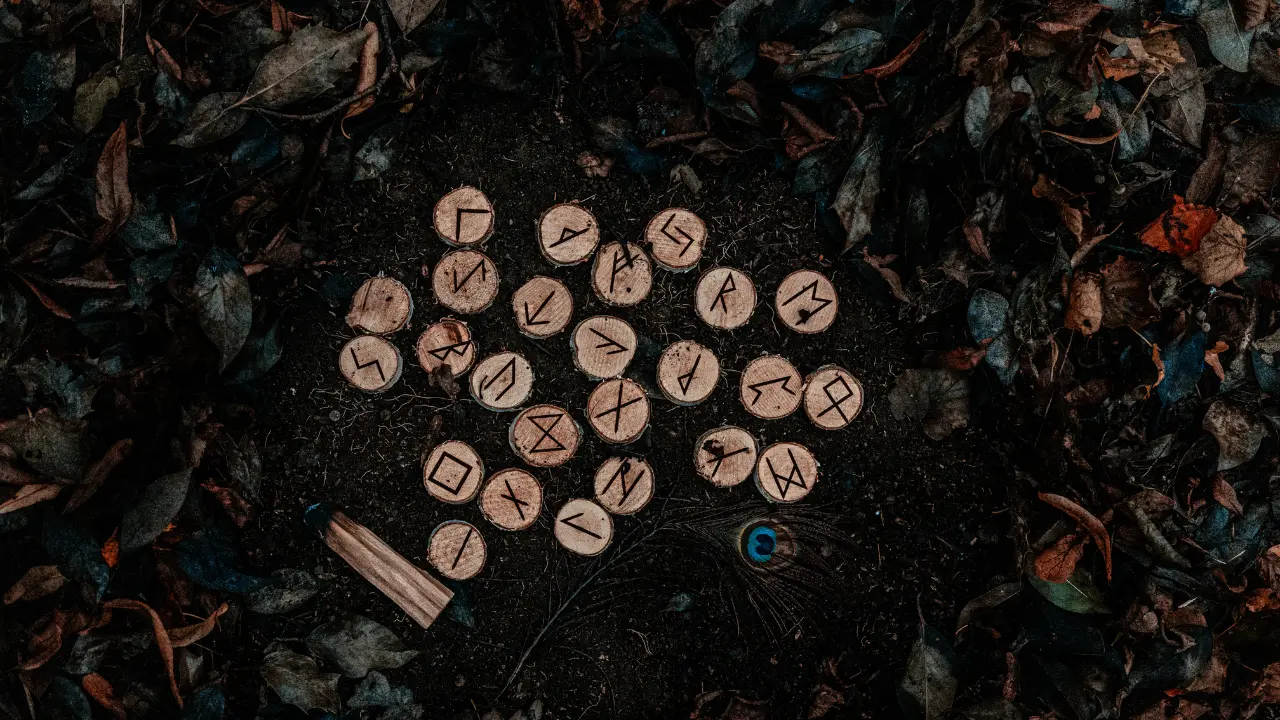
Runic Magick relies upon a sequence of alphabetic scripts used by Germanic peoples from the 2nd century AD through the late Middle Ages. These writing systems, collectively known as runes, functioned simultaneously as phonetic characters for communication and ideographic symbols for esoteric practice. The evolution of these scripts—from the primordial Elder Futhark to the expanded Anglo-Saxon Futhorc and the condensed Younger Futhark—reflects profound linguistic shifts and cultural adaptations across Scandinavia and the British Isles. This historical trajectory reveals how the Germanic peoples utilized these staves for monumental epigraphy, practical messaging, and the encoding of Wyrd, transitioning from the Roman Iron Age through the Viking Age and into the Christianized medieval era.
Etymology of Runa and Proto-Germanic Roots
The linguistic origin of the script provides the primary key to understanding its dual function in communication and Magick. The term rune derives from the Proto-Germanic root rūnō, which denotes a secret, a mystery, or a council. This etymon possesses cognates in other Germanic languages, such as the Gothic rūna (secret/counsel), the Old English rūn (whisper/mystery), and the Old High German rūnen (to whisper). These linguistic connections indicate that the transmission of information through these characters involved an element of restricted knowledge or private exchange.
Scholars propose three primary theories regarding the graphical origin of the script. The Latin theory suggests an adaptation of the Roman alphabet, citing the resemblance between characters like Fehu and the Latin ‘F’. The Greek theory points to Archaic Greek cursive scripts utilized around the Black Sea. However, the North Italic theory (Etruscan or Raetic) remains the most substantiated, as these alphabets were active in the Alpine regions where Germanic tribes encountered Mediterranean literacy. The distinct angularity of runic shapes—lacking horizontal strokes—confirms they were engineered for carving against the grain of wood or into stone, facilitating their durability as tools for both records and Runic Magick.
The Elder Futhark and Proto-Norse Period
The Elder Futhark stands as the oldest confirmed runic row, in use from approximately the 2nd to the 8th century AD. This system comprises 24 characters arranged in a fixed sequence known as the Futhark, named after the phonetic values of the first six runes: Fehu, Uruz, Thurisaz, Ansuz, Raidho, and Kenaz. These characters represent the phonemes of Proto-Norse, the ancestral language of the North Germanic dialects.
The 24 runes are organized into three groups of eight called Aettir (singular Aett), often mythologically associated with the deities Freya, Heimdall, and Tyr. This tripartite structure is essential for runic cryptography and the organization of Runic Magick systems.
| Aett | Runes Included | Primary Associations |
| First Aett | Fehu, Uruz, Thurisaz, Ansuz, Raidho, Kenaz, Gebo, Wunjo | Creation, physical vitality, primal forces |
| Second Aett | Hagalaz, Nauthiz, Isa, Jera, Eihwaz, Perthro, Algiz, Sowilo | Necessity, disruption, cosmic structure |
| Third Aett | Tiwaz, Berkano, Ehwaz, Mannaz, Laguz, Ingwaz, Othala, Dagaz | Justice, humanity, inheritance, transformation |
Epigraphic evidence for this period remains scarce but significant. The Kylver Stone (c. 400 AD) from Gotland features the earliest complete sequential listing of the 24 staves, likely functioning as a magical protection or a primer for an Erilaz (rune master). Another critical artifact, the Vimose Comb (c. 160 AD), bears the inscription harja (comb or warrior), demonstrating the early use of runes for identifying ownership. During the Migration Period, the use of Bracteates—gold medallions stamped with runic formulas and iconography—proliferated. These amulets often contained repeated strings of runes or the charm word alu, evidencing the active application of high Magick for protection and divine favor.
The Anglo-Saxon Futhorc Expansion
As Germanic tribes migrated to the British Isles starting in the 5th century, the runic row underwent a necessary expansion to accommodate the complex vowel shifts of Old English. The Anglo-Saxon Futhorc initially extended the row to 28 characters and later to 33 in the Northumbrian tradition. This adaptation allowed for the phonetic distinction between sounds that Proto-Norse grouped together, splitting the Ansuz rune into Ac (Oak), Aesc (Ash), and Os (Mouth/God).
The Old English Rune Poem serves as the primary textual source for preserving the names and meanings of these expanded staves. Unlike the laconic Scandinavian inscriptions, this poem provides stanzaic definitions for each rune, blending pagan imagery with Christian context. For instance, the rune Sigel (Sun) is described with maritime imagery relevant to an island nation.
Christian syncretism heavily influenced the Northumbrian runes. Artifacts such as the Ruthwell Cross display runic inscriptions of the poem The Dream of the Rood alongside Latin iconography, demonstrating that the script retained its prestige and utility even within a monastic context. The addition of runes like Yr (Bow), Ior (Serpent/Beaver), and Ear (Grave/Earth) introduced a more nuanced eschatological and material vocabulary to the system.
The Younger Futhark and Old Norse Transition
The transition to the Younger Futhark in Scandinavia (c. 8th century) presents a counter-intuitive linguistic phenomenon: as the oral language became more complex, the written script became simpler. This reduction from 24 to 16 characters coincided with the onset of the Viking Age and a linguistic process known as Syncope, where unstressed syllables were eliminated from Proto-Norse words.
This 16-rune row required individual staves to represent multiple phonemes. The rune Ur, for example, came to signify /u/, /o/, /v/, /w/, and /y/. Scholars categorize the Younger Futhark into two primary graphical variants:
- Long-Branch Runes: Also called Danish runes, used primarily for formal inscriptions on stone.
- Short-Twig Runes: Also called Swedish-Norwegian or Rök runes, simplified for faster carving on wood.
The reduction facilitated the development of Staveless Runes (Hälsinge runes), a minimal system relying on the vertical position of markings to denote the character. This era also saw the proliferation of Runic Codes and cipher runes, where the coordinate of a rune within the Aettir system was marked rather than the rune itself. This cryptographic capability indicates a high degree of literacy and systemic understanding among the practitioners of the time.
Medieval Runes and Latin Influence
Following the Christianization of Scandinavia (c. 1000–1100 AD), the runic script did not vanish but evolved to compete with the Latin Alphabet. Medieval Runes incorporated “dotted” or “stung” variants to distinguish between voiced and unvoiced consonants (e.g., distinguishing ‘B’ from ‘P’ or ‘T’ from ‘D’), effectively expanding the character count back up to match the Latin phonology.
The Codex Runicus (c. 1300 AD), a vellum manuscript containing the Scanian Law, stands as a testament to the continued legal and administrative use of runes well into the medieval period. However, the most illuminating discovery regarding daily usage comes from the Bryggen Inscriptions found in Bergen, Norway. These hundreds of wooden distinct rune-sticks record mundane transactions, casual messages, romantic solicitations, and name-tags, proving that runic literacy was not exclusively the domain of sorcerers or priests but a functional tool of the merchant class.
Decline of Usage and Folk Preservation
The widespread adoption of parchment and ink ultimately rendered the angular, carving-based runic script obsolete for official documentation. By the 15th century, the Latin alphabet had firmly established dominance in religious and secular administration. Runic usage retreated into rural isolation, surviving in pockets such as Dalarna, Sweden, where Dalecarlian Runes were used for local dialects into the early 20th century.
Despite the administrative decline, the esoteric function of the script persisted in Folk Magick. Post-medieval grimoires, often referred to as Black Books (Svartebøker), incorporated corrupt runic forms and Galdrastafir (magical staves) like the Aegishjalmur and Vegvisir. These symbols, while distinct from the strict alphabetic usage of the Elder Futhark, maintained the continuity of the belief that these graphical forms possessed inherent power to influence Wyrd and manifest intent.