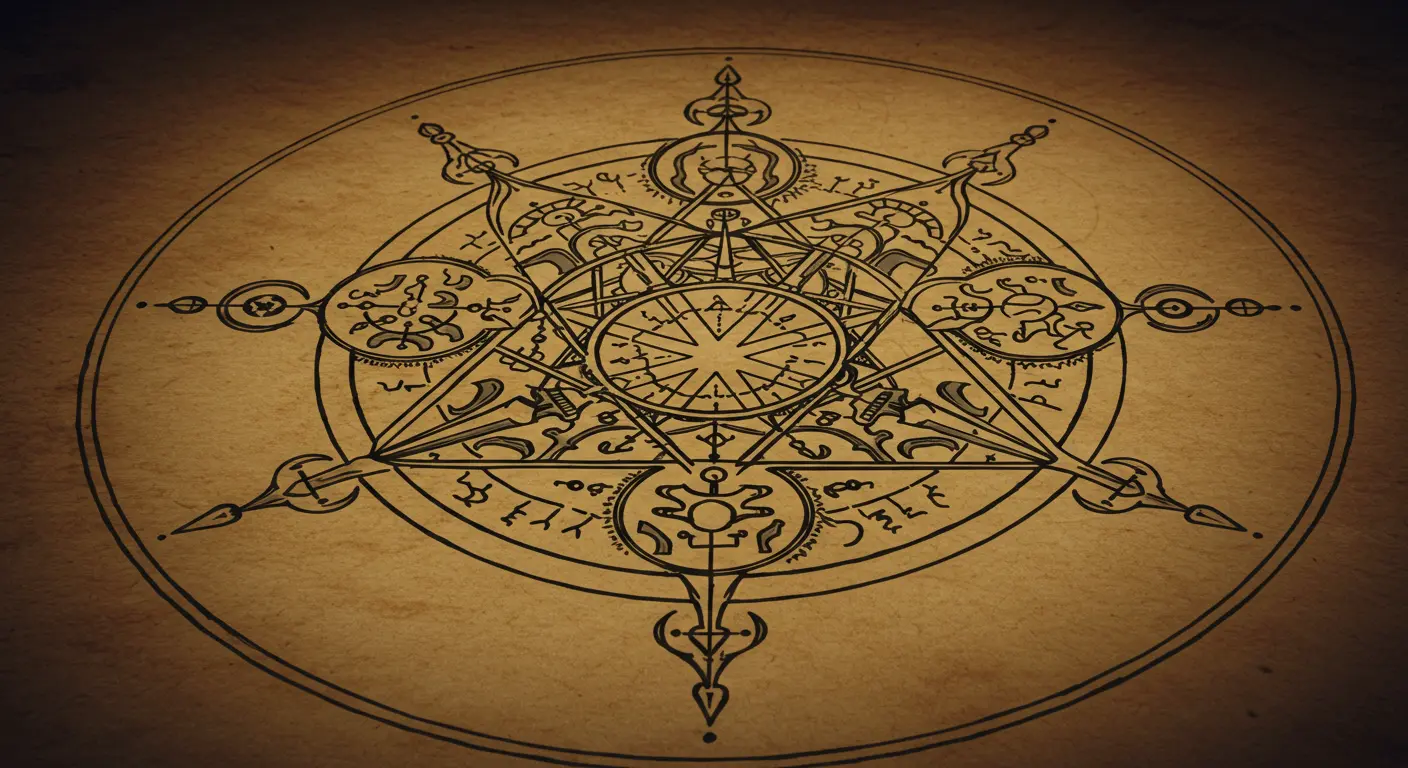
The history of Chaos Magick spans from the early 20th-century artistic occultism of Austin Osman Spare, through the late 1970s punk-infused formation of the Illuminates of Thanateros (IOT) in West Yorkshire, England, to Pete Carroll’s Arcanorium College started in the early 2000s. This movement structurally rejected the rigid dogmas of traditional Hermeticism and Thelema, substituting them with a pragmatic, results-oriented methodology.
- Precursor: Austin Osman Spare (1886–1956) laid the foundational mechanics of sigil magick and subconscious manipulation in The Book of Pleasure.
- Inception: The tradition officially emerged in 1978 in England, spearheaded by Peter J. Carroll and Ray Sherwin.
- Foundational Texts: Liber Null (1978) and The Book of Results (1978) codified the early systems.
- Primary Organization: The IOT, established in 1978, served as the central network for practitioners.
- Expansion: The 1980s and 1990s saw the tradition integrate with industrial music via Thee Temple ov Psychick Youth (TOPY) and comic book pop culture.
Austin Osman Spare: Postmodern Occultism Precursor
Austin Osman Spare functioned as the ideological grandfather of the movement, dismantling Victorian ceremonial complexes, specifically the Hermetic Order of the Golden Dawn, to isolate the psychological mechanisms of spellcasting. His solitary practice provided the mechanical blueprint that later practitioners synthesized into a cohesive system.
Zos Kia Cultus
Spare’s personal cosmology, the Zos Kia Cultus, operated on the premise that the subconscious mind acts as the primary engine of reality manipulation. He severed ties with Aleister Crowley and the Argenteum Astrum (A∴A∴) in 1912 to develop a solitary system devoid of external deities. The framework positioned “Zos” as the physical body and “Kia” as the universal atmospheric “I”, utilizing altered states—termed the death posture—to bridge the two.
Development of Pictorial Sigils
The isolation of intent into abstract, pictorial glyphs represents Spare’s most significant technical contribution to modern occultism. He stripped linguistic desires of repeating letters and combined the remaining characters into a single monogram. This encoded the desire into a format the conscious mind could not immediately interpret, allowing the command to implant directly into the subconscious during a state of vacuity. He subsequently expanded this mechanism into the Alphabet of Desire, a proto-linguistic framework of abstract glyphs representing foundational emotional and energetic currents.
Late 1970s West Yorkshire Occult Revival
The formal inception of Chaos Magick occurred in West Yorkshire during the late 1970s, characterized by the synthesis of Austin Osman Spare‘s techniques with the prevailing anti-establishment cultural movements. This era produced the first foundational texts and established the core tenets of paradigm shifting.
Punk DIY Ethos and Anti-Dogmatic Synthesis
The 1970s British punk subculture provided a critical sociopolitical template for early Chaos Magicians. Practitioners adopted a “Do-It-Yourself” (DIY) methodology, prioritizing functional results over the attainment of spiritual grades or adherence to historical lineages. This pragmatic approach incorporated elements of Discordianism—a paradigm utilizing humor and absurdity—and the neurological theories of Robert Anton Wilson to deconstruct rigid belief structures.
Publication of Liber Null and The Book of Results
The year 1978 marked the material codification of the movement with the publication of two primary monographs. Peter J. Carroll authored Liber Null, outlining the mechanics of gnosis (altered states of consciousness, originally categorized into inhibitory gnosis and excitatory gnosis, and later also indifferent vacuity by Phil Hine) and the theoretical models of the practice. Simultaneously, Ray Sherwin published The Book of Results, detailing the practical application of sigil magick. These texts democratized the techniques, making them accessible outside of formal initiatory lodges.
Formation of the Illuminates of Thanateros
The Illuminates of Thanateros (IOT) originated as an open network before restructuring into a formalized, international magickal pact. Initiated by Carroll and Sherwin, the organization functioned as an experimental laboratory for esoteric techniques, evolving a specific hierarchical framework to manage its expanding membership.
Peter J. Carroll and Ray Sherwin’s Collaboration
The operational collaboration between Carroll and Sherwin began via an occult zine titled The New Equinox. Through this publication, they announced the formation of the IOT in 1978, presenting it as a meritocratic alternative to the dogmatic orders of the era. The initial focus remained on peer-reviewed ritual experimentation and the exchange of functional techniques.
Structural Evolution of the IOT Pact
As the network expanded globally throughout the 1980s, the IOT transitioned from a loose affiliation into The Pact, a structured organization with defined initiatory degrees. The hierarchy consisted of four distinct grades: Neophyte, Initiate, Adept, and Magus. This structuring aimed to maintain qualitative control over the experimental work while preventing the internal schisms common in historical occult orders.
| Degree Level | Grade Title | Primary Focus |
|---|---|---|
| 4° | Neophyte | Basic proficiency in core techniques and foundational theory. |
| 3° | Initiate | Active participation in group rituals and experimental design. |
| 2° | Adept | Independent research, paradigm synthesis, and sanctuary administration. |
| 1° | Magus | Leadership, global strategic direction, and advanced theoretical contributions. |
Second Wave and Global Expansion
The 1980s and 1990s constituted the second wave of Chaos Magick, characterized by rapid international distribution through industrial music networks, the advent of internet forums, and the integration of postmodern occultism into mainstream pop culture and comic book media.
Thee Temple ov Psychick Youth (TOPY)
Founded in 1981 by Genesis P-Orridge and members of the industrial band Psychic TV, Thee Temple ov Psychick Youth (TOPY) functioned as an autonomous, youth-driven magickal network. TOPY popularized sigil magick among a broad, non-occult demographic, mandating its members to create and invited mail in personal sigils on the 23rd of each month. This decentralized infrastructure accelerated the global transmission of the main principles.
Phil Hine and Pragmatic Accessibility
The 1990s witnessed further democratization through the writings of Phil Hine. His seminal texts, Condensed Chaos (1992) and Prime Chaos (1993), stripped remaining ceremonial pretension from the paradigm. Hine emphasized the psychological utility of shifting paradigms, operationalizing “belief as a tool” and integrating Chaos Magick into urban shamanism and everyday functional utility.
Frater U∴D∴ and the Ice Magick Schism
European institutional expansion was heavily mediated by Ralph Tegtmeier (Frater U∴D∴ aka Ubique Daemon∴ Ubique Deus∴), who established robust IOT sanctuaries across the German-speaking world. However, in the early 1990s, ideological conflicts surrounding Tegtmeier’s promotion of “Ice Magick”—a hyper-authoritarian, quasi-martial esoteric framework—precipitated the Ice Magick Schism (often termed the Ice Magick Wars or just the Ice Wars). This ideological fracture resulted in Tegtmeier’s formal expulsion and a structural contraction of The Pact (by roughly about a quarter).
Pop Culture Integration and Hypersigils
The late 1990s introduced the concept of the hypersigil, a protracted magickal operation embedded within a narrative structure, conceptualized primarily by comic book author Grant Morrison. Morrison utilized his comic series The Invisibles as a macroscopic sigil designed to alter consensus reality and inject Chaos Magick principles directly into the cultural zeitgeist. This era finalized the tradition’s shift from underground occult lodges to open-source, media-driven spellcasting.
21st Century’s Digital Decentralization
The proliferation of digital infrastructure precipitated the third wave of Chaos Magick, migrating the paradigm from localized physical lodges to decentralized, globalized cybernetic networks and synthesizing esoteric mechanics with computational technology.
Technomancy and Technoshamanism
Technomancy and Technoshamanism emerged as natural evolutionary extensions of the pragmatic Chaos ethos, effectively operationalizing digital architecture as both a ritual environment and a magickal implement. Modern adepts substituted traditional altars with servers, utilizing algorithmic random number generators (RNGs) for divination, compiling executable code as automated, self-replicating sigils, and navigating cyberspace as a contemporary, mechanistic iteration of the astral plane. This paradigm shift systematically dissolved the dichotomy between mysticism and materialism, treating hardware and software as malleable vectors for intent while adopting the hacker ethos to reverse-engineer, patch, and manipulate the underlying source code of consensus reality.
Online Forums and Networks
The expansion of broadband infrastructure shifted esoteric discourse from print zines to digital forums and Discord channels, later migrating to hyper-fragmented social media clusters and Facebook groups. This fertile digital ecosystem birthed the Domus Kaotica Marauder Underground (DKMU)—a decentralized, non-hierarchical collective that uses memetics and Chaos Magick to disrupt consensus reality through the propagation of open-source egregores like the Ellis linking sigil.
Peter J. Carroll’s Arcanorium College
Peter J. Carroll started Arcanorium College (which I’m a member of) to introduce academic pedagogy and practical occult mentorship into the digital esoteric sphere. While it was originally launched as an online forum to bridge the gap between traditional lodges and digital discourse, it is now hosted as a central feature of Pete’s Specularium website. It provides a structured, academic framework for Chaos Magick, offering a comprehensive Bachelor of Magic (BoM) curriculum with confidential email exchange. Under this open-access model, Carroll acts as a direct mentor, allowing magi to study his modular material, submit practice reports, and receive personal feedback to refine their magickal techniques.