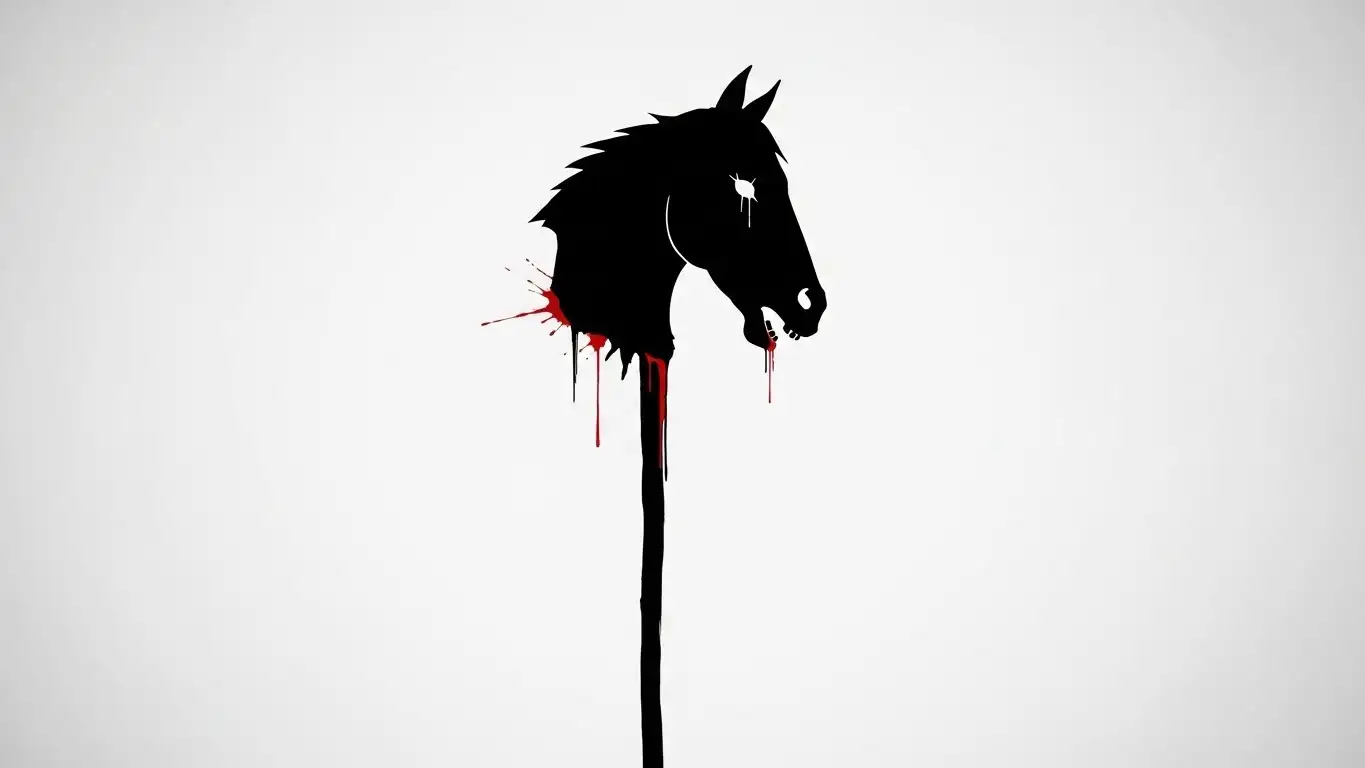
In the Runic Sorcerer’s spell arsenal, the ability to heal is matched precisely by the capacity to harm. Baneful magick, often sanitized in modern practice, remains a fundamental component of the Northern Tradition. It is the application of entropy, the deliberate unraveling of an adversary’s Wyrd. This is not “evil” in the Judeo-Christian sense; it is a martial application of force, utilizing the chaotic currents of the Thurs (Giants) to break stagnant structures or repel hostility.
The Runic Witch understands that cursing is a thermodynamic transaction. To inflict Nauthiz (constraint) upon another is to handle the frequency of starvation itself. The operator acts as a conduit for destructive forces, and without precise grounding, the radiation of the working can erode the caster as surely as the target.
The Níðstöng (Nithing Pole) Architecture
The ultimate engine of Norse execration is the Níðstöng, or Scorn Pole. Historically famously employed by the skald and sorcerer Egill Skallagrímsson against King Eric Bloodaxe, this device is not merely a symbol of hatred but a spiritual antenna designed to poison the local ecology of the target.
Construction Mechanics
The device consists of three primary components:
- The Hazel Pole: Hazel is the wood of magick and boundary. A long pole is cut and driven into the earth, creating an Axis Mundi of disruption.
- The Head: Traditionally, a severed horse’s head is mounted atop the pole. The horse, a sacred animal of the Vanir and a carrier of souls, acts as the amplifier. In modern eclectic practice, animal skulls or effigies crafted from clay or wax serve as the capacitor for the Níð.
- The Orientation: The head must face the dwelling of the enemy.
Targeting the Landvaettir
The curse is not solely directed at the human target but at the Landvaettir (land spirits) surrounding them. The inscription—typically carved deeply into the pole—commands the wights to be restless, terrifying them so they flee the land or turn against the inhabitant. By stripping the enemy of their spiritual environmental support, the Runic Mage ensures that the target’s luck (Hamingja) withers, leading to madness, crop failure, or exile.
The Runes of War and Ruin
While any rune can be inverted for harm, three specific staves form the “war fetters” of the baneful canon.
Thurisaz: The Directed Strike
Thurisaz represents the Thorn or the Hammer of Thor. In healing, it breaks fevers; in cursing, it breaks shields.
Application: The Runic Occultist visualizes the rune as a red-hot spike. Unlike general bad luck, Thurisaz is a precision weapon. It is used to pierce specific defenses—mental barriers, legal protections, or magickal wards. It causes acute, sharp pain or sudden conflict.
Hagalaz: Structural Disintegration
Hagalaz is the Hailstone—a seed of ice and destruction from the Ninth World.
Application: This rune is impersonal. When cast banefully, it introduces uncontrollable chaos into the target’s life. It does not strike a single blow; it erodes the foundation. Relationships crumble, electronics fail, and health degrades. It returns the target’s ordered reality to Ginnungagap (primal chaos).
Nauthiz: The Imposition of Constraint
Nauthiz is the Need-Fire, the friction of survival.
Application: Used to bind and restrict. A Runic Spellcaster might scratch Nauthiz on a poppet or photo to induce a state of “want.” It manifests as poverty, stagnation, and the inability to move forward. It is the “shackling” rune.
Somatic Cursing: Turn-Skins and Hamfarir
Beyond physical tools, the Runic Witch may employ the Hamr (soul-shape) as a weapon. This is the art of the Hamrammr (Shape-Strong) or Turn-Skin.
The Kveldríða (Evening Rider)
In deep trance (Seidr), the sorcerer exteriorizes their spirit, densifying the Hamr to such a degree that it can affect physical reality. This projected double—often taking the form of a wolf, bear, or nightmare hag—travels to the sleeping victim to “ride” their chest, inducing paralysis and draining Megin (vitality). This is psychic vampirism weaponized through shape-shifting protocols.
Mechanics of Recoil and Blowback
The primary danger in baneful working is the elasticity of Wyrd. When you attach a curse to a target, you establish a sympathetic link—a cable connecting your soul to theirs.
The Tether Effect
If the target is spiritually fortified or possesses a stronger Hamingja, the curse can bounce off their shields and travel back down the tether to the path of least resistance: the caster. This is blowback.
Mitigation: The Runic Sorcerer never anchors the curse in their own body. The link is tied to a disposable object (the Nithing Pole, a stone, or a buried talisman). Once the energy is sent, the link is physically severed (cut with a seax), and the grounding tool is destroyed or abandoned, ensuring that any recoil hits the earth, not the operator.